
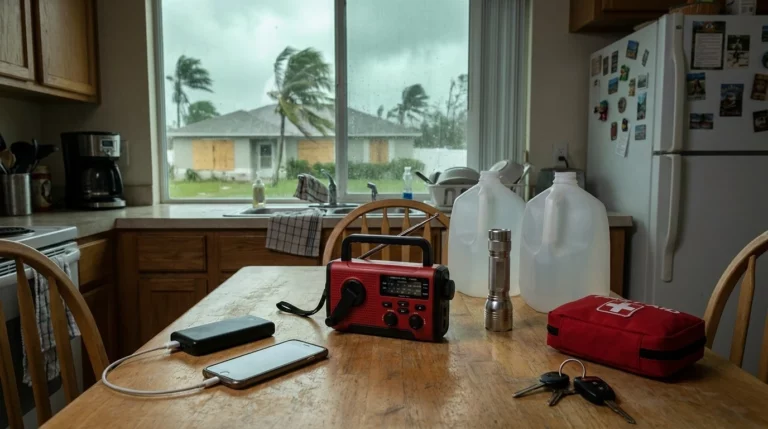
A hurricane watch means conditions are possible and you have about 48 hours; a warning means they are expected and you have about 36. The National Weather Service sets those windows deliberately: it issues the watch 48 hours ahead because, in its words, it may not be safe to prepare once winds reach tropical-storm force. Everything below is ordered by that clock — what only gets done early, what can wait, and the one number that decides whether you leave at all: your evacuation zone.
The two words, and the clock each one starts
These are the National Weather Service definitions, not a paraphrase:
| Alert | What it means | Lead time |
|---|---|---|
| Hurricane watch | Hurricane conditions (sustained winds of 74 mph or more) are possible in your area | Issued about 48 hours before tropical-storm-force winds are expected |
| Hurricane warning | Hurricane conditions are expected | About 36 hours ahead |
| Tropical storm watch / warning | Sustained winds of 39 to 73 mph possible / expected | 48 hours / 36 hours |
| Storm surge watch | Possibility of life-threatening inundation from rising water moving inland | Generally within 48 hours |
| Storm surge warning | Danger of life-threatening inundation | Generally within 36 hours; check for evacuation orders |
Note which one carries the word “life-threatening”. Ready.gov states it plainly: historically, storm surge is the leading cause of hurricane-related deaths in the United States. Wind damages the house; water is what kills people in it. A storm surge warning is the line at which the decision stops being about property.
At the watch: 48 hours out
These are the jobs that become impossible later, either because the stores empty or because it is no longer safe outside.
- Look up your evacuation zone. Not your flood zone, not your county — the lettered or numbered zone your emergency management office uses to order evacuations. Search “[your county] evacuation zone”. Write the letter on the fridge. When the order comes it will name zones, not streets, and this is the ninety seconds that decide whether you understand it.
- Fill the car and fill water. Fuel queues form the moment a warning is issued. Fill every container you own, and fill the bathtub last, before the warning: municipal water can lose pressure or be contaminated after a surge. Our supply calculator gives the quantity for your household.
- Cash, documents, medication. Card networks go down with the power. Prescriptions take days to refill after landfall. Photograph every room of the house on your phone for the insurance claim — five minutes now, thousands of dollars later.
- Charge everything, then charge the spares. Phones, power banks, laptops, the radio. See our hand-crank radio guide: when cell towers fail, NOAA Weather Radio is what still speaks.
- Decide, as a household, at what point you leave. Agree it now, out loud, while everyone is calm. “If our zone is called, we go” is a decision. “We’ll see” is not.
At the warning: 36 hours out
- If your zone is ordered to evacuate, leave. Early, not at the last convoy. Take the go-bags, the documents, the pets and their carriers (see pets), and tell your out-of-state contact where you are going.
- If you are staying, finish the outside. Bring in or tie down anything the wind can pick up: furniture, bins, planters, the grill. Board or shutter windows. Clear the gutters and storm drains near the property.
- Turn the fridge and freezer to their coldest settings and freeze water bottles to fill the gaps. A full freezer holds its temperature about twice as long as a half-empty one.
- Park the car uphill, away from trees, and never in a low underpass.
- Fill a few buckets for flushing. Water pressure fails long before the water comes back.
The last hours, and during
Stay in an interior room on the lowest floor that is not at risk of flooding — and that last clause matters, because the two rules conflict in a surge. If water is rising, go up; if wind is the threat, go to the middle of the house. Never shelter in an attic without a way out: a locked attic in rising water is a trap, which is the mistake we cover in our urban flood guide.
Do not go outside during the calm: if the eye passes over, the wind returns from the opposite direction within minutes, and it brings whatever it tore loose the first time. And never run a generator, a grill or a camp stove indoors, in a garage or near a window — carbon monoxide is the most common way people die after a storm, not during. Our guide to heating one room safely covers the same rule in winter, with the alarms that catch it.
“We’re not on the coast”
Ready.gov’s first line on the subject: hurricanes are not just a coastal problem. Rain, wind, inland flooding and tornadoes routinely reach hundreds of miles from where a storm makes landfall. The National Hurricane Center says the same thing about its forecast cone — the centre of the storm stays inside the cone about 60 to 70 % of the time, and the effects span hundreds of miles beyond it. If you are two states inland and reading this because a storm has a name, the flooding and power-outage parts of this page are still yours.
The seasons, so you know when this applies
- Atlantic: June 1 to November 30
- Eastern Pacific: May 15 to November 30
- Central Pacific: June 1 to November 30
The climatological peak is around September 10, which is also when the stores are busiest. The kit you assemble in May costs less and exists when you need it; ours is priced item by item in what a 72-hour kit actually costs.
FAQ
Is a hurricane watch or a warning more serious?
A warning. A watch means conditions are possible, about 48 hours out; a warning means they are expected, about 36 hours out. Preparation belongs in the watch window, because it may no longer be safe outside once tropical-storm-force winds arrive.
What category do I need to worry about?
The category describes wind only. It says nothing about surge, rainfall or how long the power stays off — and storm surge is historically the leading killer. A Category 1 that stalls over your county can flood more homes than a fast-moving Category 3.
Should I tape my windows?
No. Tape does not stop breakage and it creates larger shards. Shutters or plywood, or an interior room.
When can I go back after evacuating?
When local officials say the area is open, not when the storm passes. Return brings its own hazards: standing water hiding downed lines, weakened structures, and no traffic signals.
Official sources & further reading
The guidance in this article comes from official sources. Consult them directly for the authoritative version:

Dan Lockland is a preparedness instructor and survival skills educator with over 15 years of hands-on experience. He shares practical, no-nonsense guidance on emergency preparedness, self-reliance, and sustainable living at PreparingWithDan.com.