
The best-selling one-person 72-hour kit on Amazon ships with six 4.25 oz water pouches — about 25 ounces for three days. Ready.gov’s figure is a gallon per person per day. Every pre-built kit on this page is short on water and on calories for the same reason: water is heavy and food bars are cheap. Buy the kit for the bag, the first aid pouch and the twenty small items you would never assemble yourself; then add the water and food, which is where our costed 72-hour kit shows more than half the real money goes.
Eight kits below, compared on what the listings actually say is inside, with the catch for each. No scores, no prices — prices change daily and the buttons show today’s. If you would rather build your own, the second half of this page is the parts list, and the free supply calculator gives quantities for your household.
The arithmetic every kit hides
Two numbers decide whether a 72-hour kit is a three-day kit or a one-day kit with a nice bag:
- Water. Ready.gov: one gallon per person per day, for drinking and sanitation. A one-person kit needs three gallons — about 25 lb. No backpack kit carries that, so every kit substitutes pouches, typically 4.25 oz each. Six pouches is 25 oz; the gap is 2.8 gallons.
- Food. The standard kit food is a 2,400-calorie bar per person, which is 800 calories a day over three days. Our kit cost study works through the same problem with the 3,600-calorie bars: the commonly cited need is 1,600 to 2,500 calories a day, so even the bigger bar leaves a deficit, and the 2,400 bar leaves a larger one. A healthy adult survives it; a child, an older parent or anyone doing physical work should not have to.
So the honest way to read the table: the kit is the container and the small items. Water and food are yours to add, and at grocery prices that is roughly $30 of shelf-stable food per person and a case of bottled water — the two cheapest, highest-value additions in the whole exercise.
The eight kits at a glance
| Kit | Best for | Weight (listing) |
|---|---|---|
| Ready America 70180, 1 person | One person: car, desk, a first go-bag | 4.2 lb |
| Ready America 70492 Comfort Sustain Supply, 4 persons | A family that wants one bag and no assembly | 32.4 lb |
| Emergency Zone, 2 persons | A couple, or a starter kit you will improve | 14.5 lb |
| Ready America 70380, 4 persons | Best value for a family of four | 19.2 lb |
| Blue Seventy-Two Pro Series | Someone who wants a better backpack than the kit | not stated |
| EVERLIT upgraded first aid kit | The medical upgrade inside any of the kits above | 2.3 lb |
| RIKOJUXI 262-piece survival kit | Tools for the car or a camping bag | not stated |
| QuakeHOLD! Evacuation Essentials Plus | A desk drawer, a glovebox, a classroom | 3 oz |
Pre-built 72-hour kits

Ready America 70180, 1 person
For: One person: car, desk, a first go-bag
What the listing says is inside: One 2,400-calorie food bar, six 4.25 oz water pouches, 18-piece first aid kit, blanket, poncho, 12-hour lightstick, whistle, dust mask, gloves. Weight: 4.2 lb.
Before you buy: The water is 25 oz for three days. Ready.gov asks for a gallon a day. Plan on adding at least two gallons per person before this bag is a three-day kit.
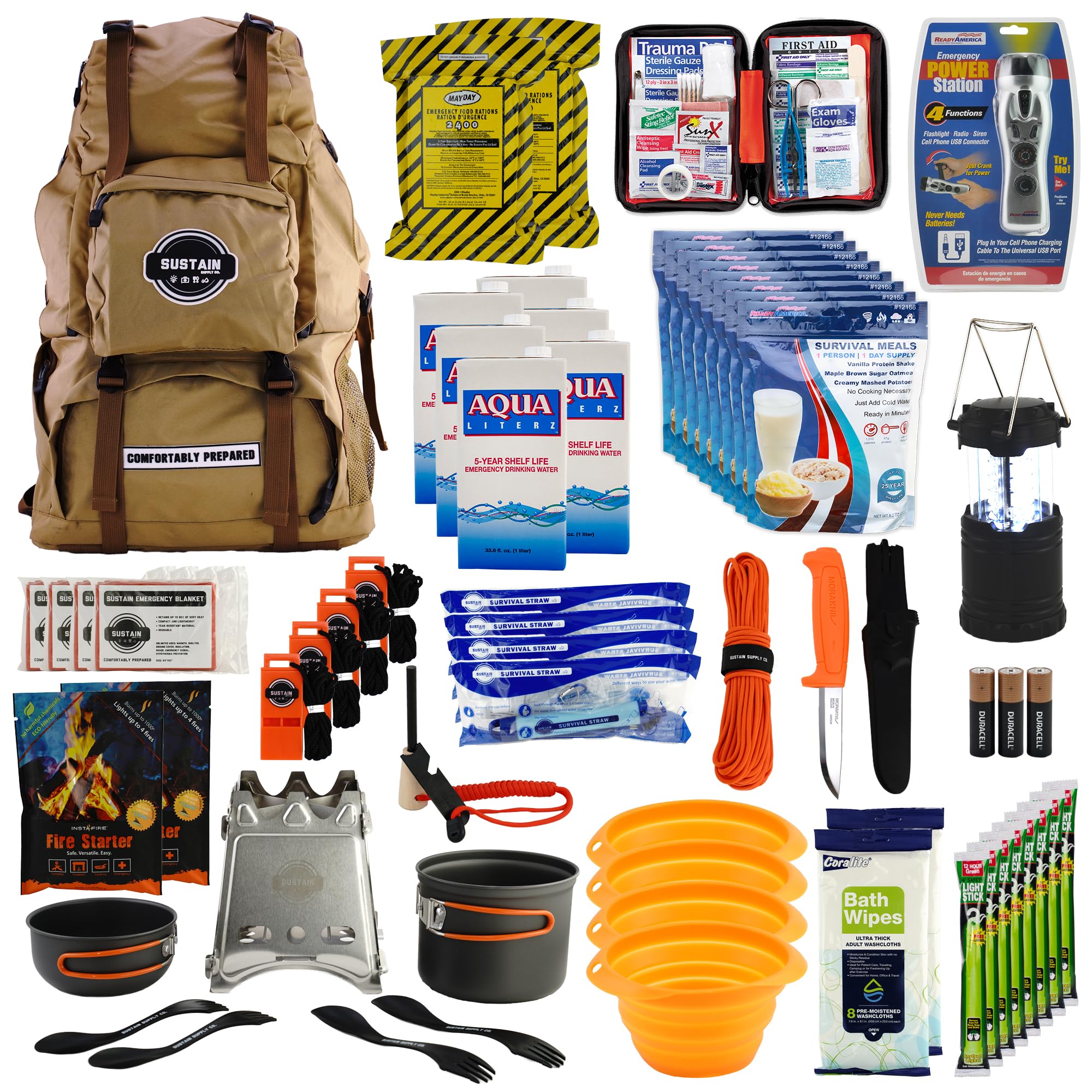
Ready America 70492 Comfort Sustain Supply, 4 persons
For: A family that wants one bag and no assembly
What the listing says is inside: Long-shelf-life food and water rations for four, first aid and safety gear, hygiene and warmth items, lighting, tools. Weight: 32.4 lb.
Before you buy: At over 30 lb it is a car or closet kit, not something one adult carries far. Inventory it on arrival: the listing does not state the water volume.

Emergency Zone, 2 persons
For: A couple, or a starter kit you will improve
What the listing says is inside: Food and water, first aid supplies, shelter items, pouch-organised bug-out bag. Weight: 14.5 lb.
Before you buy: The organisation is the strength; the individual items are entry-level. Budget for replacing the flashlight and first aid contents over time.

Ready America 70380, 4 persons
For: Best value for a family of four
What the listing says is inside: Four 2,400-calorie food bars, water pouches, 107-piece first aid kit, four blankets, four ponchos, four lightsticks, masks, gloves, whistle. Weight: 19.2 lb.
Before you buy: One bar per person for three days is 800 calories a day, half the low end of what an adult needs. The bag is worth it for the first aid kit and the small items; add real food.

Blue Seventy-Two Pro Series
For: Someone who wants a better backpack than the kit
What the listing says is inside: Triple-pocket reinforced backpack, 2,400-calorie food bars, water pouches, 36-piece first aid kit, shelter and signalling items. Weight: not stated.
Before you buy: Same food-bar arithmetic as every kit on this page. You are mostly paying for the pack; check that the bag, not the contents, is what you want.
Not 72-hour kits, but worth knowing about
Three products that appear in every “best emergency kit” search and are not, in fact, three-day kits. Two of them are still useful; know what you are buying.

EVERLIT upgraded first aid kit
For: The medical upgrade inside any of the kits above
What the listing says is inside: 173-piece first aid supplies in a tactical EMT pouch, 8 x 6.5 x 4 in. Weight: 2.3 lb.
Before you buy: Not a 72-hour kit: no food, no water. It is here because the first aid pouch in most pre-built kits is the weakest item, and this replaces it.
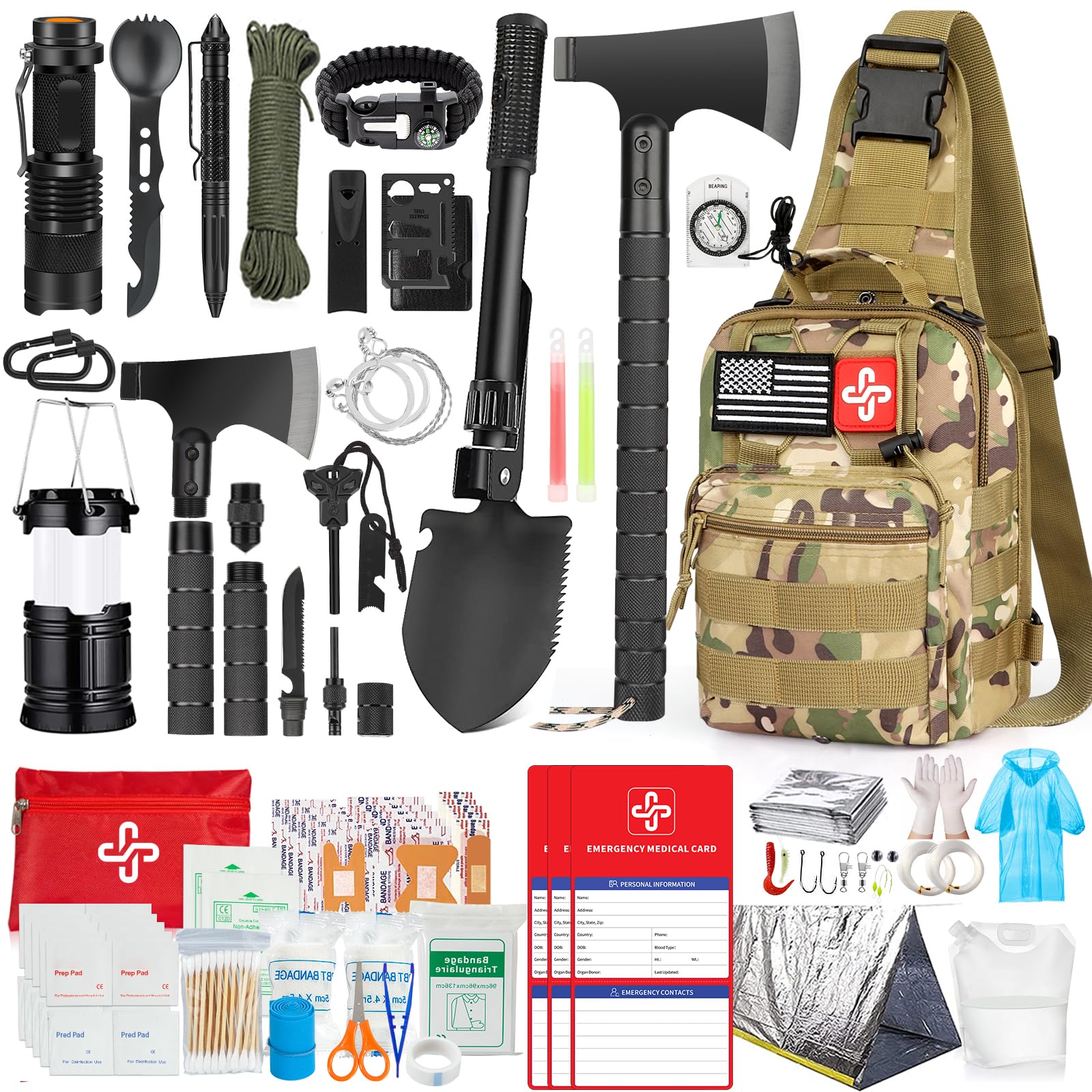
RIKOJUXI 262-piece survival kit
For: Tools for the car or a camping bag
What the listing says is inside: Tools, emergency tent, small axe and shovel, first aid supplies, crossbody bag with MOLLE straps. Weight: not stated.
Before you buy: Not a 72-hour kit either: 262 pieces and, as far as the listing shows, no food or water. Treat it as a tool bundle, and expect gadget-grade tools at this price.

QuakeHOLD! Evacuation Essentials Plus
For: A desk drawer, a glovebox, a classroom
What the listing says is inside: Lightstick, whistle, dust mask, survival blanket, small food and water ration, 5-year shelf life. Weight: 3 oz.
Before you buy: It weighs three ounces; it covers the walk out of the building, not three days. Good to hand out at work, not a substitute for a kit.
Build your own: the parts list
Our 72-hour kit cost study priced the Ready.gov list for a family of four, item by item, in July 2026: about $200, of which water and food were more than half. If you go this route, the eight items that carry the cost are water (a gallon per person per day), purification tablets as backup, three days of food you will actually eat, a flashlight per person, a power bank, a hand-crank NOAA radio, a first aid kit and an emergency blanket per person. The calculator sizes the water and food for your household; our reviews cover the radio, the tablets and the backpack.
The realistic hybrid, and what we would do: buy the cheapest pre-built kit that fits the household for its bag and small items, then spend the difference on water, real food, a better first aid pouch and the medications and documents no kit can include. The full checklist is the audit to run once the bag is on the floor.
What to add to any kit on this page
- Water to a gallon per person per day, stored next to the bag rather than in it.
- Food you would eat when frightened: peanut butter, canned fish, crackers, dried fruit. Rotate it twice a year.
- Medications for a week, spare glasses, and a copy of the family plan — see our family emergency plan.
- Children’s items: the baby and toddler kit lists what no adult kit contains.
- A date on the bag. Food bars and water pouches carry a five-year shelf life; the lightsticks and the batteries do not last that long. Check when the clocks change.
FAQ
Pre-built or build your own?
Pre-built if you want a kit this week and will add water and food; build your own if you want to choose the food and the first aid contents and have an afternoon. The cost difference is smaller than it looks once you add what the pre-built kit lacks.
Is one 72-hour kit enough for a family?
One bag per person is the Ready.gov model, with the family’s water stored at home and in the car. A single four-person bag works for a family that evacuates together by car; it does not work for a parent who has to walk out with two children.
How long do the contents last?
The food bars and water pouches in these kits are rated for five years; that is the number to write on the bag. Everything else — batteries, lightsticks, adhesive dressings, ponchos — should be checked yearly.
Preparing with Dan is reader-supported: as an Amazon Associate we earn from qualifying purchases. Product contents are as stated on the retailer listings at the time of writing; check the listing before you buy.
Official sources & further reading
The quantities in this article come from official guidance. Consult it directly for the authoritative version:

Dan Lockland is a preparedness instructor and survival skills educator with over 15 years of hands-on experience. He shares practical, no-nonsense guidance on emergency preparedness, self-reliance, and sustainable living at PreparingWithDan.com.