
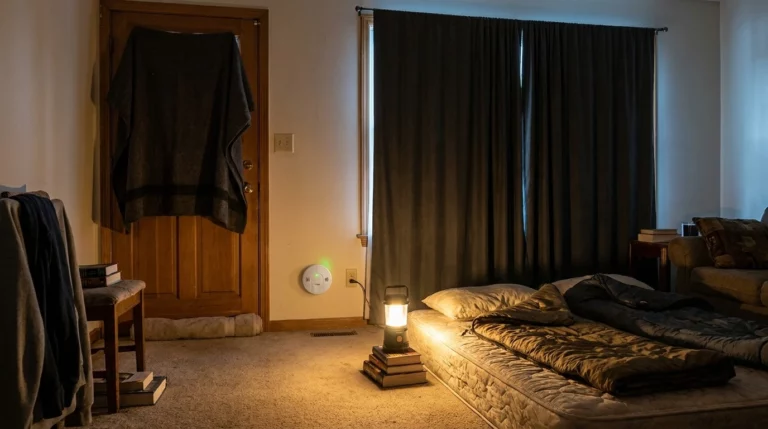
When the power goes out in winter, you do not heat the house — you heat one room, and you do it with something that cannot fill that room with carbon monoxide. Generators, camp stoves and charcoal grills stay outdoors, at least 20 feet from any window (Ready.gov). The gas oven is never a heater. Everything else on this page follows from those two rules.
Winter storms kill in two ways that have nothing to do with the cold itself: carbon monoxide from an indoor fuel-burning appliance, and a heart attack from shovelling. Ready.gov lists both above hypothermia. This guide covers what actually works to keep a family warm for two or three days without electricity, in the order you should set it up, with the safety rules from Ready.gov, the American Red Cross and the National Weather Service. Our companion article on surviving extreme cold at home without heating covers the no-heat-source scenario; this one is about the heat sources themselves.
Before anything else: a carbon monoxide detector on every level
Both Ready.gov and the Red Cross put this first, and so do we: battery-backed carbon monoxide detectors on every level of the home, tested before the season. CO is colourless and odourless; the symptoms (headache, dizziness, nausea, confusion) look like the flu or like being tired and cold, which is exactly what everyone in a powerless house already feels. A $25 detector is the only thing that tells you the difference. If you already own one, check the date on the back — most have a fixed life of 7 to 10 years and stop working silently.
The one-room strategy
Heating a whole house without electricity is not realistic and not necessary. Pick one room and move the family into it:
- Small, interior, south-facing if possible, with the fewest exterior walls and windows. A bedroom or a den beats the living room.
- Close every other door in the house and hang blankets over the doorway of the warm room.
- Open the curtains on the sunny side during the day, then cover every window at night with blankets, cardboard or foam board. Windows lose more heat than walls.
- Put an indoor thermometer in the room (a Red Cross recommendation). It tells you whether what you are doing is working, and it tells you when it is time to leave for a warming centre rather than guess.
- Everyone sleeps in that room, in layers, with hats on. Body heat from four people is a real heat source in a small space.
Heat sources, from safest to most dangerous
1. Layers, sleeping bags and body heat — always safe
The Red Cross guidance is loose layers, a hat, mittens rather than gloves, and covering the nose, ears, cheeks, chin, fingers and toes — the first places frostbite starts. A cold-rated sleeping bag per person turns a 45°F room into a survivable night; it is the single best heating purchase because it cannot fail and cannot poison anyone. We covered the specific items in 29 winter survival items worth owning.
2. A wood stove or fireplace you already have — safe if it is maintained
If the house has a wood stove or a working fireplace, it is the best fuel-burning option, because it is designed to vent outdoors. The conditions: the chimney has been inspected and swept this year, you have dry seasoned wood stored under cover, and the damper is open before you light anything. An open fireplace heats the room in front of it and pulls cold air through the rest of the house; a stove with a closed door is far more efficient. Never burn treated lumber, painted wood or trash.
3. An indoor-rated propane heater — safe only if it is rated for indoor use
Portable propane heaters exist in two kinds, and the difference is the whole point: models certified for indoor use, with an oxygen-depletion sensor that shuts the burner off, and outdoor models that are not. Only the first kind belongs inside, and even then: follow the manufacturer’s ventilation instructions (typically a window cracked open), never run it while everyone is asleep, keep it three feet from anything that can burn, and keep the CO detector in the same room. A one-pound propane cylinder gives roughly a few hours on low; plan the cylinders for the number of days, not the number of hours.
4. A kerosene heater — workable, with real drawbacks
Kerosene heaters put out serious heat and were the standard emergency heater for decades. They also produce fumes and moisture, need fresh (not last year’s) kerosene to burn cleanly, must be refuelled outdoors when cold, and need a cracked window like the propane heater does. If you own one, test it in October, not during the storm. If you are choosing between kerosene and an indoor-rated propane heater today, propane is simpler and cleaner for a family in a small room.
5. Candles — a light source, not a heat source
Candles are in this list because every guide recommends them and every fire department wishes they would not. The heat from a few candles is negligible in a room, and the fire risk in a house full of blankets, sleeping children and no working smoke alarm power is not. Use a battery lantern for light and put the candles away.
6. Anything that burns fuel and was designed for outdoors — never inside
Ready.gov’s rule, without exceptions: generators, camp stoves and charcoal grills are used outdoors, at least 20 feet from windows, doors and attached garages. Not in the garage with the door open. Not on the porch. Not “just for an hour”. And never use a gas stovetop or oven to heat the home. These are the appliances behind most winter-storm carbon monoxide deaths, and the people who die are usually asleep in the warm room they made.
If you run a generator
A generator does not heat a house either, but it will run a space heater in the one room and keep the refrigerator cold. Ready.gov’s generator rules: outdoors and 20 feet away as above; a working CO detector on every level; keep it dry and protected from rain (a wet generator is an electrocution risk); connect appliances with heavy-duty extension cords, never through a wall socket; and let it cool before refuelling, because spilled fuel on a hot engine ignites. We compared the trade-offs in solar vs gas generators — for a winter outage, a battery power station will run an electric blanket and phones silently indoors, which is often the better purchase for an apartment.
The rest of the house while you are in one room
- Pipes. Open the cabinet doors under sinks, let one cold tap drip, and know where the main water shut-off is. A burst pipe in a house at 20°F is the expensive part of a winter outage.
- Food. Ready.gov’s figures: a closed refrigerator keeps food cold for about 4 hours; a full freezer for about 48 hours. Do not open them. In freezing weather, a cooler on the porch works better than either.
- Water. Set aside one gallon per person per day before the storm (Red Cross) — municipal supplies can fail when pumping stations lose power.
- Medication and devices. A one-month supply of medications and charged backup batteries for anything medical (CPAP, wheelchair). Ask your provider now what to do with refrigerated medicines in an outage.
Know when to leave
The Red Cross is explicit: know where you will go if your home becomes too cold — a friend’s house, a public library, a warming centre. A house at 40°F with an infant or an older adult is a reason to leave, not to add another blanket. The indoor thermometer makes that decision for you: below roughly 50°F for more than a night, with vulnerable people in the household, go while the roads are still passable.
And the warning signs that mean get out now: anyone with a headache, dizziness or nausea in the warm room — carbon monoxide until proven otherwise. Everyone outside, then call 911.
The October checklist
- Test smoke and CO detectors; replace batteries; check CO detector expiry dates.
- Chimney inspected if you have one; dry wood under cover.
- Indoor-rated propane heater tested, with enough cylinders for three days.
- One sleeping bag per person, plus hats and mittens, stored in the chosen room.
- Battery lantern and hand-crank radio with fresh batteries.
- Indoor thermometer in the chosen room.
- Car kit with blankets, a full tank, sand and a shovel (Ready.gov) — the storm may catch you on the road.
- The address of the nearest warming centre written on the fridge.
Official sources & further reading
The safety rules and quantities in this article come from official emergency-preparedness guidance. Consult it directly for the authoritative version:

Dan Lockland is a preparedness instructor and survival skills educator with over 15 years of hands-on experience. He shares practical, no-nonsense guidance on emergency preparedness, self-reliance, and sustainable living at PreparingWithDan.com.