
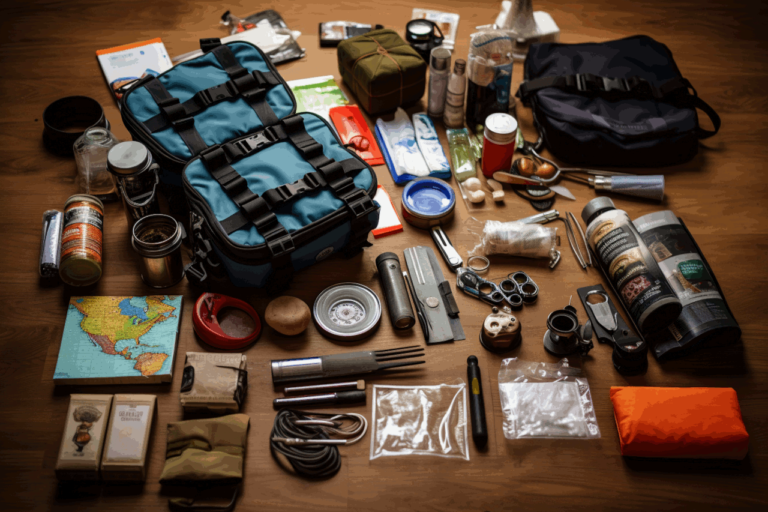
A FEMA-recommended 72-hour emergency kit for a family of four costs $200 for the eight items that carry the cost — $50 per person, or $16.67 per person per day.
That figure comes from pricing every item ourselves in July 2026, using the cheapest option we could verify at a major US retailer. No estimates, no “around $200” — the numbers are below.
We also found something that should worry anyone building a kit on the cheapest food option. More on that in a moment.
The eight items that carry the cost
| Item | Official quantity | Cheapest verified price |
|---|---|---|
| Drinking water | 1 gal/person/day × 3 days = 12 gal | $16.44 |
| Water purification tablets | backup treatment | $34.99 |
| Food, 72 hours | 3-day supply × 4 people | $59.96 |
| Flashlights | 1 per person = 4 | $17.98 |
| Power bank | 1 | $19.99 |
| NOAA hand-crank radio | 1 | $14.00 |
| First aid kit | 1 family kit | $23.99 |
| Emergency blankets | 1 per person = 4 | $12.65 |
| Total | $200.00 |
Quantities follow the official Ready.gov Build A Kit list — they are not our opinion.
The $15 food problem nobody mentions
The cheapest way to cover 72 hours of food is an emergency ration bar: around $15 per person, shelf-stable for years, no cooking needed. It is what most budget kit lists recommend.
Here is the arithmetic nobody does. A standard bar provides 3,600 calories for three days — 1,200 calories per day. The generally cited requirement for an adult in an emergency is 1,600 to 2,500 calories per day.
That is a shortfall of 400 to 1,300 calories per person, every day.
For 72 hours, an otherwise healthy adult will survive this comfortably. But it is a deliberate deficit, and nobody selling the bars says so. It matters if your plan runs longer than three days, if anyone in the household is a child, elderly, pregnant or diabetic, or if you are doing physical work — clearing debris, walking out, keeping warm without heating.
What we would do: treat the ration bar as the floor, not the plan. Adding roughly $30 of ordinary shelf-stable food from a normal grocery run — peanut butter, canned fish, crackers, dried fruit — closes the gap and makes the kit edible by people who are stressed and frightened. That is the single best $30 in the whole kit.
Where the money actually goes
Water and food alone are $111 of the $200 — more than half. Everything else combined is under $90.
This is useful if you are starting out: get water and food right first. A second flashlight will not save you. Three days of drinkable water will.
Two other observations from the pricing:
- Water purification tablets cost more than the water itself ($34.99 vs $16.44). The pack we priced treats 400 gallons — vastly more than 12. Tablets are not for your stored water; they are for the water you find after the stored water runs out. Priced per emergency, they are cheap. Priced per kit, they look absurd. Both are true.
- The radio is the cheapest serious item on the list ($14). During a blackout, when the mobile network is saturated or down, a hand-crank NOAA radio is often the only information channel left. Best value per dollar in the kit.
What we did not price
Being straight about the limits of this exercise.
We priced eight items. The Ready.gov list also includes a manual can opener, whistles, dust masks, moist towelettes, garbage bags, personal hygiene items, plastic sheeting and duct tape, a wrench for utility shutoff, a document pouch, and a cash reserve.
We did not price those, so $200 is not the cost of a complete kit — it is the cost of the eight items where the money goes. The remaining items are low-unit-cost commodity goods, but we are not going to attach a number to them that we have not verified.
Prices also change constantly. Ours are a snapshot: 26 July 2026, US national retail listings.
Do the maths for your own household
These numbers are for two adults and two children over three days. Yours will differ — a different household size, a longer window, a hot climate that raises water needs.
Use our free Emergency Supply Calculator to get the quantities for your exact household. No signup, no email.
Methodology
- Household modelled: 2 adults + 2 children, 72 hours.
- Quantities: official Ready.gov / FEMA recommendations, including water and food guidance.
- Prices: cheapest option we could verify for each item, surveyed 26 July 2026 on US national retail listings. Multi-item packs counted at pack price where a smaller pack was not confirmed — this makes our total conservative rather than optimistic.
- Not included: the low-cost consumables listed above.
- Caveat on the official water figure: the 1 gallon per person per day baseline covers drinking. Add cooking and basic hygiene and real household use is higher. We priced the official figure, not the realistic one — treat 12 gallons as a minimum.
Prices surveyed July 2026 across major US retailers. Retail prices change frequently — check current pricing before purchasing.
Reuse: you are welcome to reproduce this table with attribution and a link to this page.
Cite or reuse this data
These figures are original and may be quoted, charted or republished with attribution. Suggested citation: “What a 72-Hour Emergency Kit Actually Costs in 2026”, Preparing with Dan, July 2026, preparingwithdan.com/basics/72-hour-emergency-kit-cost-2026/. To embed the cost table on your own page, copy the HTML below (it carries the source link):
<table><tr><th>72-hour kit, family of four (Ready.gov quantities)</th><th>Cheapest verified price, July 2026</th></tr><tr><td>Drinking water, 12 gal</td><td>$16.44</td></tr><tr><td>Water purification tablets</td><td>$34.99</td></tr><tr><td>Food, 72 hours x 4</td><td>$59.96</td></tr><tr><td>Flashlights x 4</td><td>$17.98</td></tr><tr><td>Power bank</td><td>$19.99</td></tr><tr><td>NOAA hand-crank radio</td><td>$14.00</td></tr><tr><td>First aid kit</td><td>$23.99</td></tr><tr><td>Emergency blankets x 4</td><td>$12.65</td></tr><tr><td><b>Total</b></td><td><b>$200.00</b></td></tr></table><p>Source: <a href="https://preparingwithdan.com/basics/72-hour-emergency-kit-cost-2026/">What a 72-Hour Emergency Kit Actually Costs in 2026, Preparing with Dan</a></p>
A printable one-page version of this checklist, free, is on our free printables page; the wider context is on our emergency preparedness statistics page.
Official sources & further reading
The quantities in this article come from official emergency-preparedness guidance. Consult it directly for the authoritative version:

Dan Lockland is a preparedness instructor and survival skills educator with over 15 years of hands-on experience. He shares practical, no-nonsense guidance on emergency preparedness, self-reliance, and sustainable living at PreparingWithDan.com.