
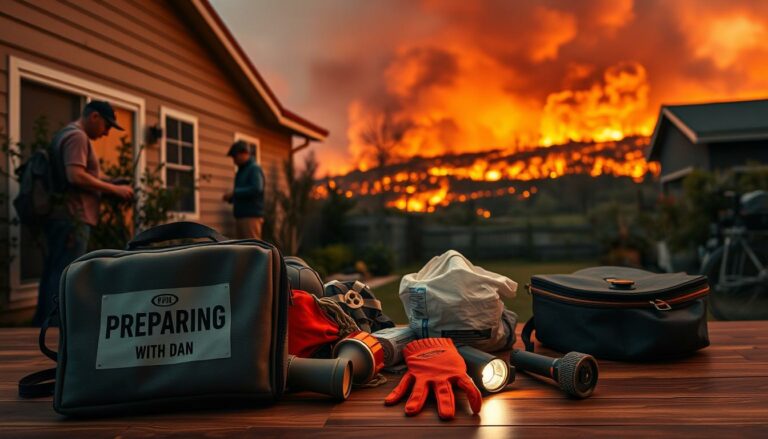
A wildfire evacuation is decided before the smoke: a car that never drops below half a tank, a go-bag already by the door, two routes out in different directions, and a place to sleep that takes your dog. More than 60,000 US communities are at risk of wildland fires — this is not only a California problem.
The rest of this checklist is in the order things actually happen: the weeks before fire season, the day a Red Flag Warning is issued, the moment an evacuation order comes, and the return home. Every quantity and rule below comes from Ready.gov, the American Red Cross or the US Fire Administration, and the sources are listed at the end.
The one rule that decides everything: leave before you are told
The American Red Cross puts it bluntly: you might not get an official notice to evacuate. Wildfires move faster than alert systems, cell towers burn, and evacuation orders are issued zone by zone while the fire ignores the zones. The families who get out cleanly are the ones who had already decided their own trigger — a Red Flag Warning plus visible smoke, an evacuation warning (not yet an order) for a neighbouring zone, or simply the feeling that the road out is about to get crowded.
Ready.gov’s guidance is the same in different words: leave early enough to avoid being trapped. Nobody has ever regretted evacuating two hours too soon.
Weeks before fire season: the home and the plan
Create a 30-foot zone the fire cannot use
Ready.gov’s minimum is a fire-resistant zone free of leaves, debris and flammable material for at least 30 feet from the house. In practice, for one weekend:
- Clear gutters and the roof of leaves and needles — embers land there first.
- Remove dead plants, dry grass and firewood stacks from the 30-foot ring; move the propane grill and its tank away from the wall.
- Trim branches that overhang the roof.
- Find an outdoor water source with a hose that reaches every side of the property (a Ready.gov recommendation, not a substitute for leaving).
If you are renting or in an apartment, this section is your landlord’s job — but the next ones are yours.
Prepare one clean-air room
Smoke reaches far beyond the fire line, and for many families it is the only part of a wildfire they will ever experience. Ready.gov’s instruction is to designate one room that can be closed off from outside air, keep doors and windows shut, and run a portable air cleaner there when conditions are smoky. If you have central air, switch it to recirculate and close the outdoor intake. Store N95 masks — cloth and surgical masks do not stop smoke particles.
Know your evacuation zone and two ways out
Most counties in fire-prone states now publish evacuation zones with names or numbers; find yours before the season and write it on the fridge. Then pick destinations in different directions — Ready.gov’s phrasing — because the fire chooses which road is closed, not you. A friend’s home in another town, a motel, a relative: two options minimum, and drive both routes once so they are familiar at night.
Decide now where the pets go
This is the detail that stalls the most evacuations. Most public shelters accept only service animals (Ready.gov). If the plan is “we’ll figure it out”, the plan is to stay too long. Identify a pet-friendly motel, a boarding kennel outside the risk area or a friend, and keep a carrier and a week of pet food with the go-bag. Our emergency prep guide for pets covers the kit itself.
Copy the documents once
Ready.gov asks for up-to-date insurance policies and ID, with copies in a secure, password-protected digital space. Photograph every room and the contents of closets and garage while you are at it — it takes ten minutes and it is what the insurance claim will be built on.
The go-bag: three days you can carry
The Red Cross distinguishes two kits, and the distinction matters for wildfire more than for any other hazard:
- Go-Kit — 3 days of supplies you can carry, kept where you can grab it in under a minute.
- Stay-at-Home Kit — 2 weeks of supplies for when the road is closed but the house is safe (smoke events, utility shut-offs).
Both organisations agree on the essentials: water (one gallon per person per day), non-perishable food, a first aid kit, flashlight and batteries, a battery-powered or hand-crank radio, phone chargers and a backup battery, and a one-month supply of medication in a child-proof container (Red Cross). Add N95 masks and sturdy shoes for the wildfire version.
If you would rather not assemble it yourself, we compared eight pre-built bags against building your own in our 72-hour emergency kit review — and we priced the eight items that carry the cost in what a 72-hour kit actually costs. For the radio, the hand-crank models we tested are the cheapest serious item in the whole kit.
The car: half a tank, always
Ready.gov’s rule is precise: keep a half tank of gas at all times, and fill up when an evacuation seems likely. Gas stations close during emergencies and cannot pump during power outages — and power is routinely cut in fire zones. Two more rules from the same source: one car per family to reduce congestion on roads that were never built for everyone leaving at once, and a portable emergency kit that lives in the trunk.
If you do not have a car, decide now who you will leave with, and tell your local emergency management office you may need transport — they plan for it, but only for the people they know about.
Alerts: three channels, because one will fail
Ready.gov’s advice is to have several ways to receive alerts. Set up all three before the season:
- Wireless Emergency Alerts (WEA) — already on your phone, no sign-up, but only if the phone is on and has signal.
- The FEMA app — real-time National Weather Service alerts for up to five locations, so you can watch your parents’ town as well as your own.
- Your county’s alert system — the one that carries the actual evacuation orders for your zone. It usually needs a sign-up.
Then a fourth that does not depend on the network: a NOAA weather radio. Keep the phone charged whenever a fire is anywhere in the region, and keep a backup battery in the go-bag. If alerts stop arriving, that is information too.
Watch the air quality index as well as the fire map: AirNow.gov’s fire and smoke map is the fastest way to see whether the clean-air room needs to be sealed today.
When the order comes: the ten-minute departure
If the plan above exists, leaving takes ten minutes. Ready.gov’s sequence, in the order that matters:
- Wear sturdy shoes, long pants and a long-sleeved shirt.
- Go-bag, pets, medication, documents — in that order, into the one car.
- Close and lock doors and windows. Leave lights on so firefighters can see the house.
- If instructed and if there is time, shut off gas.
- Leave a note on the door saying when you left and where you are going.
- Call or text your out-of-area contact from the road, not from the driveway.
If you are trapped — the road is blocked, the fire is between you and the way out — call 911 and give your location, turn on every light in the house to help rescuers find it, and stay inside a closed room with the N95 on. Ready.gov is honest that emergency response may be delayed or impossible; the point of everything above is never to reach this paragraph.
Coming home
Do not return until authorities say so, even if the fire looks out. Both Ready.gov and the Red Cross warn about the same things: hot ash, smouldering debris and heat pockets in the ground that can burn through shoes or re-ignite; ash pits that look like solid ground; and downed power lines. Clean up in gloves, long sleeves, goggles and a respirator, wet the debris before moving it, and photograph everything before you touch it. People with asthma or other lung conditions should stay away until the air quality is back to normal.
What this checklist does not cover
Hardening a house against wildfire — roofing, vents, decks — is a real subject with its own standards, and it is not something to improvise from a blog post. If you live in the wildland-urban interface, your state forestry agency or fire department will have a local programme; the US Fire Administration’s WUI resources are the starting point. This article is about getting your family out, which is the part every household can control.
Official sources & further reading
The quantities and rules in this checklist come from official emergency-preparedness guidance. Consult it directly for the authoritative version:

Dan Lockland is a preparedness instructor and survival skills educator with over 15 years of hands-on experience. He shares practical, no-nonsense guidance on emergency preparedness, self-reliance, and sustainable living at PreparingWithDan.com.