
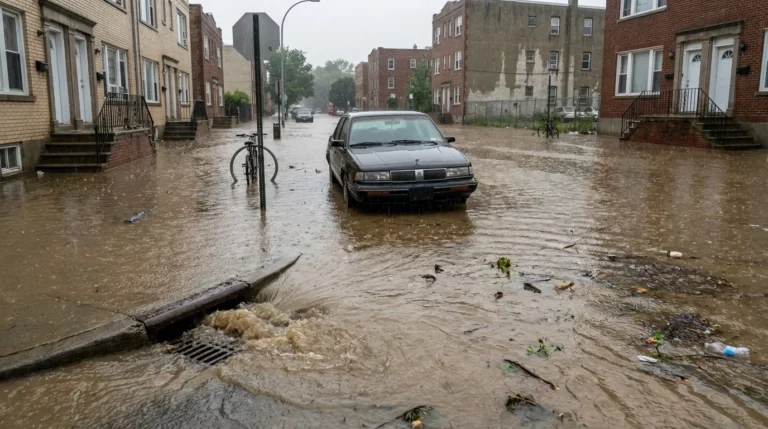
More than half of all flood drownings in the United States happen inside a vehicle that was driven into water (National Weather Service, citing CDC data). Six inches of moving water knocks an adult over; twelve inches carries away most cars; two feet takes an SUV. Surviving an urban flood is therefore mostly one decision, made early: you do not drive or walk into water you cannot see the bottom of. The rest of this guide is what to do before and after that decision.
City flooding does not look like a river bursting its banks. It looks like a storm drain that cannot keep up, an underpass filling in twenty minutes, a basement apartment with water coming through the door, a parking garage on the wrong side of the street. The guidance below comes from Ready.gov, the National Weather Service and the American Red Cross, adapted to what a city household can actually do — sources at the end.
Before: know whether your street floods, and whether you are covered
Look up the address, not the neighbourhood
The Red Cross advice is to search your address in the FEMA Flood Map Service Center. In a city, two buildings on the same block can be in different zones: the one on the slope and the one at the bottom of it. Basement and ground-floor apartments, underpasses on your commute, and the parking garage are the three places to check specifically. If the map says you are outside the high-risk zone, that is a statistic, not a guarantee — urban flash flooding from a blocked drain does not read maps.
Flood insurance is separate, and it is not instant
Ready.gov’s flood page links a document with the whole story in its title: Your Homeowners Insurance Does Not Cover Flood. Flood cover in the US comes through the National Flood Insurance Program (FloodSmart.gov) or a private flood policy, and renters can buy contents-only cover. Policies generally have a waiting period before they take effect, so the week a storm is forecast is too late. If you rent a basement or ground-floor unit, a contents policy is the single most useful thing on this page.
Protect the property that can be protected
Ready.gov’s list for the home: move valuables to higher levels, clear drains and gutters, install check valves (so sewer water cannot back up into the house), and consider a sump pump with a battery backup — the flood and the power cut arrive together. For an apartment, the version is simpler: nothing irreplaceable on the floor, nothing electrical on the floor, and the document pouch (below) somewhere you can grab it.
Documents in a waterproof container, and a digital copy
Ready.gov, verbatim: keep documents in a waterproof container and create password-protected digital copies. ID, insurance policies, lease or deed, prescriptions, and photographs of every room and its contents — a flood claim is settled on what you can prove you owned. Ten minutes with a phone camera now is the difference between a paid claim and an argument.
Two places on higher ground, and a way to hear the warning
The Red Cross rule for flash floods: designate a place on higher ground you can get to quickly, and plan to move there before flooding begins. For a city household, that is a specific friend’s apartment upstairs or uphill, or a named public building, not “somewhere higher”. Then the alerts: Wireless Emergency Alerts on the phone are on by default, the FEMA app adds NWS alerts for up to five locations, and a NOAA weather radio works when the towers do not. Flash Flood Warnings are the ones that mean move now.
The kit
Ready.gov’s flood kit is the standard several-day supply — food, water, cleaning supplies — with one addition that matters here: cleaning supplies, because after a flood the house is a contamination problem before it is anything else. The go-bag stays packed during the rainy season; we compared eight pre-built ones in our 72-hour kit review and priced the contents in what a 72-hour kit actually costs. Add rubber boots, heavy work gloves and N95 masks — all three are on Ready.gov’s after-flood list.
During: the numbers that decide everything
From the National Weather Service’s Turn Around, Don’t Drown programme:
- 6 inches of fast-moving water can knock over an adult.
- 12 inches of rushing water carries away most cars.
- 2 feet carries away SUVs and trucks.
- Over half of flood drownings are people in vehicles driven into water; the next largest group walked into or near it.
The rules that follow, all from Ready.gov and the NWS:
- Never drive around barricades. The road under the water may be gone; a barricade is the only warning you get.
- Do not walk, swim or drive through floodwater. You cannot judge depth, current, or what is under the surface from the driver’s seat, and in a city the water may be electrically charged by downed or underground lines.
- Stay off bridges over fast-moving water. They are washed away without warning.
- If the car is trapped in moving water, stay inside it. If water is rising inside the car, get on the roof. Ready.gov’s wording — the car is stable until it is not, and the roof is the last dry place.
- If trapped in a building, go to the highest level. Do not climb into a closed attic — people drown in attics with no way out. Get onto the roof only if necessary, then signal.
- Evacuate immediately if told to. In a city, that usually means on foot, uphill, early, while the water is still in the gutters. Our guide on leaving the city fast covers the timing; underground spaces — subways, underpasses, parking garages, basements — are the places to be out of first.
If someone is sick and needs care during the flood, Ready.gov’s instruction is to contact the provider and shelter in place if possible; 911 for a genuine emergency. Responders are on the barricades, not in the water.
After: the part that sends people to hospital
The dangerous half of an urban flood starts when the water goes down. Ready.gov’s after-flood list, in the order it kills people:
- Electricity. Do not touch electrical equipment if it is wet or you are standing in water. Turn off the power at the breaker only if it is safe to reach. Floodwater can be charged by underground lines — this is the city-specific risk.
- Generators outdoors only, away from windows. After a flood, running one in a wet garage is how carbon monoxide deaths happen.
- Contamination. Avoid wading in floodwater; it carries sewage, fuel and debris. Throw away any food that touched it (Ready.gov’s food guidance). Wash everything that touched it.
- Mould. Ready.gov: people with asthma, other lung conditions or immune suppression should not enter buildings with visible or smellable mould; children should not take part in cleanup at all. Heavy work gloves, protective clothing, boots and a mask for the adults who do.
- Animals. Snakes and other animals end up inside flooded houses. Open doors with a stick, not a hand.
- Return only when authorities say so, and avoid driving except in emergencies — the roads are being assessed for collapse.
Then the claim: photograph everything before you move it, keep samples of damaged flooring and drywall, and file quickly. Ready.gov links a flood insurance claims checklist for the process.
The apartment-specific version
Most flood guidance is written for houses. If you rent in a city:
- A contents flood policy is cheap relative to what a basement unit loses in one night.
- Know where your building’s electrical room and water shut-off are, and who has the key. Ask the super before the season.
- The building’s stairwell is your higher ground; the elevator is not, and the lobby and garage are the first places to flood.
- If you park in an underground garage, move the car to street level or a ramp the day a Flood Watch is issued. Waiting for the Warning is how cars end up floating.
- Keep the go-bag on a shelf, not the floor.
What this article does not cover
River flooding, storm surge and dam or levee failure are their own hazards with their own evacuation timelines, and the Red Cross page below covers the differences. Coastal households should read it alongside our evacuation checklist, which applies to any leave-now scenario. This article is about the flood that happens on your street, from the sky, in an afternoon.
Official sources & further reading
The figures and rules in this article come from official emergency-preparedness guidance. Consult it directly for the authoritative version:

Dan Lockland is a preparedness instructor and survival skills educator with over 15 years of hands-on experience. He shares practical, no-nonsense guidance on emergency preparedness, self-reliance, and sustainable living at PreparingWithDan.com.