
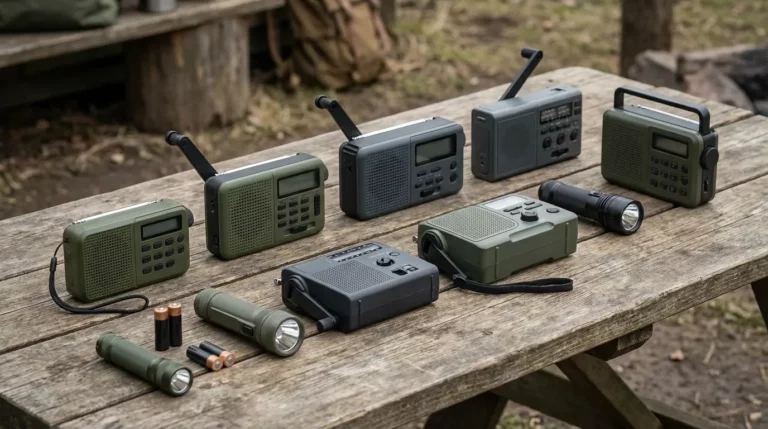
A hand crank emergency radio is the one piece of prep gear that works when everything else has failed — dead phones, downed cell towers, no power. For a family of 4, you need one that reliably picks up NOAA alerts, has multiple power sources, and doesn’t require reading a manual under stress. Here are the picks that actually deliver that, at every budget.
Table of Contents
- Why Every Family Needs One (and Why Phones Aren’t Enough)
- Features That Actually Matter
- Best Hand Crank Emergency Radios of 2026
- Side-by-Side Comparison
- How to Use Your Emergency Radio Effectively
- Maintenance: Keeping It Ready
- Common Mistakes
- FAQ
Why Every Family Needs One (and Why Phones Aren’t Enough)
Cell towers have backup generator power for 4–8 hours. After that, service degrades or disappears entirely in a regional disaster. Your smartphone is a communication device that depends on functional infrastructure — which is exactly what fails during the emergencies you’re preparing for.
A hand crank radio with NOAA reception works when:
- Cell towers are overloaded or offline
- Your phone battery is dead and your power bank is depleted
- The internet is down regionally
- You need continuous weather alerts overnight without draining your devices
NOAA Weather Radio broadcasts 24/7 on 7 frequencies covering the entire US, with automatic alerts for tornadoes, flash floods, and severe weather. It’s the most reliable emergency broadcast system in the country — and it works completely independently of the internet or cell networks.
Features That Actually Matter
Must-have features (non-negotiable):
- NOAA weather band reception — 7 pre-programmed NOAA channels. This is the core function. If a radio doesn’t have it, it’s not an emergency radio.
- Multiple power sources — hand crank + solar panel + AA/AAA batteries minimum. You want backups for your backups.
- USB phone charging port — doubles the radio’s value by keeping your phone alive during an outage.
- LED flashlight — basic but essential; this radio will be grabbed in the dark.
Nice to have (worth paying for):
- SAME (Specific Area Message Encoding) alerts — auto-activates the radio for alerts specific to your county
- AM/FM reception — local news and station updates during non-severe events
- SOS alarm/strobe — for signaling if you’re in a vehicle emergency or need to attract attention
- Larger battery (2,000+ mAh) — more reserve power without cranking
Skip these: Bluetooth speakers, FM recording, and “shortwave” features are marketing additions that add cost without emergency value. Spend that money on battery capacity instead.
Best Hand Crank Emergency Radios of 2026
Best Overall: Midland ER310
The ER310 is the most recommended emergency radio in the preparedness community for good reason — it does everything right. Excellent NOAA reception, 2,000 mAh battery, hand crank + solar + AA batteries, USB phone charging, and bright flashlight/strobe. Simple enough to operate in the dark, durable enough to last years in a kit. It’s the right call for most families.
Best Budget: RunningSnail MD-090P
The RunningSnail MD-090P delivers the essentials: NOAA weather band, hand crank, solar, USB charging port, and LED flashlight. The battery is smaller (1,000 mAh) and the build quality is lighter than the Midland, but for a backup radio, a second kit radio, or a gift for a family member getting started, it’s excellent value.
Best Premium: Eton Elite Field BT
For families who want serious reception capability, the Eton Elite Field BT picks up AM/FM/NOAA plus shortwave bands 1–8, has Bluetooth streaming, and includes a larger battery. It’s overkill for pure emergency prep — but if you want the best signal acquisition in a rural area or during international events, it’s the top performer.
Best Compact: Kaito KA500
The Kaito KA500 packs AM/FM/NOAA/shortwave into a compact, lightweight body with hand crank and solar charging. It’s the right choice for bug-out bags — it fits easily in a side pocket and runs on AA batteries as a primary source. It hits a good balance of capability and portability.
Side-by-Side Comparison
| Model | Battery | Power Sources | NOAA | USB Charging | Best For |
|---|---|---|---|---|---|
| Midland ER310 | 2,000 mAh | Crank + Solar + AA | ✅ + SAME alerts | Yes | Main home kit — best overall |
| RunningSnail MD-090P | 1,000 mAh | Crank + Solar + USB | ✅ | Yes | Budget/backup/second radio |
| Eton Elite Field BT | 2,000 mAh | Crank + Solar + AA | ✅ + SAME | Yes | Premium reception, rural areas |
| Kaito KA500 | 650 mAh internal | Crank + Solar + AA + USB | ✅ | No | Bug-out bag, portability |
| Midland ER10VP | 1,000 mAh | Crank + Solar + AAA | ✅ | Yes | Budget Midland option |
How to Use Your Emergency Radio Effectively
Cranking efficiency: 1 minute of steady cranking = 10–15 minutes of listening time. For continuous overnight monitoring, use AA batteries or the solar panel rather than cranking. Reserve cranking for when all other power sources are depleted.
NOAA channels by region: NOAA broadcasts on 7 frequencies (162.400–162.550 MHz). Most radios auto-scan and lock onto the strongest signal. If reception is poor, try each channel manually — the strongest signal in your area may not be 162.400.
SAME alerts (if your radio has them): Program your 6-digit FIPS county code (findable at weather.gov) into the radio. It will then alert only for your specific county, eliminating alerts from neighboring counties that don’t affect you. This matters at 3 AM when you don’t want to be woken by a tornado warning 100 miles away.
Phone charging reality check: Most emergency radio USB ports output 5V/500mA — enough to slowly charge a phone, not fast charge it. A full phone charge from a 2,000 mAh radio battery would drain the radio entirely. Use it to top up a phone from 20% to 50%, not as a primary charging source.
Maintenance: Keeping It Ready
| Task | Frequency | Why |
|---|---|---|
| Test all functions (crank, solar, NOAA scan) | Every 6 months | Confirm it still works before you need it |
| Charge internal battery via AC or USB | Every 3–6 months | Li-ion batteries degrade when stored fully depleted |
| Replace AA/AAA backup batteries | Annually | Batteries self-discharge; fresh batteries = reliable backup |
| Wipe down with dry cloth | Annually | Dust in ports reduces charging reliability |
| Verify NOAA channel still works for your area | Annually | NOAA occasionally adjusts transmitter frequencies |
Common Mistakes When Buying an Emergency Radio
- Buying based on feature count, not feature quality. A radio that lists 5 power sources but has poor NOAA reception is less useful than a simpler radio with excellent reception. NOAA signal clarity is the core function — test reviews for that specifically.
- Only buying one. One radio for a family of 4 means it’s wherever one person is. Keep one in the home emergency kit and one in the car. A solid budget model is cheap enough to make this an easy double-up.
- Never testing the crank before an emergency. Hand cranks can seize or break from disuse. Test yours every 6 months. Finding a broken crank at 2 AM during a tornado warning is a bad moment.
- Skipping SAME alert programming. Most families never program their county FIPS code, so they get alerts for a 5-county region instead of their specific area. Takes 5 minutes, makes 3 AM alerts much more relevant.
- Storing with batteries inside long-term. Batteries left in a radio for 12+ months can leak and corrode the contacts. Store backup batteries separately in a sealed bag, or use lithium batteries (they don’t leak).
FAQ
What’s the best hand crank emergency radio for a family?
The Midland ER310 for most families — excellent NOAA reception with SAME county alerts, 2,000 mAh battery, hand crank plus solar plus AA batteries, and USB phone charging. It covers every real emergency need without unnecessary extras. Buy a second one for the car at the same time.
How long does 1 minute of cranking power the radio?
About 10–15 minutes of listening time, depending on the model and volume level. Cranking is a last-resort power source, not a primary one. For extended use, the internal rechargeable battery (charged via USB or solar) is far more efficient. Use AA batteries as your primary backup, cranking only when those are also dead.
Do I need SAME alerts on my emergency radio?
Yes, if you live in a region with frequent severe weather. SAME (Specific Area Message Encoding) lets you program your county’s FIPS code so the radio only alerts for your specific area. Without it, you’ll get alerts for every county within the broadcast range — including counties 80 miles away that don’t affect you. Worth paying a little more to have it.
Can an emergency radio charge my phone?
Yes, but slowly and with limits. Most emergency radio USB outputs are 5V/500mA — adequate for slow charging but not fast charging. A 2,000 mAh radio battery gives your phone roughly a 30–50% charge before the radio battery is depleted. Use it to maintain your phone above 20%, not as a full charging source. Keep a dedicated 20,000 mAh power bank for that job.
How often should I test my emergency radio?
Every 6 months. Test the NOAA reception, the hand crank, the solar panel (put it in a sunny window for 30 minutes and see if the battery indicator responds), and the USB charging output. Replace AA backup batteries annually. A radio you’ve never tested under pressure is a radio you can’t trust when it matters.
Bottom Line
Get the Midland ER310 for your home emergency kit. Add a RunningSnail MD-090P for the car or as a backup. Program your NOAA county frequency and your SAME code, charge the battery, and test it once. That’s the whole job — and it takes 30 minutes. For the rest of your communication prep during a blackout, see How to Survive a Long-Term Blackout.
Last Updated: April 2026

Dan Lockland is a preparedness instructor and survival skills educator with over 15 years of hands-on experience. He shares practical, no-nonsense guidance on emergency preparedness, self-reliance, and sustainable living at PreparingWithDan.com.