
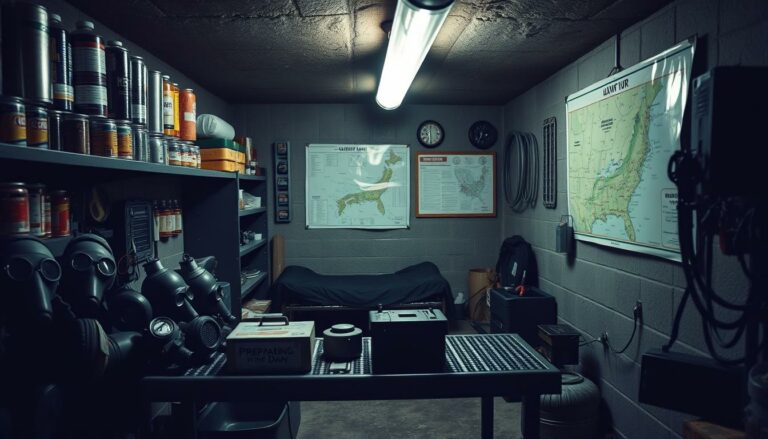
After a nuclear detonation you have, in Ready.gov’s words, 10 minutes or more to get inside before fallout arrives, and you then stay in the most protective place you can reach — a basement or the centre of a brick or concrete building — for the first 24 hours, because radiation levels drop sharply during that first day. Removing your outer clothing takes off up to 90% of any radioactive dust. That is the whole first day: get inside, stay inside, stay tuned.
This article follows the official US guidance hour by hour and adds nothing to it. The instructions are Ready.gov’s and the Radiation Emergency Medical Management programme’s (HHS); the sources are at the end. Our nuclear fallout pillar covers the weeks after; this is the first day only, written for a family in a city.
Minute 0: the flash and the blast
Ready.gov’s sequence, if you have any warning at all: take cover from the blast behind anything that might offer protection. If you are outside, lie face down to protect exposed skin from the heat and from flying debris. Do not look at the flash. Then wait for the shockwave to pass — it follows the flash by seconds to tens of seconds depending on distance — and only then move.
Minutes 1–10: get inside
This is the window that decides the rest. Ready.gov: after a detonation, you will have 10 minutes or more to find an adequate shelter before fallout arrives. The rules for where:
- If a multi-storey building or a basement can be safely reached within a few minutes, go there immediately.
- The safest buildings have brick or concrete walls. Wood-frame houses and cars offer little protection.
- Underground parking garages and subways can also provide good shelter — in a city these are often the closest good option.
- Inside, go to the basement or the centre of the building, away from windows, with as many walls as possible between you and the outside.
Do not drive to a better shelter across town, and do not go home to collect the family if home is more than a few minutes away. Ten minutes is the budget; the nearest concrete is the answer. Your family plan should already say that everyone shelters where they are and meets afterwards — that is the hardest part of this page to accept, and it is the part that saves lives.
The first hour: seal the room, clean up
Once inside, Ready.gov’s stay inside list:
- Close windows and doors; close fireplace dampers.
- Turn off fans, air conditioners and forced-air heating that bring in outside air.
- Pets and service animals come inside too.
Then, if you were outside after the blast or think you have dust on you, decontaminate — Ready.gov’s steps, in order:
- Remove your outer layer of clothing. This alone removes up to 90% of radioactive material. Do it carefully so the dust does not shake loose; avoid touching eyes, nose and mouth.
- Put the clothing in a plastic bag (the trash bag from the kit) and seal it, away from people and pets.
- Shower or wash with soap and water any skin and hair that was uncovered. No shower: a wipe or a clean wet cloth. Do not use household cleaning wipes on skin. Hand sanitiser does not remove radioactive material.
- Pets that were outside after the dust arrived: brush the coat gently, then wash with soap and water if you can.
Hours 1–24: stay put, stay tuned
Ready.gov’s core instruction: remain in the most protective location for the first 24 hours unless threatened by an immediate hazard — fire, gas leak, building collapse, serious injury — or told by authorities that it is safe to leave. The reason is physics, not caution: radiation levels decrease rapidly, becoming significantly less dangerous, during the first 24 hours. Every hour inside is worth more than the hour before it.
The instruction is to stay tuned, and this is where the kit matters. A battery-powered or hand-crank radio is on Ready.gov’s list precisely because it works when other communication fails; the models we tested are the item to have within reach. Emergency officials will say when it is safe to leave, which routes are open, and where shelters are. Our guide on calling for help when the network is down covers reaching your family in the meantime; assume the mobile network is overloaded and text rather than call.
Food and water inside the shelter
Ready.gov is specific and reassuring here: it is safe to eat and drink food that was inside a building. Food in sealed containers that were outside is safe once the container is wiped with a damp cloth; seal that cloth in a bag afterwards. Unsealed food from outside may be contaminated and should not be eaten. Tap water: follow the instructions on the radio; sealed bottled water from the kit first.
If someone is hurt
Serious injury is one of the listed reasons to leave shelter. For everything short of that, the first aid kit and the 24 hours inside. The symptoms of significant radiation exposure (nausea, vomiting within hours) need medical care as soon as authorities say movement is safe; REMM is the reference clinicians use, and the reason this article does not attempt to give medical advice beyond get inside, decontaminate, wait for instructions.
Potassium iodide: only on instruction
Iodine tablets protect the thyroid against one specific radioactive isotope, and the official position is to take them only when public health officials say to. Our potassium iodide guide explains why; the short version is that they do nothing against the fallout dose itself and are not a substitute for the walls.
What the kit needs for this specific day
Ready.gov’s additions to the standard kit for radiation emergencies, all cheap:
- A spare change of clothes for each family member (you will have bagged the ones you were wearing).
- A trash bag for contaminated clothing.
- Sealed food, water and medicine — sealed is the operative word.
- The hand-crank radio, and the out-of-state contact’s number written down.
Our 72-hour kit cost study priced the standard kit; the additions above add a few dollars. A detector is a later, optional purchase — our Geiger counter buyer’s guide explains what it can and cannot tell you on this day (mostly: whether the number is going down, which it will be).
After 24 hours
Leave only when officials say so, by the routes they give. If you are told to evacuate, the guidance is to listen for routes, shelters and procedures, and not to return until told it is safe. The fallout pillar linked above takes over from here: the days and weeks, the shelter design, food and water beyond the kit.
The one-card version
- Flash: cover, face down, wait for the shockwave.
- Ten minutes: nearest concrete or basement. Not the car. Not home if home is far.
- Seal the room: windows, doors, dampers, fans off. Pets in.
- Outer clothes off and bagged (90%). Wash with soap and water. No sanitiser, no cleaning wipes.
- 24 hours inside. Radio on. Text, don’t call.
- Food from inside or sealed only. Iodine only on instruction.
- Leave only when told, by the route you are told.
Official sources & further reading
Every instruction in this article is taken from official US guidance. Consult it directly for the authoritative version:

Dan Lockland is a preparedness instructor and survival skills educator with over 15 years of hands-on experience. He shares practical, no-nonsense guidance on emergency preparedness, self-reliance, and sustainable living at PreparingWithDan.com.