
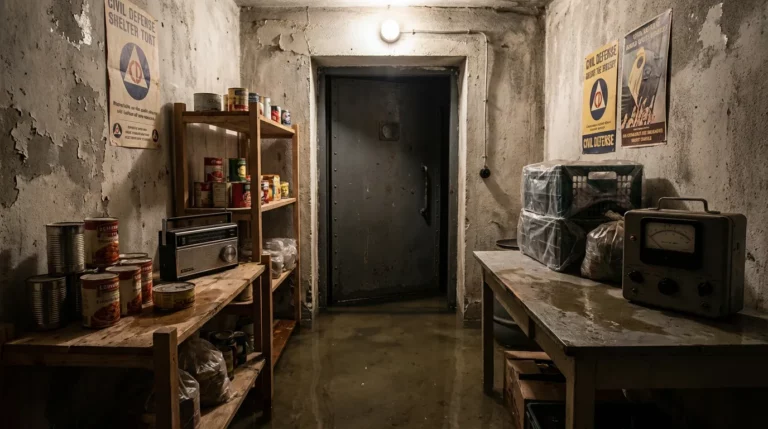
After a nuclear detonation you have roughly 15 minutes before fallout starts landing. Get inside, move to a basement or the centre of a large building, and stay there. Fallout radiation falls by about 90% in the first seven hours – sheltering in place, not driving away, is what keeps people alive.
Most of what people believe about surviving nuclear fallout is wrong. They either believe survival is impossible (it is not, for most scenarios) or they believe it requires elaborate preparation they do not have (it largely does not). The reality is that the actions taken in the first 15 minutes after a nuclear detonation are the most important survival decisions you will make — and the correct actions are simple, available to almost anyone, and require no special equipment.
This guide covers the complete survival sequence: what to do in the first seconds, the first hour, the first day, and the first week. It is written for a family of four at moderate distance from a nuclear detonation — the scenario where good decisions make the greatest difference.
This guide addresses survival planning for families at distances where survival is possible — typically more than 1 mile from a tactical nuclear detonation or more than 5 miles from a larger weapon. Within the immediate blast zone, survival depends primarily on being indoors in a solid structure when the detonation occurs. Close-range survival is largely luck; moderate-distance survival is largely planning and action.
Understanding the Threat Sequence
A nuclear detonation produces three sequential threats, each requiring different responses:
1. Blast wave (seconds): The pressure wave from the explosion. At moderate distances (several miles), this may arrive as a strong wind and structural damage rather than the explosive overpressure that kills people closer to the detonation. Get down, away from windows, protected by structural elements.
2. Thermal radiation (seconds to minutes): The flash of light and heat. At moderate distances, this can cause skin burns and ignite flammable materials. It travels at the speed of light and arrives before the blast wave. If you see an unexpected flash, get behind any cover immediately.
3. Fallout (minutes to hours): The contaminated debris and soil thrown up by the explosion that settles downwind over hours. This is the primary danger for families at moderate distances. Fallout is radioactive and causes radiation exposure through proximity and contamination. This is what shelter-in-place protects against, and it is what this guide primarily addresses.
The Critical First 15 Minutes
The sequence of actions in the first 15 minutes after a nuclear event is the most important survival period. These actions should be practiced and automatic:
If you see a flash or receive a nuclear emergency alert:
- Get inside immediately. Any solid structure is better than being outside. A concrete or brick building is far better than a wood-frame structure. The closest substantial building is your destination — do not drive home if you are blocks away. Get inside the nearest suitable building and shelter in the most interior location, preferably below grade.
- Get away from windows. Windows are the primary hazard during the blast phase. Get to an interior wall, below any window line, with your back to the exterior.
- If caught outside when the blast hits: Drop flat on the ground, face down, hands protecting the back of your neck. Debris thrown by the blast wave is the primary injury mechanism at moderate distances.
- Stay inside. Once you are inside a building, do not go back outside to retrieve items, check on neighbors, or drive to get family members. Fallout begins arriving within 10–30 minutes of a low-altitude or ground-level detonation. You need to be sheltered before it arrives.
If you are driving when the alert occurs: Do not continue driving. Every minute of driving is a minute spent in a vehicle — one of the worst possible shields against radiation. Drive immediately to the nearest substantial building (office building, school, shopping center, concrete structure). Get inside and shelter. Your car provides minimal protection compared to any substantial interior space.
FEMA and ready.gov have simplified nuclear survival to three steps: Get Inside, Stay Inside, and Stay Tuned. These three words capture the most important actions. Everything else in this guide is elaboration on those three instructions.
Selecting Your Shelter Location
Not all interior spaces provide equal protection. The physics of radiation shielding favor mass and distance from contaminated surfaces:
Best options, roughly in order:
- Basement of a brick or concrete building (Protection Factor 40–100+)
- Basement of any building (PF 10–40)
- Interior room on the lowest floor of a concrete/brick building, away from windows (PF 10–20)
- Interior room on the lowest floor of a wood-frame building, away from windows and exterior walls (PF 3–10)
- Any interior space is better than outside or in a vehicle
The fallout that settles on your roof is directly above upper floors. Moving to the lowest floor reduces your proximity to that rooftop contamination. Multiple walls between you and the outside reduce your proximity to ground-level fallout on all sides. Basements have earth providing shielding on all four sides and below, making them dramatically more protective than above-grade rooms.
Sealing Your Shelter Space
Once you are in your shelter location, reducing the entry of fallout particles significantly lowers your inhalation and internal contamination risk:
- Seal window gaps with plastic sheeting and tape (stored in advance in your shelter kit)
- Seal door gaps with tape or towels placed at the base of doors
- Turn off HVAC systems (forced-air heating and cooling recirculates outdoor air)
- Close fireplace dampers completely
- Seal any visible gaps in the building envelope (dryer vents, bathroom exhaust fans, etc.)
You are not trying to create an airtight space indefinitely. Air quality will become a concern after 12–24 hours. The goal is to reduce particle infiltration during the first 24–48 hours when fallout radiation is highest and declining most steeply via the 7-10 rule.
If You Were Caught Outside: Decontamination Protocol
If a family member was outside during fallout arrival, decontamination before entering your shelter is critical. Fallout particles on clothing and skin bring radiation inside with them:
- Remove outer clothing outside or at the threshold (before entering). This eliminates approximately 80% of external contamination. Cut clothing off rather than pulling over the head — this prevents dragging contaminated fabric across the face.
- Bag removed clothing immediately in heavy plastic bags. Seal and leave outside or as far from living areas as possible. Do not bring contaminated bags into the shelter.
- Shower immediately with mild soap and lukewarm water. Wash hair with shampoo only — no conditioner (conditioner bonds particles to hair). Rinse thoroughly. Pat dry rather than rubbing.
- Change into clean clothes from inside the shelter.
A contaminated person who showers before entering adds minimal radiation to the shelter environment. A person who does not decontaminate brings their contamination in with them, elevating dose for the entire household.
Potassium Iodide: Timing Is Everything
If official guidance recommends potassium iodide (KI) for your area, take it immediately at the appropriate dose for each family member. KI protects the thyroid from radioactive iodine-131 released in nuclear events — but only if taken within the protection window:
- Taken up to 24 hours before or at the time of exposure: approximately 100% effective
- Taken 1–4 hours after exposure: approximately 85% effective
- Taken 4–8 hours after: approximately 40% effective
- After 24 hours: essentially no benefit
Do not wait for official guidance if you have confirmed fallout in your area and have KI on hand. The window closes quickly. Doses by age:
- Adults 18–40: 130 mg
- Adults 40+: 130 mg (if confirmed high exposure)
- Adolescents 12–18 (<150 lbs): 65 mg
- Children 3–12: 65 mg
- Children 1 month–3 years: 32 mg
- Infants birth–1 month: 16 mg
The First 24 Hours: Staying Sheltered
The first 24 hours after a nuclear detonation is when fallout radiation is highest. The 7-10 rule describes the decay: for every 7-fold increase in time since detonation, radiation falls by a factor of 10. At 7 hours, radiation has fallen to 10% of the 1-hour level. At 49 hours, to 1% of the 1-hour level.
This means the first 24 hours is the most important period to be sheltered. After that, the risk/benefit calculation for brief outside exposure changes significantly.
During shelter, focus on:
- Monitoring NOAA weather radio for official guidance and updates
- Maintaining family communication via your designated GMRS channel
- Tracking radiation levels with your Geiger counter (establishing whether levels are declining at the expected rate)
- Staying hydrated with stored water
- Maintaining routine and managing family stress
- Preparing food from sealed stored supplies only (no fresh food from outside)
Food and Water Safety During Fallout
Safe to consume:
- Food and water stored in sealed containers before the event
- Commercially packaged, sealed food
- Water from indoor tap supplied by municipal treatment (in most scenarios)
Do not consume:
- Open containers that were exposed to fallout particles
- Fresh produce from outside the shelter
- Rainwater collected during or after fallout
- Water from open outdoor sources (streams, ponds, rain barrels that were uncovered)
- Well water from shallow wells until tested (surface runoff can contaminate shallow wells)
Your pre-positioned shelter food supply (target: 2 weeks of calorie-dense stored food) is the resource that eliminates this concern entirely. People who shelter with no food stores face foraging decisions that compound their radiation exposure. This is a compelling argument for pre-positioning supplies.
Determining When to Emerge
Emerging from shelter too early is dangerous. Emerging too late is unnecessary hardship. The decision should be based on:
Official guidance: NOAA weather radio and official emergency management channels are your primary reference. Follow official all-clear guidance from your county emergency management authority rather than social media rumors.
Radiation meter readings: If you have a Geiger counter, track your shelter’s ambient radiation level. When it has fallen to near your pre-event baseline reading (or to levels specified in official guidance), conditions are improving. The reading should be declining over time following the 7-10 rule pattern.
General timeline guidance:
- First 24 hours: stay inside except for brief emergencies
- 24–72 hours: reassess based on official guidance and radiation readings; brief outside exposure for essential purposes may be acceptable
- Beyond 72 hours: follow official guidance for your specific area and distance from detonation
When you do go outside, cover exposed skin (long sleeves, pants, hat), cover nose and mouth (an N95 mask significantly reduces particle inhalation), limit time outside, and shower and change clothes when you return inside.
The 14-Day Supply Target: Why It Matters
FEMA recommends initial shelter-in-place of 24 hours, but the full picture is longer. After emerging from initial shelter, your community may have:
- Disrupted food supply chains (stores closed, deliveries stopped)
- Contaminated water supplies requiring extended boiling or filtering
- Medical system overwhelm preventing access to care
- Power outages affecting refrigeration, water pumping, and heating/cooling
A family with 14 days of food, water, and essential medications can navigate the post-event period without depending on infrastructure that may not be functioning. A family with 72 hours of supply faces those shortages almost immediately. The supply gap between these two situations directly determines outcomes in the 2–14 day post-event period.
The Post-Event Period: Practical Priorities
Once initial shelter-in-place ends and you begin operating again:
- Check on immediate family members who were not with you. Follow your pre-established reunification protocol. Contact your out-of-area contact to relay information both ways.
- Assess your shelter for continued occupation. Can you stay where you are, or do you need to move to less contaminated areas? Follow official guidance on evacuation versus sheltering.
- Inventory your supplies. What do you have, what is depleted, what needs resupply? Make decisions about resupply timing based on current radiation levels and available sources.
- Document any symptoms (nausea, vomiting, skin changes) in family members and seek medical care if indicated. Medical facilities will be overwhelmed — contact before arriving and follow triage guidance.
- Reconnect with your neighborhood network. Coordinating with neighbors improves everyone’s resource access and information quality.
Common Mistakes in Nuclear Fallout Survival
- Driving away from a nuclear event instead of sheltering immediately. At moderate distances, you are more likely to drive into fallout than away from it unless you have specific, confirmed information about wind direction. Sheltering immediately in the nearest substantial building provides better protection than most evacuation decisions made in the first minutes.
- Trying to reach family members during the first 24 hours. The instinct to physically reunite with family is powerful and dangerous during active fallout. Family members who are each separately sheltered are far safer than anyone driving through fallout to find them. Communicate via radio and phone; reunite physically when conditions allow.
- Relying on a wood-frame house above ground when a basement or more substantial building is accessible. The difference in protection factor between a basement and an above-ground wood-frame room is 5–10 times. Know in advance what your best available shelter option is — including buildings in your neighborhood, workplace, and children’s school.
- No supplies in the shelter location. A perfectly selected shelter with no water and no food is abandoned within hours. Pre-position at least 72 hours of water and food in your designated shelter location.
- Acting on social media information rather than official guidance. Social media during a nuclear event will generate a mix of accurate real-time information and dangerous misinformation. For shelter-in-place decisions, use official channels (NOAA weather radio, local emergency management) rather than social media.
- Not having a Geiger counter. Without a radiation detector, you are making shelter-emergence decisions blind. A $90 Geiger counter converts an invisible threat into a measurable number you can act on.
Frequently Asked Questions
Is nuclear fallout survival really possible for regular people?
Yes, for the vast majority of scenarios that do not involve being within the immediate blast zone. The difference between survival and non-survival at moderate distances is almost entirely determined by the actions taken in the first 15 minutes — getting inside a substantial building, staying there, and decontaminating if exposed outside. These actions require no special equipment and minimal preparation beyond knowing what to do.
How far from a nuclear detonation is “safe”?
There is no sharp line. Effects scale with weapon yield, altitude of detonation, terrain, wind, and building protection. A rough framework: for a 10-kiloton weapon (tactical nuclear), the fatal blast zone is approximately 0.5 miles; severe damage out to 1–2 miles; significant fallout risk for miles downwind depending on wind speed. FEMA’s guidance is that for most nuclear scenarios, sheltering provides meaningful protection at distances where the buildings are still standing.
What if I do not have a basement?
The most interior room on the lowest floor of your home, away from exterior walls and windows, provides meaningful protection versus being outside or on an upper floor. If a neighbor, local business, or public building has a basement within walking distance, that is a better option. Know your best available shelter option in advance.
How do I keep my family calm during shelter-in-place?
Having a plan, having practiced the plan, and having supplies reduces acute fear significantly. During shelter, focus on structured routines, assigned tasks for each family member, limited news monitoring, and physical activity within the shelter. The most psychologically destabilizing experience is sitting in an unplanned shelter with no supplies, no information, and no routine. All of those are addressable through preparation.
Will any food from my garden be safe after fallout?
Do not harvest produce from outside during active fallout or immediately after. After the initial shelter period, root vegetables with intact, unbroken skin can be scrubbed clean and may be safe. Leafy greens and vegetables with exposed surfaces should be tested or avoided. Official guidance will address food safety in your specific area. Your stored food supply eliminates this concern during the critical period.
The Bottom Line
Nuclear fallout survival for most scenarios comes down to three decisions made in the first 15 minutes: get inside the best available building, stay there with your supplies, and decontaminate anyone who was caught outside. Everything after that is managing the duration with food, water, communication, and information.
The families that survive nuclear fallout at moderate distances are not the ones who built the most elaborate shelters. They are the ones who knew what to do, had basic supplies pre-positioned, and made the right decisions in the first fifteen minutes when the margin between good and bad outcomes is widest.
The preparation is simple. The window for action is narrow. Do the preparation now so you have those fifteen minutes working for you instead of against you.
Official sources & further reading
The guidance in this article aligns with official emergency-preparedness resources. Consult them for the authoritative version:

Dan Lockland is a preparedness instructor and survival skills educator with over 15 years of hands-on experience. He shares practical, no-nonsense guidance on emergency preparedness, self-reliance, and sustainable living at PreparingWithDan.com.