
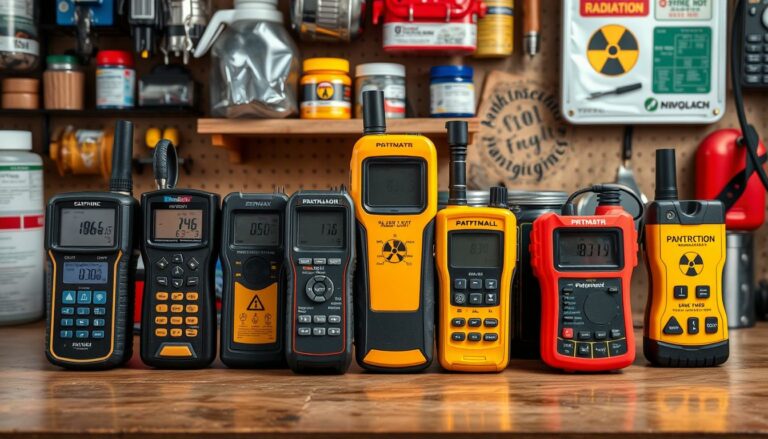
A consumer Geiger counter will not save you in a radiation emergency — Ready.gov’s instruction is the same whether you own one or not: get inside, stay inside, stay tuned. What a $100–$300 detector does is answer one question afterwards, honestly and immediately: is the radiation level here going up, down, or normal? That is worth owning if you understand what it cannot do, and this guide is mostly about that.
This is a buyer’s guide, not a bench test. We have not laboratory-tested the units mentioned below, and we are not going to invent ratings. What we can do is explain, from the official guidance (Ready.gov, the EPA) and the physics, which features matter for a household and which are marketing, so that whatever you buy is bought for the right reason. Our companion guide on using radiation detection tools covers reading the numbers once you own a device.
What the official guidance says
Ready.gov’s radiation-emergency guidance does not mention personal detectors at all. Its plan is: several ways to receive alerts (FEMA app, community alerts, a hand-crank radio), an emergency kit with a change of clothes and a trash bag for contaminated clothing, a family communications plan with an out-of-state contact, and the rule for the event itself — get inside, stay inside, stay tuned. After a nuclear detonation you have 10 minutes or more to reach a basement or the centre of a brick or concrete building, and you stay there for the first 24 hours unless told otherwise. The EPA adds the three protection principles: time, distance and shielding. A detector helps with none of those decisions in the first hours; it helps with the ones that follow.
What a Geiger counter actually measures
A Geiger counter counts ionising events in a small gas-filled tube and converts them to a dose rate on the screen. Three consequences follow, and they explain most of the disappointment people feel after buying one:
- It measures where the tube is, right now. It tells you the level at your kitchen table, not whether the rain outside is contaminated or whether the food in the can is. To check an object you hold the tube against it and compare with the background reading you took last week — which is why the first thing to do with a new detector is to learn what “normal” reads in your home.
- It does not identify the source. A consumer Geiger counter cannot tell you which isotope it is seeing. Devices that can (scintillation-based spectrometers) exist for consumers now, cost more, and are the only kind that can distinguish, say, a naturally radioactive granite countertop from fallout.
- Most detect beta and gamma; alpha needs a specific window. Alpha particles are stopped by a sheet of paper and by the metal wall of a standard tube. Units with a thin mica “pancake” window can see alpha; sealed tubes cannot. Alpha matters for contamination on surfaces and food, not for the dose you receive from the air, so decide which question you are buying the device to answer.
Features that matter, and features that do not
Matters
- A clear reading in one unit you understand (µSv/h is the most common), a backlit screen, and an audible alarm with a threshold you set. In an emergency you want the device to tell you when something changed, not to be read continuously.
- Battery life measured in days, on common cells (AA/AAA) or USB-rechargeable from the same power bank as your phone. A detector that dies on day two of a shelter-in-place is a paperweight.
- Response time. Cheap tubes need a long averaging period to settle at background; that is fine for checking a room, slow for scanning objects. Product pages rarely state this honestly; user reviews do.
- Logging, if you want to know what the level was while you slept. Bluetooth to a phone app is convenient but not essential.
- A case, because the tube is the fragile part and the bug-out bag is not gentle.
Does not matter (for a household)
- “Military grade” and similar labels. Ruggedness matters; the phrase does not mean anything.
- Maximum measurable dose rate in the thousands of µSv/h. If you are in a place where that range is being used, the reading is not the information you need — distance is.
- Calibration certificates for a device you will use to compare readings against your own baseline. They matter for professional use; for “is it going up?” they do not.
The honest use case for a family
After the first 24 hours indoors, the questions that a detector can help with are practical: is the level in the basement lower than upstairs (choose where the family sleeps); has the level outside dropped enough to make a short trip to the car reasonable; did the dust on the shoes we left at the door read higher than the floor inside. Those are relative readings against your own baseline, and every consumer device can do them. Radiation from fallout also decays quickly in the first days, and watching the number fall is genuinely reassuring in a way that no broadcast can be. That reassurance — and the decision-support after day one — is what you are buying.
What you are not buying is protection. Iodine tablets protect the thyroid from one specific isotope on official instruction (see our potassium iodide guide); shelter and time protect against everything else (fallout shelter guide). The detector goes on the list after those two, the radio and the kit — and the radio comes first, because the official instruction you will actually act on arrives by radio, not by tube.
Models people commonly compare
The three below are the units most often cross-shopped in this category. We have not tested them and do not rank them. Specifications, prices and availability change; check the listing and recent owner reviews before buying, and prefer the unit whose manual you can read online before you commit.
- GQ GMC series — the widely sold entry point, with logging and a PC/phone connection on most models. Check the current listing.
- RADEX RD1503 series — a simpler, pocket-sized dose-rate meter without logging, popular for the low learning curve. Check the current listing.
- A scintillation-based pocket spectrometer — the step up if you want isotope identification rather than a dose rate alone; more expensive, and worth it only if that is the question you need answered. Check the current listing.
Links above are affiliate links; the site earns a commission at no cost to you. It does not affect what we wrote, which is why there are no scores.
Before it goes in the kit
- Take a baseline reading in each room and outdoors on a normal day, and write it inside the case.
- Set the alarm threshold to a multiple of that baseline, not to a number from the internet.
- Store it with its batteries out, or on a charge schedule, in the same place as the hand-crank radio — the models we tested are the device you will reach for first.
- If your concern is EMP as well as fallout, the detector is electronics like any other: our Faraday bag review covers whether that protection is worth it.
Official sources & further reading
The protective actions in this article come from official guidance. Consult it directly for the authoritative version:

Dan Lockland is a preparedness instructor and survival skills educator with over 15 years of hands-on experience. He shares practical, no-nonsense guidance on emergency preparedness, self-reliance, and sustainable living at PreparingWithDan.com.