
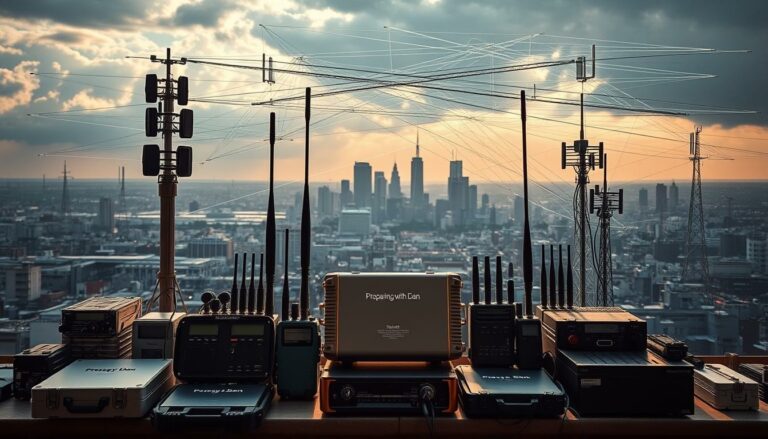
When the mobile network is overloaded, a text message usually still gets through when a call does not — Ready.gov’s own explanation is that texts need less bandwidth. So the order of operations for calling for help is: text your out-of-state contact, try 911 by voice, then text-to-911 if your county supports it, then a licence-free FRS radio, then the signals that need no electronics at all. Mesh devices and ham radio come after those, not before.
Most guides to emergency communication start with the gadget. This one starts with what fails first and what still works, in the order a family in a city would actually try things, using the rules from Ready.gov, the FCC and the ARRL (sources at the end). Our emergency communication strategies pillar covers the overall plan; this article is the narrow question: the network is down — how do I reach someone?
Layer 1: the phone, used differently
Text, don’t call
Ready.gov’s Get Tech Ready guidance: mobile networks can become overwhelmed during emergencies, making it hard to make and get phone calls. Text messages require less bandwidth, which means they are able to be transmitted more reliably. A text also keeps retrying quietly in the background. So the first move is a short text to the one person your family agreed on in advance — Ready.gov’s plan asks for an out-of-state contact, because a relay two states away is on a network that is not overloaded. Everyone in the household should have that number written down, not only stored in a phone.
911: voice first, text where it exists
The FCC is precise about this. Always contact 911 by voice if you can: a voice call gives the call centre more information. Text-to-911 exists, but only in the areas whose call centres have chosen to accept it; the FCC publishes a monthly list. If you text 911 where it is not supported, FCC rules require the carrier to send a bounce-back message telling you to call instead — so a text to 911 is never silently lost, but it is also not guaranteed to be read. Check the FCC list for your county before you need it, and treat text-to-911 as the option for when a voice call fails or when speaking is not safe.
Alerts still arrive when calls do not
Wireless Emergency Alerts (the loud, vibrating messages from the National Weather Service and local authorities) are, in Ready.gov’s words, not affected by network congestion. They are one-way — they cannot carry your call for help — but they are the reason to keep the phone on and charged even when it cannot make a call. The FEMA app adds NWS alerts for up to five locations, and FEMA’s text service answers SHELTER plus a ZIP code, sent to 43362, with a list of open shelters — a text-sized request that works when a web page will not load.
Keep the phone alive
A phone that is searching for a signal drains its battery fast. Airplane mode between attempts, screen brightness down, one person’s phone on at a time, and a power bank in the go-bag. The hand-crank radios we tested charge a phone slowly and, more usefully, receive the broadcasts that tell you where help is.
Layer 2: radios that need no network
FRS: no licence, 22 channels, a few blocks
The Family Radio Service is, per the FCC, licensed-by-rule — anyone can use it without applying for anything. It has 22 channels around 462 and 467 MHz and uses cheap hand-held radios. Realistic range in a city is blocks, not miles, because the same buildings that block the view block the signal. That is enough for the use that matters: one radio with the person who went to check on a neighbour, one at home, both on the channel you agreed on and wrote on the fridge. The etiquette is listen-before-talk; the channels are shared.
GMRS: a licence, more power, and text and GPS
The General Mobile Radio Service shares the FRS channels but requires an individual FCC licence (no exam; the licence covers the whole immediate family and runs ten years). In return it allows higher power, repeaters that extend range across a town, and — since 2017 — short data messages, including text and GPS location. For a family that wants a radio plan rather than a pair of toys, GMRS is the sensible step up, and the licence is a form, not a test.
Ham radio and ARES: the professionals’ fallback
Amateur radio needs an FCC licence earned by examination (ARRL runs the classes and exam sessions), which is why it is a hobby first and a lifeline second. But it is the network that, in the ARRL’s phrase, works when all else fails: ARES volunteers provide communications for shelters and emergency management when cell towers and wired networks are down. You do not need a licence to benefit — knowing where the local ARES group operates from is knowing where messages can be passed out of the disaster area. Our beginner’s guide to emergency ham radio covers getting licensed.
Layer 3: mesh devices — useful, with two honest limits
Mesh communicators pair with a phone and pass short text messages between each other over radio, hopping from device to device, with no tower involved. The appeal is obvious: texting that works with the network down. The two limits are equally obvious once stated:
- Both ends need a device. A mesh unit lets you reach the other people in your group who also carry one. It does not reach 911, your parents in another state, or anyone who did not buy the same system. It is a family or neighbourhood tool, not a call-for-help tool.
- Range is line-of-sight. In a dense city the effective distance is comparable to a good FRS radio, extended only by other units in between acting as relays — which means it works best exactly where several neighbours have adopted it together.
Where it earns its place: a building or block that organises together (our guide on building a community emergency network), a family that splits up across a city during the day, or anyone who wants location sharing without a network. Buy it after the FRS radios, not instead of them, and test it across your actual streets before trusting it.
Layer 4: no electronics at all
The last layer is the one search-and-rescue teams are trained to look for:
- A whistle: three blasts, pause, repeat. It carries farther than a voice, costs nothing to run, and is on every official kit list. One per person, on the go-bag and on the bed-kit.
- A note on the door saying who left, when, and where to — Ready.gov’s evacuation guidance asks for exactly this.
- A pre-agreed meeting place outside the neighbourhood, so that not reaching each other by phone is an inconvenience, not a crisis.
- If you are trapped: bang on a pipe or wall in a rhythm, and use the whistle rather than shouting, which fills your lungs with dust (Ready.gov’s earthquake guidance).
- Lights on at night if you are waiting for rescue; a bright cloth on the car antenna if you are stranded.
The plan on one card
- Out-of-state contact’s number, written on a card in every wallet and go-bag.
- Text before calling. Short, with your location and status.
- 911 by voice; text-to-911 only if your county is on the FCC list and a call is impossible.
- FRS radios: one channel, agreed in advance, written down. GMRS if you want range and a licence.
- Whistle, note on the door, meeting place.
- Keep the phone on for alerts even when it cannot make a call; power bank and crank radio in the bag.
Official sources & further reading
The rules in this article come from official guidance. Consult it directly for the authoritative version:

Dan Lockland is a preparedness instructor and survival skills educator with over 15 years of hands-on experience. He shares practical, no-nonsense guidance on emergency preparedness, self-reliance, and sustainable living at PreparingWithDan.com.