
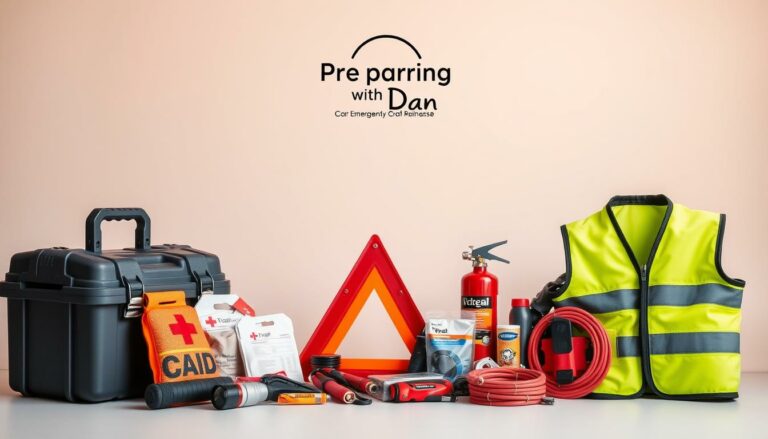
A car emergency kit is one base list — the seven items Ready.gov names — plus a climate layer that changes with your state: sand and a sleeping bag in Minnesota, a gallon of water per person and a sunshade in Arizona. The base list fits in a shoebox and costs under $60. The mistake most drivers make is buying a “130-piece” kit and never adding the layer that matches where they actually drive.
Two Ready.gov numbers frame the whole subject: six inches of moving water can stall a car or make it lose control, and a foot of water will float many cars. Most of what goes wrong on the road in an emergency is a decision problem (driving through water, leaving the car in a blizzard), not an equipment problem. The kit exists for the hours after the right decision, when you are stopped and waiting. Everything below comes from Ready.gov’s car safety and winter weather guidance and the American Red Cross.
The base list (every car, every state)
Ready.gov’s car kit, verbatim, is seven items:
- Jumper cables (or a lithium jump-starter, which also charges phones)
- Flares or a reflective triangle
- Ice scraper
- Car cell phone charger
- Blanket
- Map — paper, because the outage that strands you also takes the cell towers
- Cat litter or sand for tyre traction
To that, Ready.gov’s winter guidance adds a flashlight, warm clothes, bottled water and non-perishable snacks, and the Red Cross adds a first aid kit and boots. That is the complete base: about a dozen things, most of which you already own. Put them in one bag or box in the trunk, not loose, so they are still there in six months.
Two things that are not objects but belong on the list:
- Fuel. Ready.gov: keep your gas tank full in case of evacuation or power outages; a full tank also keeps the fuel line from freezing. Our working rule is never below half. Gas stations cannot pump without power.
- A mechanic’s check before the season — antifreeze, battery, brakes, exhaust, heater and defroster, lights, wipers and washer fluid, tyres. The kit is for when this list was skipped.
The climate layer: what to add depending on where you drive
Northern winter (Upper Midwest, Northeast, Mountain West, Alaska)
The scenario is being stranded in a snowstorm for hours, possibly overnight, with the engine off. Add:
- A cold-rated sleeping bag per regular passenger, not just a blanket. This is the item that decides whether an overnight is uncomfortable or dangerous.
- Hat, mittens and dry socks for each person — the Red Cross’s frostbite list is nose, ears, cheeks, chin, fingers and toes.
- A small shovel, and the sand or litter from the base list in a real quantity (a 10 lb bag).
- A bright cloth to tie to the antenna and a whistle.
- Extra washer fluid rated for sub-zero, and a tow strap.
- A hand-crank radio — the models we tested run the phone too.
The rules that matter more than the gear: stay with the car (it is shelter and it is visible; a person walking in a whiteout is neither), run the engine only about ten minutes an hour for heat, and clear the exhaust pipe of snow first — a blocked tailpipe fills the cabin with carbon monoxide. Crack a window on the downwind side while the engine runs. Ready.gov also says to disable cruise control on icy roads: if the wheels lose traction, cruise control accelerates to hold the speed and spins them faster.
Desert and hot South-West (Arizona, Nevada, inland California, Texas)
The scenario flips: the danger is heat and distance, and the car itself becomes an oven. Add:
- One gallon of water per person, and more on long desert routes — rotated every few months so it is not baked plastic-tasting when you need it.
- A reflective sunshade, a wide-brim hat, and a light long-sleeved shirt per person.
- Electrolyte packets and salty snacks rather than sweet ones.
- A tyre plug kit and a 12 V compressor: heat plus distance is where tyres fail, and a spare is one flat.
- Extra coolant and a gallon of plain water for the radiator.
The rule the National Weather Service repeats every summer: never leave a child in a vehicle, even with the windows down, even for a minute. And if the car dies in the desert, stay with it in the shade it makes, on the ground beside it, and signal — do not walk out in the afternoon.
Hurricane and flood country (Gulf Coast, Florida, Atlantic seaboard, river valleys)
The car is your evacuation tool, and the enemy is water on the road. Add:
- A seatbelt cutter and window breaker within reach of the driver’s seat — not in the trunk.
- A waterproof pouch with copies of documents (ID, insurance, registration) and some cash; ATMs and card readers go down with the power.
- Rain gear and a headlamp (both hands free).
- The go-bag from our evacuation checklist lives in the trunk during the season, not in the hall closet.
And the decision rule, from Ready.gov: do not drive through flooded areas. Six inches stalls the car; a foot floats it; and the road under the water may have washed out. If water is rising around a stopped car, abandon it and move to higher ground — the car is replaceable.
Wildfire regions (West, Pacific Northwest, Colorado Front Range)
- N95 masks for everyone in the car; smoke arrives before the fire.
- Goggles, a cotton (not synthetic) long-sleeved layer, and a wool blanket.
- The half-tank rule becomes a three-quarter-tank rule during Red Flag season.
- Paper maps with two routes out marked — the reason is in the base list.
City driving (any climate)
An urban breakdown is usually short and near help, so the city layer is small: a reflective vest so you can stand beside the car on a shoulder, a portable power bank (the car charger is useless if the car is dead), walking shoes if you commute in anything else, and a note of who to call besides 911. If you evacuate a city by car, the kit is the same as the flood layer above; our guide on leaving the city fast covers the timing.
Where the affiliate kits fit
Pre-assembled “car emergency kits” typically cover the base list — cables, triangle, a thin blanket, a small first aid pouch — and none of the climate layer. They are a reasonable way to get the base list into the trunk in one purchase; they are not the finished kit. We compared the equivalent pre-built bags for the home in our 72-hour kit review, and the same conclusion applies: buy the shell if it saves you from never starting, then add what your climate needs.
Twice a year
Clocks change, kit changes: swap the water, check the flashlight batteries and the jump-starter charge, move the sleeping bags in for winter and the water out for summer. A car kit that was assembled once and never opened is, five years later, a bag of dead batteries and warm plastic bottles — and it is the kit most people have.
Official sources & further reading
The base list and the driving rules in this article come from official emergency-preparedness guidance. Consult it directly for the authoritative version:

Dan Lockland is a preparedness instructor and survival skills educator with over 15 years of hands-on experience. He shares practical, no-nonsense guidance on emergency preparedness, self-reliance, and sustainable living at PreparingWithDan.com.