
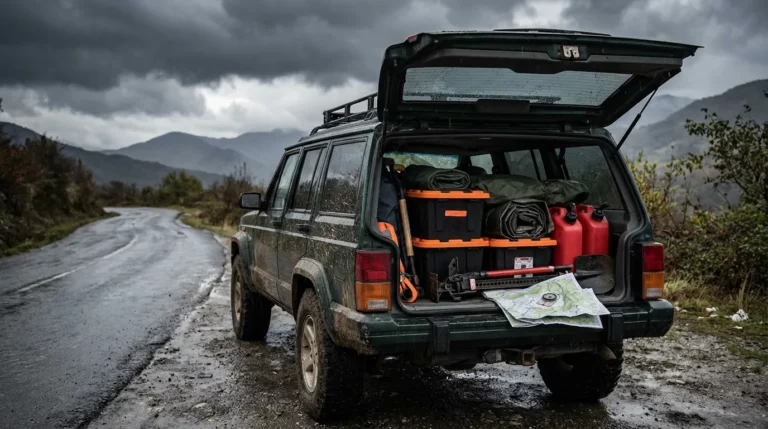
Your bug-out vehicle is the one piece of gear that carries everything else—your family, your supplies, and your evacuation options. A bad choice here limits every other prep you have done. The wrong vehicle breaks down at the worst moment, runs out of fuel before you reach safety, or cannot handle the road conditions your route requires. This guide cuts through the noise and gives you a practical framework for choosing, building, and maintaining a bug-out vehicle that actually works for a family of four.
The Five Criteria That Actually Matter
Forget the fantasy BOV—military-surplus trucks, armored SUVs, and off-road-only builds that cannot navigate a standard highway or fit into a gas station. A practical family bug-out vehicle needs to score well on five real criteria:
- Reliability: A vehicle that breaks down during an evacuation is worse than no vehicle. Parts availability, known failure points, and simplicity of repair trump exotic capability every time.
- Fuel range and efficiency: You need to reach your Tier 1 or Tier 2 location on one tank, plus carry reserve fuel. Anything under 18 MPG on the highway creates logistics problems during a mass evacuation when fuel stations are dry.
- Cargo and passenger capacity: A family of four with 72-hour bug-out bags, a week of food, water, and emergency gear needs real cargo space—not the back seat of a two-door vehicle.
- Off-road capability: You do not need a Baja racer. You need a vehicle that can handle a dirt road, a flooded underpass, or a rutted field without getting stuck.
- Repairability: Can you fix it on the road with basic tools? Is it a platform with millions of parts in circulation at any auto parts store in America? This matters more than any single performance spec.
Vehicle Type Comparison
| Type | Best For | Weaknesses | Family of 4 Rating |
|---|---|---|---|
| 4WD SUV | Best all-around: passengers + cargo + off-road | Lower fuel economy than cars | ★★★★★ |
| 4WD pickup truck | Maximum cargo, excellent off-road, towing | Cab limits passengers; open bed vulnerable to weather | ★★★★ |
| Large van / minivan | Maximum interior space, comfortable for family | Limited off-road, low ground clearance | ★★★ |
| Motorcycle / dual sport | Traffic bypass, fuel sipping, route flexibility | Cannot carry family or meaningful supplies | ★ (secondary vehicle only) |
| Sedan / passenger car | Fuel economy, highway speed, low profile | No off-road, limited cargo, low ground clearance | ★★ (only if it is all you have) |
Specific Vehicle Recommendations for a Family of Four
The ideal BOV platform for most families is a mid-size or full-size 4WD SUV with proven reliability, wide parts availability, and a real cargo area. Here are the platforms that consistently deliver:
Best Overall: Toyota 4Runner (2003–present)
The 4Runner is the benchmark family BOV. It has body-on-frame construction (repairable, durable), part-time 4WD with a low-range transfer case, a 90+ cubic foot cargo area with seats folded, and a proven powertrain that commonly runs 250,000–350,000 miles with proper maintenance. The 2003–2009 generation can be found for $12,000–$20,000. The 2010–2024 generation runs $25,000–$45,000 used. Its single weakness is 16–19 MPG highway—plan your range accordingly.
Best Truck: Toyota Tacoma (2005–present)
The Tacoma is the most reliable midsize truck ever built, with resale values that prove it. The Access Cab with a 6-foot bed fits a family of four and carries significant gear in the bed. Expect 20–22 MPG highway with the V6. The 2005–2015 generation runs $15,000–$22,000 used. Limitations: the open bed requires a hard tonneau cover (~$500) or a camper shell (~$1,500–$3,500) to secure supplies.
Best Budget Option: Ford F-150 (2004–2014)
No truck in history has more parts in circulation at more auto parts stores. A 2004–2014 F-150 with the 5.4L V8 can be found for $8,000–$14,000 and repaired anywhere in North America. The SuperCrew cab fits four adults comfortably with gear. The 5.4L V8 is not fuel efficient (14–17 MPG), but fuel range is manageable with 26-gallon tank and a pair of 5-gallon jerry cans.
Best for Large Families: Chevrolet Suburban / GMC Yukon XL
When you need to move four people plus two weeks of gear, nothing beats a Suburban. 131 cubic feet of cargo with seats folded, 4WD, a 26-gallon tank, and tow rating of 8,000+ lbs. The 2007–2014 generation runs $12,000–$20,000 used. Fuel economy (14–17 MPG) is the tradeoff. For families larger than four or households with significant equipment needs, it is worth it.
💡 Tip: Your best BOV is often the reliable vehicle you already own
The fantasy of building a perfect from-scratch BOV misses the point. A well-maintained Toyota Camry with a full tank, your bug-out bags loaded, and two mapped evacuation routes will outperform an elaborate BOV that has deferred maintenance. Start with what you have, maintain it religiously, and upgrade your vehicle platform when it makes financial sense—not as a project.
Essential Modifications (With Real Costs)
Most BOV modifications prepper forums recommend are overkill for a realistic family evacuation scenario. Focus on the seven that actually improve your odds:
| Modification | Purpose | Recommended Product | Cost |
|---|---|---|---|
| All-terrain tires | Handle mud, gravel, flooded roads without compromising highway driving | BF Goodrich KO2 (best all-around AT tire) | ~$200/tire, ~$800 set of 4 |
| Roof rack or cargo carrier | Adds 10–15 cubic feet of waterproof-container-ready cargo space | Yakima LoadWarrior or Thule Canyon XT | $300–$600 |
| Tow strap + recovery kit | Self-recovery and neighbor assistance when roads are blocked | ARB tow strap + D-shackles + Hi-Lift jack | ~$120–$200 |
| Portable jump starter | Start the vehicle independently with a dead battery—no second vehicle needed | NOCO Boost Plus GB40 | ~$100 |
| Jerry cans (auxiliary fuel) | Extend range by 50–100 miles when fuel stations are dry | 2× NATO 5-gallon metal jerry cans + holder | ~$60–$100 |
| Tire plug kit + 12V compressor | Fix a puncture without a spare in under 10 minutes | Slime 50107 kit + Viair 85P compressor | ~$50–$80 |
| GMRS mobile radio | Vehicle-to-vehicle communication when cell networks are congested | Midland MXT275 (15W GMRS mobile) | ~$120 |
What to Keep in Your BOV Permanently
The gear that stays in your vehicle year-round—not what you grab when things go wrong. Everything on this list should be in your vehicle right now:
✅ Permanent BOV Kit Checklist for a Family of 4
- Water: 16 bottles (1 case) in the trunk. Rotate every 6 months.
- Food: 12 granola bars or 4 Mountain House pouches. Rotate annually.
- First aid kit: Adventure Medical Kits Trauma Kit (~$50). Check annually.
- Jump starter: NOCO GB40 (~$100), charged and stored in glove box.
- Tire plug kit + 12V compressor: Treat a puncture on the road, not on a shoulder.
- Tow strap: ARB 8,000 lb rated tow strap (~$40). Stores flat in cargo area.
- Physical maps: State road atlas + laminated county map covering your evacuation routes. GPS fails. Maps do not.
- Flashlight: Streamlight ProTac HL (~$45) + spare AA batteries.
- Emergency mylar blankets: 4 SOL blankets (~$5 each). Weigh nothing.
- Cash: $200 minimum in small bills. ATMs fail in power outages.
- Copies of key documents: IDs, insurance cards, registration in a waterproof envelope.
- Multi-tool: Leatherman Wave+ (~$100). Lives in the glove box permanently.
Fuel Strategy for Evacuation
The most overlooked BOV vulnerability is fuel. During a mass evacuation—Hurricane Harvey, the LA fires, Superstorm Sandy—fuel stations within 50 miles of the disaster run dry within hours of the evacuation order. Your strategy:
- Never let the tank drop below half. Full-tank discipline means you have 200–300 miles of range the moment you decide to leave. Half-tank discipline gives you 100–150 miles. That difference determines whether you make Tier 2 on one fill or have to stop in the chaos zone.
- Carry auxiliary fuel. Two 5-gallon NATO jerry cans (~$60) mounted externally add 40–60 miles of reserve. Rotate the fuel every 6 months with a fuel stabilizer like Sta-Bil (~$10).
- Know your fuel type trade-offs:
| Fuel Type | Availability in Disaster | Efficiency | BOV Verdict |
|---|---|---|---|
| Gasoline | High—most stations carry it | Moderate | Best choice for most families |
| Diesel | High at truck stops and rural stations | 25–30% better than gas | Excellent for long-distance evacuation |
| Electric (EV) | Poor—charging infrastructure fails in grid-down events | High (when infrastructure works) | Poor primary BOV choice. Keep a gas vehicle as backup. |
⚠️ Warning: EVs as primary BOVs have a critical flaw
Electric vehicles fail as primary bug-out vehicles for one simple reason: their refueling infrastructure depends on a functioning power grid. In the exact scenarios that demand evacuation—major hurricanes, grid-down events, wildfires—charging stations are either offline or have lines stretching hours long. If an EV is your only vehicle, keep a full charge at all times and maintain a gas vehicle as a backup or alternate plan.
Maintenance: The BOV That Does Not Run Is Worthless
A $50,000 perfectly modified bug-out vehicle with deferred maintenance is worse than a $12,000 reliable vehicle that is always ready. Your BOV maintenance schedule:
- Monthly: Check tire pressure (including spare), fuel level, check and top off oil, visually inspect for fluid leaks
- Every 5,000 miles: Oil and filter change, tire rotation
- Every 15,000 miles: Inspect brake pads and rotors, check coolant level and condition, check transmission fluid, inspect belts and hoses
- Every 30,000 miles: Replace air filter (~$20), replace spark plugs if gasoline engine (~$40–$80), inspect 4WD system
- Annually (regardless of mileage): Test battery load capacity (most auto parts stores do this free), inspect tires for wear and sidewall cracks, verify all emergency kit items are present and in date
Common Mistakes in Bug-Out Vehicle Planning
1. Choosing the “coolest” vehicle over the most reliable one. A lifted, custom-painted off-road build is a project vehicle, not a bug-out vehicle, if it spends more time in the shop than in your driveway. The Toyota 4Runner your neighbor has driven 200,000 miles without a major repair will save your family more reliably than an exotic rig.
2. Never letting the tank get below a quarter. Half-tank discipline is survivable. Quarter-tank discipline leaves you vulnerable. During Hurricane Harvey, gas stations within 100 miles of Houston ran dry within 12 hours of the evacuation order. Families with full tanks made it out easily. Families starting with a quarter tank were making desperate decisions on the side of the highway.
3. No physical maps in the vehicle. GPS depends on cell network or satellite connectivity, both of which degrade during mass evacuations. A state road atlas ($8 at any gas station) and a laminated county map covering your two evacuation routes cost less than a tank of gas and work when nothing else does.
4. Bug-out bags that live in the house, not the vehicle. If your bags are in the house and you have to leave from work or your kids’ school, you leave without them. Either keep duplicate go-bags in the vehicle permanently or have a confirmed plan for how the bags get to the vehicle in under 5 minutes.
5. Only one evacuation route planned. Routes close. Bridges flood. Accidents stop traffic for hours during mass evacuations. Plan two routes that do not share the same chokepoints, drive both in advance, and know which triggers switching from Route A to Route B.
6. No maintenance on the BOV until it breaks. Your bug-out vehicle’s reliability is entirely determined by how you treat it on normal days. Deferred oil changes, ignored warning lights, and worn tires do not get fixed during an evacuation. They fail during one.
FAQ
What is the best used truck to buy as a bug-out vehicle for under $20,000?
The 2005–2015 Toyota Tacoma is the top recommendation at that price point. Parts are available everywhere, the V6 4WD version handles off-road conditions confidently, and resale value remains strong (which also tells you something about quality). The 2003–2009 Toyota 4Runner is the best SUV pick under $20,000 for a family that needs passenger capacity over bed space.
Should my bug-out vehicle be diesel or gasoline?
For most families, gasoline is the practical choice because it is available at more stations including small-town and rural locations. Diesel is excellent for long-range evacuations (better fuel economy, more torque) and is reliably available at truck stops on any major highway. If you are choosing between two otherwise equal vehicles, the diesel version of a truck or SUV is a slight edge for extended emergency use. Avoid electric as your primary BOV.
Do I need a 4WD vehicle or is AWD sufficient?
AWD is better than 2WD and sufficient for most evacuation scenarios involving wet roads, light snow, or mild off-road. True part-time 4WD with a low-range transfer case (what you find on the 4Runner, Tacoma, and Wrangler) is better if your evacuation routes might involve significant off-road travel, deep mud, or steep terrain. If your evacuation is primarily highway-based, AWD is adequate and typically offers better fuel economy.
How much should I spend on a bug-out vehicle?
Do not overspend on the vehicle at the expense of supplies. A $12,000 reliable used 4Runner with a fully stocked permanent kit, good tires, and a full fuel tank is more effective than a $45,000 modified Bronco with deferred maintenance and nothing in it. Budget the vehicle as one component of your total preparedness spend, not the centerpiece. Most families with a $15,000–$25,000 used truck or SUV budget have everything they need to execute a reliable family evacuation.
What if I live in a city and only own a sedan?
Work with what you have. A well-maintained sedan with full tank, a bug-out bag in the trunk, physical maps, and two planned routes will outperform most elaborate BOV setups with poor planning. Add a roof-mounted cargo box (Thule Pulse ~$350) to expand cargo capacity. Keep the tank above half always. If a larger vehicle is a future priority, save toward the Toyota platforms mentioned above and make the transition when it is financially sound.
The best bug-out vehicle for your family is the most reliable vehicle you can afford to keep well-maintained and permanently ready—full of fuel, stocked with your kit, and with two routes already planned and driven. Reliability beats capability every time. A simple vehicle that starts reliably, has parts available in any town, and carries your family to your pre-planned location wins over any specialized rig that requires a specialist to repair.

Dan Lockland is a preparedness instructor and survival skills educator with over 15 years of hands-on experience. He shares practical, no-nonsense guidance on emergency preparedness, self-reliance, and sustainable living at PreparingWithDan.com.