
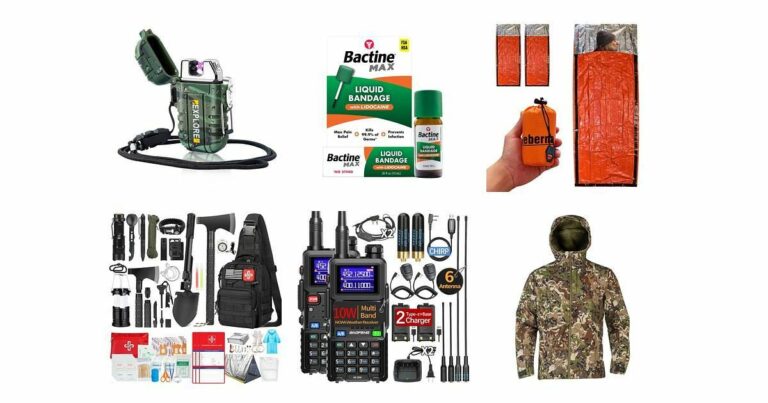
Cold kills faster than almost any other environmental threat. A healthy adult can develop hypothermia in 30 minutes in wet 40°F conditions — long before any typical emergency is resolved. This list covers the 29 items that address winter’s specific threats: heat loss, water scarcity (frozen sources), fire difficulty (wet tinder), navigation challenges (reduced daylight), and the extra caloric demand of staying warm. Everything is organized by category with specific product picks and prices.
All 29 Items at a Glance
| # | Item | Category | Cost |
|---|---|---|---|
| 1 | Merino wool base layer (top + bottom) | Warmth | $60–$120 |
| 2 | Insulation mid-layer (puffy or fleece) | Warmth | $60–$150 |
| 3 | Wool hat + balaclava | Warmth | $15–$35 |
| 4 | Waterproof insulated gloves | Warmth | $30–$80 |
| 5 | Wool socks (3 pairs minimum) | Warmth | $20–$60 |
| 6 | Insulated waterproof boots | Warmth | $100–$250 |
| 7 | Hand/foot warmers (HotHands, 40-pack) | Warmth | $20–$30 |
| 8 | Emergency mylar bivy (SOL Emergency Bivvy) | Shelter | $20–$30 |
| 9 | Emergency mylar blankets (4-pack) | Shelter | $8–$15 |
| 10 | Wool blanket (Arcturus Military) | Shelter | $40–$70 |
| 11 | Sleeping bag liner (fleece or silk) | Shelter | $25–$60 |
| 12 | BIC lighters (pack of 3) | Fire | $5–$8 |
| 13 | Ferro rod (Bayite 4″) | Fire | $8–$15 |
| 14 | Fire starter cubes or fatwood sticks | Fire | $8–$15 |
| 15 | Stainless insulated water bottle (32 oz) | Water | $20–$40 |
| 16 | Water filter (Sawyer Squeeze) | Water | $30–$40 |
| 17 | Water purification tablets (Aquatabs, 50-pack) | Water | $6–$10 |
| 18 | Compact camp stove + fuel canisters | Food/Water | $35–$80 |
| 19 | Emergency food bars, 3,600 cal (Datrex or SOS) | Food | $10–$15 |
| 20 | Headlamp + spare batteries (Petzl Tactikka) | Light | $25–$45 |
| 21 | Chemical glow sticks (Cyalume, 12-pack) | Light | $15–$25 |
| 22 | NOAA hand-crank weather radio (RunningSnail) | Communication | $25–$35 |
| 23 | FRS walkie-talkies, pair (Midland T71VP3) | Communication | $55–$80 |
| 24 | Emergency whistle (Fox 40 Classic) | Communication | $5–$8 |
| 25 | Compass + local paper maps (laminated) | Navigation | $10–$25 |
| 26 | Multi-tool (Leatherman Wave+) | Tools | $80–$110 |
| 27 | Fixed blade knife (Mora Companion) | Tools | $15–$20 |
| 28 | Folding camp shovel (RHINO USA) | Tools | $30–$50 |
| 29 | Trauma first aid kit (IFAK with tourniquet) | Medical | $50–$100 |
Warmth: Items 1–7
Clothing is your primary survival system in winter. A $10 emergency blanket can’t replace a proper layering system — it’s a last resort when layering has failed. Build the foundation first.
1. Merino Wool Base Layer
Merino wool is the best base layer material for cold weather survival because it insulates even when wet (unlike cotton, which kills), resists odor, regulates temperature across a wide range, and dries faster than most synthetics. A merino base layer top + bottom (190–230 g/m² weight) forms the foundation of every cold weather layering system.
What to buy: Minus33 Ridgeline (budget, $50–$80/piece), Smartwool Classic 250 (mid-tier, $80–$100/piece), Icebreaker 200 Oasis (premium, $100–$130/piece). For a family of 4, buy one set per person and store them with go bags.
2. Insulation Mid-Layer (Puffy or Fleece)
The insulation layer traps heat between your body and the elements. For winter survival, synthetic insulation (PrimaLoft, Coreloft) outperforms down because it retains insulating value when wet. Fleece is lighter and less packable but more durable long-term.
What to buy: Mountain Hardwear Ghost Whisperer (ultralight down, $280, for go bags where weight matters), Columbia Steens Mountain Fleece (budget fleece, $40–$60), or any 100-weight fleece jacket that packs small.
3. Wool Hat + Balaclava
You lose 7–10% of body heat through your head — less than the old myth of 40–50% but still significant relative to surface area. A wool beanie weighing 2 oz can dramatically slow heat loss. A balaclava adds face and neck coverage for -10°F and below conditions.
What to buy: Minus33 100% Merino Wool Beanie ($20–$35), Turtle Fur Comfort Shell Ninja Balaclava ($25–$35). Keep one set per go bag in a resealable bag.
4. Waterproof Insulated Gloves
This is the most critical extremity item. Cold hands lose dexterity rapidly — at 50°F internal temperature, fine motor control degrades significantly. You need gloves that are waterproof (not just water-resistant) and insulated to at least -10°F for serious winter scenarios. Budget option: Black Diamond Mercury Mitts ($60). Premium: Hestra Army Leather GORE-TEX ($175).
Also carry a pair of thin liner gloves ($10–$15) — they let you operate phones, lighters, and buckles while keeping your hands functional, then the outer mitts go back on.
5. Wool Socks (3 Pairs Minimum)
Wet feet kill. A cotton sock that gets wet becomes an ice pack. Wool socks insulate even saturated. Darn Tough Vermont socks ($22–$28/pair) come with a lifetime guarantee — the single best sock investment for winter preparedness. Carry 3 pairs minimum: one on, one drying, one in reserve.
6. Insulated Waterproof Boots
800g of Thinsulate insulation is the standard for -30°F work environments. For general winter emergency use, 400–600g handles most scenarios down to -20°F. The key spec to look for: waterproofing rated to 6″+ of water exposure. Baffin Impact (-94°F rated, $130–$160) for extreme cold. LaCrosse Alphaburly Pro ($180–$220) for wet/muddy conditions. Kamik Nation ($70–$90) for budget family-of-4 builds.
7. Hand/Foot Warmers
HotHands hand warmers ($20–$30 for 40-pack) activate on contact with air, provide 10+ hours of heat at up to 135°F, and weigh essentially nothing. They’re backup warmth for extremities, emergency heat sources for warming a cold injury, and morale items for children in a difficult situation. Store 10–20 pairs per adult in a go bag. They have a 3–5 year shelf life sealed.
Foot warmers (HotHands Toe Warmers, $25 for 30-pack) are adhesive and designed for the sole of the foot — different product, same principle.
Shelter: Items 8–11
8. Emergency Mylar Bivy (SOL Emergency Bivvy)
The SOL Emergency Bivvy ($20–$30, 3.8 oz) is a full-body bag that reflects 90% of your body heat. It’s reusable (unlike single-use mylar blankets), large enough for a sleeping bag inside it, and includes a hood. For a go bag, this replaces a sleeping bag in 72-hour scenarios. In winter, it’s the difference between surviving an overnight exposure scenario and not.
9. Emergency Mylar Blankets (4-Pack)
At $8–$15 for a 4-pack, mylar blankets are one of the highest-value emergency items per dollar. Each weighs 1–2 oz and folds to credit card size. Uses: wrap around a person with hypothermia, line the inside of a shelter to retain heat, signal (the reflective surface is visible from aircraft), and as a ground barrier. Put 2 in each adult go bag.
10. Wool Blanket (Arcturus Military Wool Blanket)
The Arcturus Heavy Military Wool Blanket ($40–$70, 80% wool) is the best value cold-weather blanket for home emergency use. Wool retains 80% of insulating value when wet, doesn’t melt if exposed to sparks, and lasts decades with minimal care. Too heavy for a go bag (4.5 lbs) but ideal for a home emergency kit, car kit, or bug-in scenario.
11. Sleeping Bag Liner
A fleece or silk sleeping bag liner ($25–$60, 10–15 oz) adds 8–15°F of effective temperature rating to any sleeping bag — or functions as a standalone sleeping bag above 50°F. Valuable as a go bag shelter item because it’s lighter than a full bag and versatile across temperature ranges. Cocoon TravelSheet ($65) or Sea to Summit Reactor Liner ($50) are the reliable options.
Fire: Items 12–14
Fire in winter serves four survival functions: warmth, water purification (melt snow), cooking, and morale. The challenge: wet tinder, wind, and numb fingers make fire-starting harder than in other seasons. Redundancy in fire-starting is especially critical in winter.
12. BIC Lighters (3-Pack)
BIC lighters are the most reliable fire-starting tool in most conditions — full stop. At $5–$8 for 3-pack, they’re essentially free. Store one in each go bag and one in a shirt pocket (body heat prevents freezing). Pre-test them after cold storage — at -10°F, cold butane may need a minute of hand-warming before igniting. Carry 2 per adult minimum.
13. Ferro Rod (Bayite 4″)
The Bayite 4″ ferro rod ($8–$12) throws a shower of 5,400°F sparks with the scraper. It works when a lighter fails in wet or extremely cold conditions, and lasts for thousands of strikes. This is your backup fire source when the BIC fails. Practice with it before you need it — the technique (scraping at a steep angle, not flicking) takes 10 minutes to learn but is hard to do incorrectly under stress without practice.
14. Fire Starter Cubes or Fatwood
Wet tinder is the winter fire-starting killer. Coghlan’s fire starter cubes ($8, 24 cubes) burn at 1,300°F for 8–10 minutes on a single cube regardless of wind or moisture — long enough to light wet wood. Fatwood (resin-saturated heartwood, $10–$15 per bag) catches from a spark and burns long enough to dry out larger fuel. Store 6–12 cubes per adult bag.
Water: Items 15–17
Winter creates two unique water challenges: sources may be frozen (requiring heat to access), and filters can freeze and crack (making them non-functional). Both require planning.
15. Stainless Steel Insulated Water Bottle (32 oz)
In winter, a plastic water bottle is a liability — it can freeze solid overnight and crack. A double-wall stainless steel bottle (Nalgene, Klean Kanteen, or HydroFlask) keeps water liquid down to -10°F in your pack and can be used directly over a fire to melt snow. 32 oz is the right size — large enough to matter, small enough to keep in an inner pack pocket near your body.
16. Water Filter (Sawyer Squeeze)
Winter warning: Hollow-fiber filters (Sawyer, LifeStraw, Katadyn BeFree) will fail permanently if allowed to freeze with water in the membrane. In winter, the filter must be stored in a warm location (inner jacket pocket, sleeping bag) and dried completely before temperatures drop below 32°F. The Sawyer Squeeze ($30–$40) is still the best value filter; just manage it properly in cold.
Alternative for winter: Aquatabs or iodine tablets don’t freeze and have no mechanical parts to fail. Carry both.
17. Water Purification Tablets (Aquatabs, 50-Pack)
Aquatabs ($6–$10 for 50 tablets) purify 1 liter per tablet in 30 minutes. They work at any temperature without the freezing risk of a filter. One 50-pack treats 50 liters — more than enough for a 72-hour emergency for a family of 4. Keep a pack in every bag and every car kit. They have a 5-year shelf life sealed.
Food and Cooking: Items 18–19
18. Compact Camp Stove + Fuel
In winter, a stove is more critical than in other seasons because you need it to melt snow for water and to prepare hot food — both survival necessities, not luxuries. The MSR PocketRocket 2 ($45, 2.6 oz) is the benchmark ultralight backpacking stove. Pair with 110g isobutane canisters (4 per bag for 72-hour use). Cold weather note: isobutane canisters lose pressure below 20°F — warm them in your armpit before use, or switch to white gas (MSR WhisperLite) for below-zero conditions.
19. Emergency Food Bars (3,600 Calorie)
In cold weather, caloric demand increases by 25–50% as your body works to maintain core temperature. Datrex 3,600 cal emergency food bars ($10–$15 each) provide 18 400-calorie portions per pack, are Coast Guard approved, and have a 5-year shelf life. One bar per person covers 72 hours at survival-level calories in cold weather. They’re not palatable — they’re functional. Keep 2 per adult bag for caloric buffer.
Light: Items 20–21
20. Headlamp + Spare Batteries (Petzl Tactikka)
Winter nights are long. In northern latitudes, December sunset comes before 5 p.m. A headlamp isn’t convenience gear — it’s safety gear. The Petzl Tactikka ($30–$45, 3 oz) uses AAA batteries, runs 150+ hours on standard mode, and has a red light mode that preserves night vision. Cold degrades battery performance significantly — alkaline batteries lose 40–50% capacity at 0°F. Lithium batteries (Energizer Ultimate Lithium) maintain performance to -40°F. Use lithium in winter; keep extras warm in an inner pocket.
21. Chemical Glow Sticks (Cyalume, 12-Pack)
Cyalume light sticks ($15–$25 for 12-pack, 12-hour duration) serve triple duty in winter: emergency lighting that requires no batteries and works when fingers are too cold to operate a headlamp switch, distress signaling (highly visible to rescuers at night), and marking a trail or camp perimeter. Store 4–6 per adult bag. The 5-year shelf life is maintained by cold storage — winter conditions are actually ideal for extending their usable life.
Communication: Items 22–24
22. NOAA Hand-Crank Weather Radio
The RunningSnail MD-090P ($25–$35) receives NOAA weather broadcasts that provide winter storm warnings, road closures, emergency instructions, and shelter locations. Critical: it operates without batteries (hand crank) or with rechargeable internal battery. In a winter storm where power is out and cell networks are down, this is your only reliable source of official information about whether conditions are improving or worsening.
23. FRS Walkie-Talkies (Midland T71VP3)
Cell towers fail in ice storms, blizzards, and power outages. Family-band walkie-talkies work without any infrastructure. The Midland T71VP3 ($55–$80/pair) covers 2+ miles in open terrain, includes 36 GMRS channels, and takes AA batteries (which keep performance in cold better than lithium-ion). Keep one per adult. Cold battery note: carry in an inner jacket pocket when not in use.
24. Emergency Whistle (Fox 40 Classic)
The Fox 40 Classic ($5–$8) is the loudest pealess whistle available — audible at 100+ meters even in high wind. In a winter emergency (vehicle off road, person down, separated family), three short blasts is the universal distress signal. It requires zero manual dexterity and works when hands are too cold to operate anything else. Clip to every go bag zipper and every kid’s jacket.
Navigation: Item 25
25. Compass + Local Paper Maps
GPS fails when batteries die in cold. Cell GPS fails when there’s no signal. A baseplate compass (Silva Ranger 2.0, $35; or Suunto A-10, $15 budget option) and laminated paper maps of your area are your navigation backup in any scenario where digital navigation fails. Take 30 minutes to learn how to shoot a bearing and follow it — this is a learnable skill in an afternoon. Store maps in a waterproof map case ($8–$15).
Tools: Items 26–28
26. Multi-Tool (Leatherman Wave+)
The Leatherman Wave+ ($80–$110) covers 18 functions including pliers, wire cutters, saw, scissors, and knife in one package that weighs 8.5 oz. In winter, the pliers are invaluable for working with frozen buckles, tent stakes in frozen ground, and gear repairs with numb hands. All four main tools (both knife blades, saw, file) deploy from outside the closed tool — accessible with gloves or in limited visibility. See our full multi-tool guide for all options.
27. Fixed Blade Knife (Mora Companion)
The Mora Companion ($15–$20, 4.1 oz) is the best-value fixed blade available. High carbon steel holds an edge well and is easy to sharpen in the field; stainless version available for wet/saltwater environments. In winter, a fixed blade is more reliable than a folder — no locking mechanism to freeze or fail, and full-tang construction withstands the leverage needed to baton wood in a survival fire situation.
28. Folding Camp Shovel (RHINO USA)
The RHINO USA folding shovel ($30–$50, 2.4 lbs) is a winter-specific item: clearing snow from a vehicle, digging a snow shelter for emergency warmth, accessing buried gear, and creating a fire pit in deep snow. In any scenario involving vehicle recovery in winter, this is essential. The 18″ folding design stores in a pack or truck cab. For vehicle kits: also add a bag of traction sand ($10) and traction boards ($80–$150) if you’re in heavy snow country.
Medical: Item 29
29. Trauma First Aid Kit (IFAK)
Winter brings elevated injury risk: falls on ice, frostbite, hypothermia, and chainsaw/axe injuries from wood-cutting. A compact IFAK (Individual First Aid Kit) with QuikClot hemostatic gauze ($15–$25), Israeli bandage ($8–$12), CAT tourniquet ($28–$35), nitrile gloves, and basic supplies in a molle-compatible pouch covers the injuries that kill quickly. The North American Rescue IFAK ($70–$100) is the standard kit used by military and first responders.
Winter-specific additions: Chemical heat packs specifically designed for rewarming (not standard hand warmers — ReWarm packs are medical-grade, $25 for 4-pack), and a hypothermia thermometer ($15–$25, reads below 94°F where standard thermometers bottom out).
Winter Gear for a Family of 4: Total Budget
| Category | Items | Budget (×4 where personal) |
|---|---|---|
| Warmth (clothing) | Base layer, mid-layer, hat, gloves, socks, boots | $400–$1,000 (varies most by quality) |
| Warmth (consumable) | Hand/foot warmers | $40–$60 |
| Shelter | Bivy × 2, mylar blankets, wool blanket, liners | $120–$200 |
| Fire | Lighters, ferro rod, fire starters | $25–$40 |
| Water | Bottles × 4, filter × 2, tablets | $100–$150 |
| Food/cooking | Stove, fuel, food bars × 4 | $80–$130 |
| Light/communication/navigation | Headlamps × 4, glow sticks, radio, walkie-talkies, whistles × 4, compass + maps | $200–$300 |
| Tools | Multi-tool, knife, shovel | $130–$180 |
| Medical | IFAK + winter medical additions | $100–$150 |
| Total | $1,200–$2,200 (clothing drives the range) |
Common Mistakes in Winter Survival Gear
- Cotton clothing in any layer. The “cotton kills” rule is real in winter: wet cotton loses all insulating value and accelerates heat loss. Denim jeans, cotton hoodies, and cotton t-shirts are the most common items found on hypothermia victims. Every layer touching your skin must be wool or synthetic.
- Relying on a single fire-starting method. BIC lighters fail in extremely cold conditions. Ferro rods require dry tinder. Matches get wet. In winter, carry all three — lighter as primary, ferro rod as secondary, waterproof matches as tertiary. Fire-starting redundancy is highest-priority in winter.
- Not keeping batteries and devices warm. Cold kills batteries. Lithium batteries at 0°F perform at 60% capacity; alkaline at 0°F perform at 20%. Store phones, headlamps, and walkie-talkies in inner pockets or sleeping bags overnight. Use lithium batteries in all critical devices in winter.
- Overlooking the car kit. Most winter emergencies happen in vehicles: getting stuck, sliding off the road, or being stranded in a storm. A car winter kit (wool blanket, shovel, traction sand, jumper cables, hand warmers, 24 hours of food/water) prevents most vehicle emergencies from becoming survival scenarios. Keep one in every vehicle from November through March.
- Skipping the boots. Of all the warmth items on this list, insulated waterproof boots are the one most commonly skipped by people who think their regular shoes will be fine. They won’t. Wet, cold feet can develop trench foot or frostbite in hours. Good boots ($100–$200) are a one-time investment that lasts a decade.
Frequently Asked Questions
What’s the most important winter survival item?
Proper layering clothing — specifically the merino wool base layer and waterproof insulated gloves. Gear can compensate for many deficiencies, but no amount of emergency blankets or fire-starting equipment overcomes the heat loss that happens when you’re wearing cotton in wet cold. Clothing is your primary thermal protection; everything else is secondary support.
How cold does it need to be for winter survival gear to matter?
Below 50°F wet or below 40°F dry is when hypothermia risk becomes real without proper clothing. At 32°F with wind and precipitation, an unprepared adult can develop mild hypothermia in 2–4 hours. Below 20°F, gear failures (frozen filters, dead batteries, lighter failure) happen reliably enough that redundancy becomes non-optional.
Can I use regular hand warmers to treat frostbite?
No — HotHands reach 135°F and can cause burns on frostbitten skin that has impaired sensation. Medical rewarming uses warm water at 104–108°F (lukewarm, not hot) and controlled exposure. Use hand warmers for maintaining warmth in gloves and boots; use proper rewarming protocol for actual frostbite. Never rub frostbitten tissue — it causes ice crystal damage in the cells.
How do I prevent my water filter from freezing?
Store it in your sleeping bag or an inner jacket pocket overnight. After using it, blow through the filter end to expel residual water before temperatures drop. If you’re unsure whether it froze, the squeeze test: if water doesn’t flow through at normal resistance, the membrane is likely compromised. Carry tablets as backup and treat any filter exposed to freezing temperatures as suspect until you can verify it in warm conditions.
What should be in a winter car emergency kit specifically?
Beyond the standard go-bag items: a wool blanket or sleeping bag rated to 0°F, folding shovel, bag of traction sand or cat litter, jumper cables (or jump starter battery pack), road flares or LED triangles, 24-hour food and water supply, ice scraper, and a phone charger cable for the car. The goal is surviving a multi-hour wait for assistance in below-freezing temperatures without leaving the vehicle.
Bottom Line
Winter survival is a gear problem more than any other season — clothing, fire, and water management are all substantially harder in cold, and the margin for error is smaller. The 29 items on this list, prioritized from most to least critical, give a family of 4 a comprehensive winter emergency capability for $1,200–$2,200 depending on clothing quality choices. Start with clothing (base layer + gloves + boots), then shelter (bivy + mylar blankets), then fire redundancy (lighters + ferro rod + starter cubes), then water (insulated bottle + filter + tablets). The survival math in winter is straightforward: stay dry, stay warm, maintain fire capability, and communicate. Everything on this list supports one of those four objectives. For the full emergency kit context these items fit into, see our ultimate emergency survival checklist.

Dan Lockland is a preparedness instructor and survival skills educator with over 15 years of hands-on experience. He shares practical, no-nonsense guidance on emergency preparedness, self-reliance, and sustainable living at PreparingWithDan.com.