
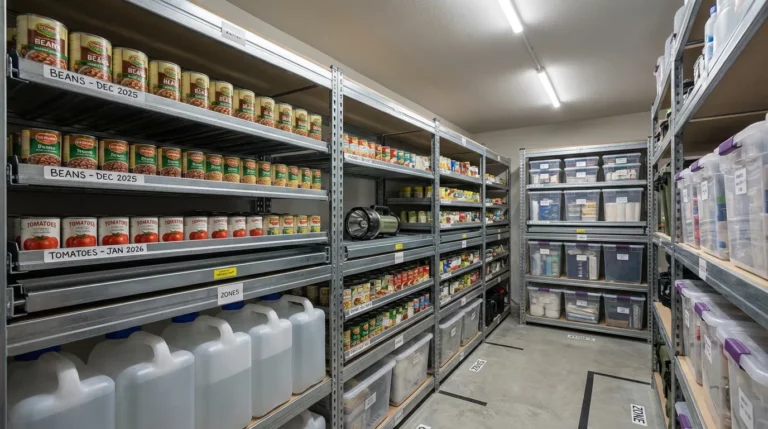
Stockpiling food and supplies isn’t about filling a basement with MREs and hoping for the best. It’s a deliberate, budget-friendly process that builds your emergency reserves over time without disrupting your finances or your available space. These six principles will help you stockpile smarter, whether you’re starting from scratch or expanding an existing prepper pantry.
1. Plan Before You Buy
The most common stockpiling mistake is buying without a plan. You end up with 40 cans of green beans, no protein, and no way to cook any of it. Before you spend a dollar, answer three questions:
- How many people are you feeding? Count every family member, including pets. An adult needs roughly 2,000 calories per day; a large dog needs about 1,000.
- What’s your target timeline? 72 hours is the FEMA minimum. 30 days is the practical sweet spot for most families. 90 days provides serious cushion.
- What does your family actually eat? Stockpiling food nobody in your house will eat is a waste of money. If your kids won’t eat lentils during normal life, they won’t eat them during a crisis either.
Write a master list organized by category: grains, proteins, fats, canned vegetables, canned fruits, water, cooking fuel, hygiene supplies, and first aid. This list becomes your shopping guide — every grocery trip, you buy 2-3 items from the list in addition to your normal groceries.
2. Build Gradually — $20 Per Week
The worst way to stockpile is to dump $500 at Costco in a panic. You’ll overspend, buy the wrong things, and miss sales on items you actually need. Instead, add $15-25 of extra supplies to each grocery trip. At $20/week, you’ll have a solid 30-day food supply within 3 months.
The steady approach also lets you take advantage of sales cycles. Canned goods go on sale every 6-8 weeks at most grocery stores. When tuna hits $0.75/can instead of $1.50, buy 20 cans. When rice drops to $0.50/lb in bulk, grab a 25-lb bag. Over 12 weeks of targeted sale buying, you’ll spend 30-40% less than someone who buys everything at full price in one trip.
3. Prioritize Calorie-Dense, Long-Shelf-Life Foods
Not all food stockpiles equally. Your core supplies should be items that deliver the most calories per dollar and per pound, while lasting the longest in storage:
- White rice — 1,650 cal/lb, stores 25+ years sealed, costs $0.50-0.80/lb in bulk
- Dried beans and lentils — 1,550 cal/lb, stores 25+ years, costs $0.80-1.50/lb
- Peanut butter — 2,650 cal/lb, stores 1-2 years, costs $0.15-0.25/100 cal
- Cooking oil — 4,000 cal/lb, stores 1-2 years (coconut oil lasts longer)
- Honey — 1,380 cal/lb, stores indefinitely, doubles as a wound treatment
- Oats — 1,750 cal/lb, stores 25+ years sealed, versatile for meals and baking
These six items alone can sustain an adult for months. Everything else — canned meats, vegetables, fruits, spices — adds variety and nutrition on top of this calorie base.
4. Rotate Everything (FIFO)
First In, First Out. This is the principle that separates a functional stockpile from a pile of expired food in your garage. Every item you stockpile should be something your family eats regularly. When you buy new cans, put them in the back and pull from the front. Use the oldest items in your normal cooking. Replace what you use on your next shopping trip.
Mark every item with its purchase date using a Sharpie. Do a quarterly check — anything within 3 months of expiration moves into your kitchen for immediate use. A properly rotated stockpile never has waste because you eat everything before it expires.
5. Don’t Forget Non-Food Essentials
Food gets all the attention, but a real emergency stockpile covers the basics of daily life beyond eating:
- Water — 1 gallon per person per day. This is the #1 item people under-stockpile. Consider a water filter as backup.
- Medications — 30-90 day supply of any prescription medications, plus OTC pain relievers, anti-diarrheal, antihistamines, and antibacterial ointment
- Hygiene — Toilet paper (1 roll per person per week), soap, toothpaste, feminine products, hand sanitizer, trash bags
- Cooking fuel — Propane canisters, butane fuel, or alcohol for a DIY stove
- Lighting — LED lanterns, batteries, candles, matches/lighters
- Communication — Hand-crank radio, batteries, charging cables
6. Store Smart — Protect Your Investment
All the stockpiling in the world is worthless if your food is stored in a hot garage, a damp basement, or in packaging that lets pests in. Three rules:
- Cool and dry: 50-70°F is the sweet spot. Every 10°F above 70°F roughly halves shelf life. A climate-controlled closet beats an uninsulated garage.
- Sealed containers: Transfer bulk dry goods (rice, beans, flour) into Mylar bags with oxygen absorbers, then into food-grade 5-gallon buckets. This protects against moisture, oxygen, and rodents.
- Off the floor: Moisture wicks through concrete. Use wire shelving, pallets, or plastic bins — never store directly on a concrete or dirt floor.
A $200 wire shelving unit from a hardware store, combined with $30 worth of Mylar bags and oxygen absorbers, will protect a $500+ food investment for decades. It’s the cheapest insurance you’ll buy.
Bottom Line
Smart stockpiling is simple: plan your list, buy gradually on sale, prioritize calorie-dense long-shelf foods, rotate everything, cover non-food essentials, and store properly. Do this consistently for 12 weeks and you’ll have a 30-day supply that costs less than most people’s monthly entertainment budget. For a detailed food list and quantities, see our full prepper pantry guide.

Dan Lockland is a preparedness instructor and survival skills educator with over 15 years of hands-on experience. He shares practical, no-nonsense guidance on emergency preparedness, self-reliance, and sustainable living at PreparingWithDan.com.