
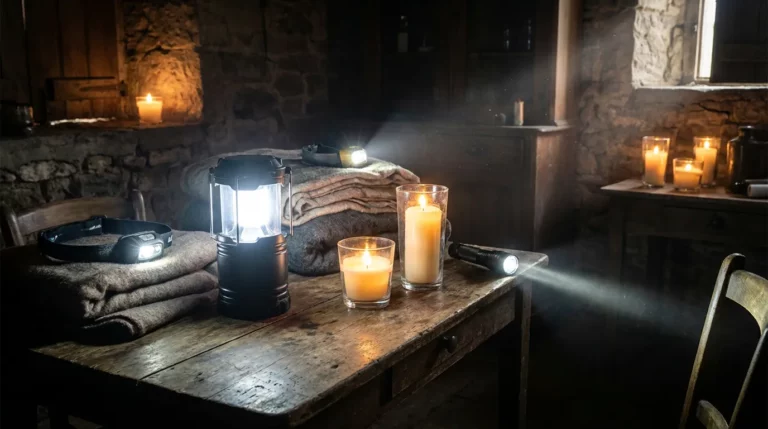
The first night of a power outage is manageable — you find your phone flashlight and figure it out. The third night is a different story. Your phone is at 12%, the kids can’t sleep, someone trips on the stairs, and you realize you have one dying flashlight for a family of four and no plan.
Emergency lighting isn’t glamorous, but it’s one of the easiest preps to get right. A few targeted purchases and a simple room-by-room plan gives your family safe, comfortable light for weeks — at a cost that fits any budget.
Here’s exactly what to buy and how to set it up.
The Four-Layer Emergency Lighting System
Don’t build your lighting strategy around one category. Each type serves a different need, and they work together:
| Layer | Type | Primary Use | Coverage Duration |
|---|---|---|---|
| 1 — Personal carry | Flashlight / headlamp | Navigation, task work, outside movement | As long as batteries last |
| 2 — Area lighting | Battery lantern | Room illumination, family gathering spaces | 50–200+ hours per set |
| 3 — Long-duration ambient | Solar lantern / solar string lights | Passive room light, recharges daily | Indefinite with sun access |
| 4 — Emergency backup | Candles / fuel lantern | Last resort when batteries fail | Weeks to months of fuel storage |
Flashlights and Headlamps: Personal Carry
Best Headlamps for Preppers
A headlamp beats a handheld flashlight for most emergency tasks. For a family of 4, buy 4 headlamps and keep them in a dedicated drawer everyone knows about.
- Black Diamond Spot 400 (~$40): 400 lumens max, red night-vision mode, IPX8 waterproof. Best all-around headlamp. The red mode is important — it preserves night vision and doesn’t wake sleeping kids.
- Petzl Tikkina (~$20): 300 lumens, simple 1-button operation. Good for kids and as backups. Easy enough for a 6-year-old to use without help.
- Fenix HM65R (~$70): 1,400 lumens, USB-C rechargeable. For the primary adult who’s doing most of the navigating and task work.
Best Flashlights for Preppers
Keep at least two high-quality flashlights in your kit — one per adult minimum.
- Streamlight ProTac HL-X (~$80): 1,000 lumens, runs on 2 CR123A or 2 AA with included adapter. Reliable, durable, built for professionals. This is the “always works” flashlight.
- GearLight S1000 (~$25 for 2-pack): 1,000 lumens, zoomable, runs on 3 AAA. Excellent value for backup flashlights and keeping in the car. Not as rugged as the Streamlight but good enough for home use.
- Olight Warrior Mini 2 (~$70): 1,750 lumens, magnetic charging, proximity sensor that dims automatically. Compact enough to carry daily.
Area Lighting: Lanterns for Room Illumination
Personal carry lights only illuminate where you’re pointing them. For sitting, cooking, or keeping the family calm in one space, you need area lighting that fills a room.
Battery-Powered Lanterns
- Goal Zero Lighthouse 600 (~$80): 600 lumens, USB charging in both directions (charges your phone too), hand crank backup, dimmer. This is the best overall battery lantern. At 600 lumens on high, it illuminates a living room comfortably. Run time: 150 hours on low.
- Streamlight Siege Lantern (~$50): 340 lumens, runs on 3 AA, IPX4 water-resistant. Compact, very rugged, great backup lantern. At 60 lumens on low: 175 hours on 3 AA batteries.
- BioLite AlpenGlow 500 (~$80): 500 lumens, rechargeable, wide-angle diffused light. Excellent for ambient family lighting. Chromotherapy color modes are a morale bonus for kids.
Fuel-Powered Lanterns
Fuel lanterns are your layer 4 — when batteries eventually run out in a week-long or longer outage, these keep working as long as you have fuel.
- Coleman Premium Dual Fuel Lantern (~$75): Runs on white gas (Coleman fuel) or unleaded gasoline. About 14 hours per tank on high. Extremely bright (700 lumens equivalent). Keep 2–3 gallons of Coleman fuel (~$10–12/gallon) stored for this.
- Mr. Heater Big Buddy (as indirect light): If you already have a propane heater, the light it produces is useful ambient lighting bonus — not a dedicated lamp but worth knowing.
- UCO Candlelier Deluxe (~$35): 3-candle candle lantern, equivalent to ~75W of warm light. Runs on standard taper candles. A 30-pack of emergency candles (~$15) gives you 90+ hours of fuel for this lantern. The glass protects the flame and makes it much safer than open candles.
Solar Lighting: The Low-Maintenance Long-Term Layer
Solar-powered lights are your most sustainable option. No batteries to deplete, no fuel to run out — just set them in a window during the day and they’re ready at night. The limitation is recharge time (a few hours of sun for a few hours of light), which is why they supplement rather than replace battery lanterns.
- Goal Zero Crush Light (~$20): Collapsible solar lantern. 150 lumens. Hang it in a south-facing window during the day. 4 hours of sun = 4 hours of light. Buy 3–4 of these. They’re small, pack flat, and double as camping gear.
- LuminAID PackLite Max 2-in-1 (~$30): Inflatable solar lantern, 150 lumens, also charges USB devices. Good for the kids’ room.
- BioLite SiteLight XL Solar String Lights (~$130): 100 LED string lights on a solar panel. Hang these in your main living area for ambient lighting across the whole room. Charges in sunlight, runs 9 hours from a full charge.
Battery Strategy: Powering Your Lights for Weeks
Most preppers buy lights and forget about the fuel that powers them. Running out of batteries on Day 4 of an outage is avoidable with a simple battery system.
Standardize on AA and AAA Where Possible
Before buying lights, check what batteries they use. Build your kit around AA and AAA — the two most universally available and most important sizes. Avoid flashlights that require proprietary batteries unless they’re also USB-rechargeable.
Rechargeable Batteries
- Energizer Recharge Universal AA/AAA (~$15 for 4 AA): 1,300 mAh AA cells. The budget-friendly option. A set of 16 AA rechargeables covers most of your lights.
- Eneloop Pro AA by Panasonic (~$25 for 4): 2,550 mAh, 500 charge cycles, holds charge for 1 year in storage. The premium option — worth it for lights you rely on most.
- EBL 808 battery charger (~$20): Charges AA, AAA, C, D, and 9V simultaneously. Plugs into USB, can charge from a power bank or solar panel. Essential for keeping rechargeables topped off during a prolonged outage with a solar charging source.
Disposable Battery Stock
Keep a reserve of disposable AA and AAA batteries as backup — sealed in their packaging to maintain shelf life (10 years for Energizer Ultimate Lithium). For a family of 4 with 4 headlamps, 2 lanterns, and 2 flashlights:
- 48 AA batteries (~$25–30 for a bulk pack of 48 Energizer or Duracell)
- 24 AAA batteries (~$15 for a 24-pack)
That’s roughly a $50 investment that gives you a 30–60 day buffer depending on usage.
Room-by-Room Lighting Plan
Don’t just throw lights at the problem — assign specific lighting to specific areas so your family can function and stay safe throughout the house.
| Area | Primary Light | Why |
|---|---|---|
| Living room / family gathering | Goal Zero Lighthouse 600 on low (150 lumens) | Comfortable ambient light for 4+ people; 150+ hours of runtime |
| Kitchen / cooking area | Streamlight Siege or second lantern at full brightness | Cooking requires good visibility for safety — don’t skimp here |
| Kids’ bedrooms | Solar lantern (Goal Zero Crush) + glow sticks as comfort lights | Kids sleep better with a small ambient glow; solar means no battery worry |
| Master bedroom | Headlamps on nightstands for both adults | Immediate hands-free light when waking up; most important daily item |
| Hallways and stairs | Motion-activated LED lights (~$10 each, plug-in with battery backup) | Prevents trips and falls in the night; passive, no action required |
| Bathroom | Small solar lantern | Constant low-level illumination for nighttime use; no fumbling for a switch |
| Garage / workshop | Coleman fuel lantern + task flashlight | High-lumen area lighting for vehicle work, repairs, or generator access |
Common Mistakes
- Relying on phone flashlights. Your phone does triple duty as flashlight, communication device, and morale tool (music, games for kids). Drain it as a flashlight and you’ve lost all three. Keep dedicated lights so the phone stays charged.
- One flashlight for the whole family. A family of 4 needs at least 4 light sources — one per person. When two people need to do different things simultaneously (cooking and nighttime bathroom run), one flashlight creates a traffic jam.
- Buying lights but not storing batteries. A headlamp with dead batteries is a piece of plastic. Stock at minimum 2–3 full battery changes per light. Rechargeables plus a solar charging path is the sustainable long-term approach.
- All batteries in one place. If your battery stash is with your lights in the basement and the basement floods or is inaccessible, you’re out. Keep a small backup battery supply in the kitchen and another in the master bedroom.
- Forgetting about candles as real light sources. Candles get dismissed as primitive, but a quality candle in a protected lantern (like the UCO Candlelier) provides warm, reliable ambient light at almost zero cost per hour. Keep 2–3 dozen candles as your last-resort fuel source.
- Never testing the lights. Test every light twice a year. Batteries corrode in storage, bulbs fail, switches break. Discover this during a drill, not during an actual outage.
FAQ
How many lumens do I actually need for emergency lighting?
More than people think for tasks, less than you think for ambience. For task work (cooking, first aid, reading): 200–400 lumens directed. For comfortable room ambience that lets a family of 4 function normally in a living room: 150–300 lumens from a diffused lantern is plenty. Tactical flashlights with 1,000+ lumens are for outside movement and navigation — they’re too harsh and battery-draining for indoor use.
How long will batteries last in a power outage?
With disciplined use — lanterns on low setting when possible, headlamps only when moving — a set of 3 AA batteries in a Streamlight Siege runs 175 hours on low (60 lumens). That’s over 7 days of all-night use. With the rechargeable + solar charging approach, you can run indefinitely given sun access. Stock disposables as insurance, run rechargeables as your daily driver.
Are candles safe for emergency lighting?
Yes, if used properly. Open candles on a table are a fire and tip-over hazard. Candles inside a glass-enclosed lantern (like the UCO Candlelier) are significantly safer — the glass contains drips and protects the flame from drafts. Never leave candles unattended, never use them in bedrooms where people might fall asleep, and keep them away from anything flammable. Put candles out before going to sleep — use a solar or battery lantern for overnight ambient light instead.
What’s the best emergency light for a car?
Keep a dedicated car emergency kit: one tactical flashlight (GearLight S1000 2-pack fits perfectly), a set of road flares or LED emergency flares (~$20), and a small battery-powered work light that clips under the hood. Don’t rely on your phone — in an accident or roadside emergency, you need dedicated, weatherproof lighting.
How do I charge my lights during a long-term outage without grid power?
The sustainable approach: a 20W folding solar panel (~$40–60, Anker or Renogy) + the EBL battery charger + Eneloop Pro rechargeables. 4–6 hours of direct sun on the panel charges 8 AA batteries. At that throughput you can easily keep all your lights powered indefinitely. Add a small power bank (Anker 20,000 mAh, ~$40) in the charging chain for cloudy-day buffer.
Bottom Line: For a family of 4, a solid emergency lighting setup costs $150–200 total and takes about an hour to set up properly: 4 headlamps (Black Diamond Tikkina for the kids, Black Diamond Spot 400 for the adults), one Goal Zero Lighthouse 600 lantern for the living room, one Streamlight Siege for the kitchen, 3–4 Goal Zero Crush solar lanterns for bedrooms, and a 48-pack of AA batteries as backup. Assign each light to a room, test them twice a year, and keep rechargeables cycling through a solar panel when the grid goes down. That’s it. Your family won’t be stumbling around in the dark.
Official sources & further reading
The guidance in this article aligns with official emergency-preparedness resources. Consult them for the authoritative version:

Dan Lockland is a preparedness instructor and survival skills educator with over 15 years of hands-on experience. He shares practical, no-nonsense guidance on emergency preparedness, self-reliance, and sustainable living at PreparingWithDan.com.