
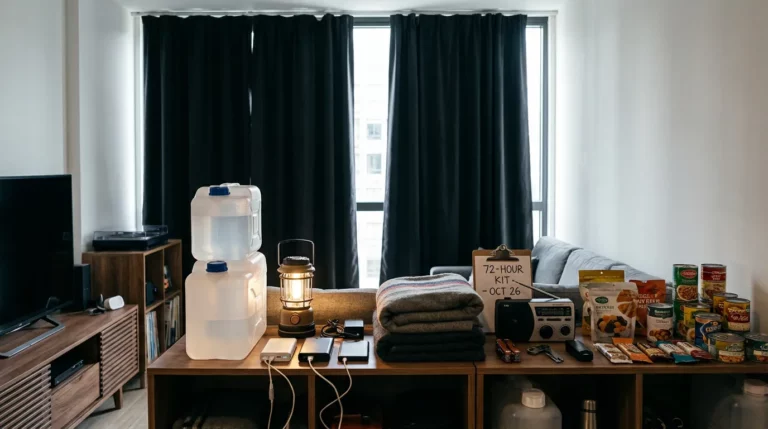
Apartment blackout prep is different from house prep in ways most guides ignore. You can’t run a gas generator on a balcony (CO risk in a shared building). You may lose water pressure when the electric pump fails. Your neighbors’ decisions affect your security. This guide is built specifically for apartment families — what works, what doesn’t, and exactly what to have ready before the next outage.
Table of Contents
- What’s Different About Apartments: The Real Constraints
- Hour 0–1: What to Do the Moment Power Goes Out
- Water in an Apartment Blackout
- Food for 72 Hours Without Refrigeration
- Managing Temperature Without HVAC
- Power and Lighting for Apartments
- Communication and Staying Informed
- Kids in a 72-Hour Blackout
- 72-Hour Apartment Checklist
- Common Mistakes Apartment Dwellers Make
- FAQ
What’s Different About Apartments: The Real Constraints
Before we get into the checklist, here’s what makes apartment blackout prep uniquely different:
- No gas generators. Running a gas generator on a balcony creates CO risk for your unit and every unit around you. Building management will shut you down — and rightfully so. Your power backup options are solar power stations only.
- Water pressure may fail. Many mid-rise and high-rise apartments use electric pumps. When power goes out, water stops within 6–12 hours. Ground floor units often have gravity-fed water longer. Know your building.
- Elevators don’t work. If you’re on floor 8 with a stroller and a toddler, this matters for evacuation planning.
- Shared building = shared security. Your building’s security depends partly on your neighbors’ behavior. A long blackout changes the dynamic in shared hallways and parking structures.
- No outdoor cooking on most balconies. Many leases prohibit open flames on balconies. A single-burner propane stove needs ventilation and a fire-safe surface — know your lease before you buy one.
Hour 0–1: What to Do the Moment Power Goes Out
The first hour is your most productive. Here’s the sequence:
- Fill every container with water immediately — bathtub, pots, bottles, pitchers. If your building uses electric pumps, water pressure will drop within hours. Do this before anything else.
- Text or call the building super or management. Get an estimated restoration time if they have one. This determines whether you’re hunkering down or planning to relocate to family.
- Charge every device on your power bank right now, while the power bank is full. Don’t wait.
- Locate flashlights and lanterns. Don’t navigate a dark apartment looking for them — know exactly where they are before this happens.
- Check in with elderly neighbors on your floor. A 30-second knock is good community practice and may actually matter.
- Stop opening the refrigerator. From this moment, it’s a clock. You have 4 hours of safe food before the temperature rises into the danger zone.
Water in an Apartment Blackout
Water is the highest-stakes item in apartment blackout prep — higher than in a house, because you have no backup well, no rainwater collection, and potentially no water pressure after a few hours.
What a family of 4 needs for 72 hours:
| Use | Gallons/Day (family of 4) | 72-Hour Total |
|---|---|---|
| Drinking | 4 gallons | 12 gallons |
| Cooking + food prep | 2 gallons | 6 gallons |
| Basic hygiene (washcloths) | 4 gallons | 12 gallons |
| Toilet flushing (bucket method) | 6 gallons | 18 gallons |
| Total minimum | 16 gallons | 48 gallons |
A standard bathtub holds 80–100 gallons. Fill it in the first 10 minutes of a blackout and you’ve covered a family of 4 for 5–6 days of conservative use. A WaterBOB bladder ($30) keeps that water clean in a sealed container instead of an open tub.
If you’re on a high floor and can’t fill the tub fast enough: keep 12 jugs (1 gallon each) stored under a bed or in a closet at all times. At $1–$2/jug and a year-plus shelf life, this is the cheapest piece of apartment prep you can do.
Food for 72 Hours Without Refrigeration
Apartment kitchens are smaller, storage is tighter, and you likely can’t cook outdoors. Here’s a realistic 72-hour food strategy:
Hours 0–4: Eat the most perishable items first — dairy, cooked leftovers, deli meat. They’ll go bad first and they’re the hardest to replace.
Hours 4–48: Your freezer stays safe if closed. Eat refrigerator items first (check with a thermometer — safe below 40°F). Frozen items bought you another 48 hours if undisturbed.
What to have stored for no-refrigeration cooking:
- Canned beans, tuna, chicken, and soups (eat straight from the can with a spoon — no heating required)
- Nut butters and crackers
- Shelf-stable milk (UHT cartons) and oats for kids’ breakfasts
- Instant rice or ramen (needs only boiling water)
- Energy bars and trail mix for no-cook meals
Cooking in an apartment blackout: A single-burner butane camp stove ($25–$35) works safely indoors with a window open — butane burns cleaner than propane and doesn’t require outdoor use. One 8oz butane canister lasts about 90 minutes of cooking time. Keep four canisters in your kit for a 72-hour supply.
Managing Temperature Without HVAC
Apartments lose and gain heat differently than houses — shared walls with neighbors mean you’re partially temperature-buffered, but you also have no control over your building’s overall thermal performance.
In a winter blackout:
- Interior units (surrounded by other units on all sides) stay warmer much longer than corner or top-floor units
- Close all doors to concentrate people and heat in one room
- Layer clothing — thermal base layers, wool socks, hats indoors — before adding blankets
- A Mr. Heater Little Buddy (4,000 BTU, indoor-safe with ventilation) warms a 100 sq ft room quickly on one 1-lb propane canister per 5–6 hours
- If temperature drops below 50°F in the apartment, seriously consider relocating to a heated shelter or family member’s home
In a summer blackout:
- Heat is the more dangerous scenario for apartments — especially upper floors where heat accumulates
- Hang wet sheets in doorways for passive cooling (evaporative cooling effect)
- Battery-powered fans circulate air without power draw (a good 20,000mAh power bank runs a USB fan for 10–15 hours)
- Identify your nearest public cooling center (libraries, malls, community centers) — in a heat emergency above 95°F with no AC, this is the right call for families with young kids
- Signs of heat illness in kids: flushed skin, rapid breathing, confusion. That’s the signal to leave.
Power and Lighting for Apartments
No gas generators in an apartment. Your options:
- Solar power station (recommended): A 300–500Wh unit ($200–$400) handles phone charging, a laptop, lanterns, and a USB fan for the full 72 hours. Recharges from a window solar panel or via AC when power returns. Silent, no fumes, no lease issues.
- Power banks: A 20,000mAh power bank ($30–$50) charges a phone 5–6 times. Keep two fully charged at all times.
- Lanterns: 3–4 distributed through the apartment. One high-output (500+ lumens) for the kitchen/living area, dimmable low-output for bedrooms and bathroom. Battery-powered, not candles.
Communication and Staying Informed
- Hand-crank NOAA weather radio: Non-negotiable. When your phone battery is at 8%, you want a dedicated device for emergency broadcasts that doesn’t compete with your phone’s battery.
- Out-of-state contact: Choose one person outside your region as the family check-in point. Text, don’t call — texts go through when voice calls can’t.
- Building management contact: Have the super’s number saved. In a building-wide outage, they’re your best source of information on timeline and water pressure status.
- Neighbors you know by name: This is the prep most people skip. Two neighbors you can knock on in an emergency changes your resilience significantly — especially if you have young kids and need a second set of hands.
Kids in a 72-Hour Apartment Blackout
Small space, no yard, no generator, potentially no elevator. Here’s how to make it work:
- Pre-download offline content on tablets before the next outage — audiobooks, downloaded shows, offline games. A charged tablet is 8–10 hours of calm.
- Flashlight games work in apartments. Shadow puppets, flashlight tag in hallways, “lantern story time” — darkness is only scary if you let it be.
- Keep snacks that don’t require cooking accessible to kids independently. Hungry and bored is a rough combination.
- Explain what’s happening, simply. “The power is off for a while, like camping at home” beats letting kids sense parental anxiety without context.
- Have a go-bag ready for each child. If the building becomes unsafe (no heat in January, extreme heat in August), you want to be able to leave in 10 minutes with everything you need.
72-Hour Apartment Blackout Checklist
| Category | What to Have | Quantity for Family of 4 |
|---|---|---|
| Water | WaterBOB + stored gallon jugs | 1 WaterBOB + 12 gallon jugs minimum |
| Food | No-cook + butane stove meals | 72-hr caloric supply + 4 butane canisters |
| Lighting | LED lanterns (battery) | 3–4 lanterns + 12-month battery supply |
| Power | Solar station or power banks | 1 x 300–768Wh station + 2 x 20,000mAh banks |
| Heat (winter) | Mr. Heater Little Buddy + canisters | 1 heater + 6 x 1lb canisters |
| Cooling (summer) | Battery fans + cooling center location | 2 USB fans + cooling center address written down |
| Communication | Hand-crank NOAA radio | 1 radio with fresh batteries |
| Sanitation | Wet wipes, hand sanitizer, waste bags | 200 wipes, 2 bottles, 10 bags |
| Documents + cash | IDs, insurance, $150+ small bills | Per family member + household |
Common Mistakes Apartment Dwellers Make
- Not filling the bathtub immediately. Water pressure in apartment buildings can drop within 6 hours. This is the highest-urgency action in the first 10 minutes — not “maybe fill it later.”
- Buying a gas generator. It won’t work safely in an apartment building. A solar power station handles what most families actually need during a 72-hour urban blackout.
- No plan for summer heat above 90°F. In a house, you can open the house up and manage. In a top-floor apartment in August with no AC and no ventilation, temperature rises fast. Know your nearest cooling center before you need it.
- One lantern for the whole apartment. You need lighting in the kitchen, bathroom, and wherever kids sleep — simultaneously. Three to four lanterns is the right number for a family of 4 in a multi-room apartment.
- Not knowing the building’s water system. Ask your super: does the building use an electric pump? On which floors does gravity-fed pressure last? This determines whether filling tubs in hour 1 is urgent or optional.
FAQ
Can I use a gas generator in my apartment?
No. Gas generators produce carbon monoxide and require outdoor operation at least 20 feet from windows. In an apartment building, this isn’t possible without endangering neighbors. Use a solar power station instead — a 300–768Wh unit handles all critical apartment needs (phone charging, lighting, USB fan, laptop) for 72 hours without any fumes or noise.
Will I have water during an apartment blackout?
Depends on your building. Mid-rise and high-rise buildings often use electric pumps — when power goes out, water pressure drops within 6–12 hours. Ground-floor units usually have gravity-fed water longer. Ask your building super how your system works, and always fill the bathtub in the first 10 minutes of any blackout.
How do I cook in an apartment without power?
A single-burner butane camp stove ($25–$35) works safely indoors with a window cracked. Butane burns clean and doesn’t require outdoor use like propane does. One 8oz canister = 90 minutes of cooking. Keep four canisters in your kit. No-cook options — canned foods, nut butter, crackers, energy bars — should cover at least half your 72-hour meals anyway.
How hot is too hot to stay in an apartment during a summer blackout?
When indoor temperatures exceed 90°F for extended periods, especially for young children or elderly family members. Heat exhaustion symptoms in kids — flushed skin, rapid breathing, confusion — mean it’s time to leave for a cooling center or air-conditioned location. Know your nearest public cooling center before the summer blackout season.
How much water does a family of 4 need for 72 hours in an apartment?
A minimum of 48 gallons for drinking, cooking, hygiene, and toilet flushing. A filled bathtub (80–100 gallons) covers that with room to spare — which is why filling the bathtub in the first 10 minutes of a blackout is the single most important action for apartment families. A WaterBOB bladder keeps that water sealed and clean.
Bottom Line
Apartment blackout prep has three real priorities: water stored before pressure drops, a solar power station instead of a gas generator, and knowing your building’s specific systems before an outage hits. Get those three right and a 72-hour blackout becomes a manageable inconvenience instead of a crisis. For longer-duration planning, see our full guide on How to Survive a Long-Term Blackout.
Last Updated: April 2026

Dan Lockland is a preparedness instructor and survival skills educator with over 15 years of hands-on experience. He shares practical, no-nonsense guidance on emergency preparedness, self-reliance, and sustainable living at PreparingWithDan.com.