
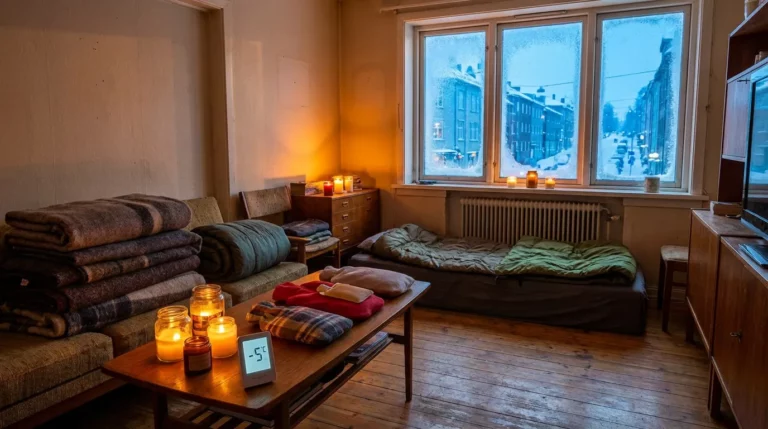
The 2021 Texas winter storm killed more than 200 people — most of them inside their homes. Not from the storm itself, but from carbon monoxide poisoning (people running generators and grills indoors), hypothermia in houses that dropped to 40°F, and medical crises that couldn’t get emergency response. They weren’t unprepared in the way you might think. They just didn’t know the specific protocols that keep families alive when a house gets dangerously cold.
This guide covers exactly those protocols — for a family of 4 in a house or apartment without functioning heat.
Temperature Reality: When Does It Get Dangerous?
| Indoor Temperature | Risk Level | Priority Action |
|---|---|---|
| 55–60°F (13–16°C) | Uncomfortable but manageable | Layer up, reduce heated space |
| 50–55°F (10–13°C) | Moderate — elderly/infants at risk | Implement warm room strategy, backup heat |
| 40–50°F (4–10°C) | High risk — hypothermia possible for vulnerable | Maximum layering, active heat source required |
| Below 40°F (below 4°C) | Severe — everyone at risk | Consider leaving if safe alternative exists |
Most healthy adults can tolerate 50–55°F with proper layering for extended periods. But children under 5, elderly adults, and anyone with cardiovascular or respiratory conditions face significantly higher risk at lower temperatures — and they’re the first to develop serious complications.
Immediate Actions: First 30 Minutes
When you lose heat, the sequence of actions matters. Do these in order:
- Check the cause: Is it a power outage, a furnace failure, or a frozen pipe burst? This determines whether you’re looking at hours or days without heat.
- Put on warm layers now: Before you lose body heat, not after you start shivering. It’s much easier to maintain heat than to recover it.
- Identify your warmest room: Interior rooms retain heat longer than rooms with exterior walls. Small rooms heat faster than large ones. Your warm room strategy begins now.
- Conserve what heat you have: Close doors to all unoccupied rooms. Put rolled towels or blankets at door bases. Close blinds and curtains on exterior windows.
- Fill containers with water: Pipes freeze when indoor temps drop below 32°F. If a long cold event is coming, fill bathtubs, large pots, and every available container with water now — before pipes freeze.
The Warm Room Strategy: Your Most Important Tool
Trying to heat your entire house without a functioning central system is inefficient and dangerous. Instead, designate one small interior room as your “warm room” and focus all your heat retention and heating efforts there.
How to Choose Your Warm Room
- Size: Smaller is warmer — body heat alone can raise temperature noticeably in a room under 150 sq ft
- Location: Interior rooms (no exterior walls) stay warmer than corner or exterior rooms
- Practical access: Near a bathroom if possible; must have a window that opens (for ventilation if using any heat source)
Setting Up Your Warm Room
- Hang heavy blankets over windows and exterior wall areas — they add insulation
- Put foam sleeping pads or folded blankets on the floor — cold rises from below in severe cold
- Bring sleeping bags rated for the expected temperatures into this room
- Move all family members, plus pets, into this room — body heat matters
- Install a battery-powered carbon monoxide detector in this room (non-negotiable)
Layering for Maximum Body Heat
Layering is not just common sense — it’s a specific system. Each layer has a function, and missing one compromises the others.
The Three-Layer System
| Layer | Function | Material | What to Use |
|---|---|---|---|
| Base layer | Moisture management — keep skin dry | Merino wool or synthetic (NOT cotton) | Wool long underwear, polyester tights |
| Mid layer | Insulation — trap warm air | Fleece, down, wool | Fleece jacket, wool sweater, down vest |
| Outer layer | Wind/moisture protection (if going outside) | Windproof, waterproof | Shell jacket, ski pants |
For indoor use, two layers are usually sufficient — base + mid. Add the outer layer if temperatures fall below 40°F indoors or when going outside.
The Most Important Layer: Head Coverage
40% of body heat is lost through the head. A wool or fleece hat is non-negotiable in cold house survival — even indoors. Wear it while sleeping. Add a balaclava at extreme cold. Keep your neck covered with a neck gaiter or scarf. Keep socks on at all times — cold feet are one of the fastest ways to drop core temperature.
Sleeping Warm
For sleeping without heat:
- Put a sleeping bag inside a heavier sleeping bag (double-bag) for extreme cold
- A sleeping bag liner adds 10–25°F of effective temperature rating
- Wear dry base layers to sleep — wet clothing from sweating during the day steals heat at night
- Two people sharing a double sleeping bag generate significantly more warmth than two solo sleepers
- Eat a small high-fat, high-calorie snack before bed — digestion generates heat for hours
Safe Backup Heat Sources
Every alternative heat source has specific safety requirements. Ignoring them doesn’t just risk fire — it risks carbon monoxide poisoning, which kills without warning in 1–3 hours at high concentrations.
Propane Indoor-Safe Heater (Best Option)
The Mr. Heater Buddy or Big Buddy series ($80–$140) are specifically certified for indoor use in residential settings. They run on 1-lb propane canisters (4–6 hours each) or 20-lb tanks with a hose adapter. Key safety rules:
- Open a window 1–2 inches in the room where it’s operating — always
- Run a battery-powered CO detector (not just a smoke alarm) in the same room
- Never sleep with it running — turn off before sleeping
- Keep children and pets at least 3 feet from the heater
- Store propane cylinders outdoors or in a ventilated space — never in a bedroom
Wood Stove or Fireplace
If you have a wood stove or fireplace that’s been maintained, this is your best long-duration heat source. It requires no fuel infrastructure beyond wood you can source locally. Annual chimney inspection is essential — creosote buildup is a fire hazard. Use seasoned (dry) wood only — green wood produces more smoke, less heat, and more creosote. Never burn treated lumber, plywood, or cardboard in a fireplace.
Candles: Minimal Heat, Maximum Risk
One candle generates approximately 80 watts — barely equivalent to a human body. You’d need 50+ candles to meaningfully heat a room. Candles are useful for light, minimal supplemental warmth, and psychological comfort. They’re dangerous when left unattended, near flammable materials, or near sleeping children. Use them for light; don’t rely on them for heat.
NEVER Use These Indoors
- ⛔ Charcoal grills — primary cause of CO deaths in power outages
- ⛔ Gas camping stoves (Coleman etc.) — not rated for indoor use; CO risk
- ⛔ Generators — must be outdoors and at least 20 feet from any opening
- ⛔ Gas-powered space heaters — not indoor-rated
- ⛔ Propane cooking stoves used for heat — not designed for this; CO risk
- Mr. Heater Buddy + 6 × 1-lb propane canisters ($80 + $20)
- Battery-powered CO detector ($30)
- Sleeping bag rated to 0°F or below per person ($60–$200 each)
- Sleeping bag liner per person ($30–$60 each)
- Wool base layer set per family member ($40–$80/set)
- Wool hats, gloves, and socks for each family member ($30–$50 total)
- Emergency Mylar blankets × 8 (backup + window insulation, $10)
Food and Water in Cold Conditions
Eat for Heat
Metabolism is your internal furnace. Feed it. In cold conditions, your body burns significantly more calories maintaining core temperature. Increase caloric intake by 15–25% during a cold house event. Prioritize:
- Fats: The most calorie-dense macronutrient — peanut butter, nuts, butter, ghee. Fat takes longer to metabolize and generates more sustained heat than carbohydrates.
- Hot liquids: Tea, soup, broth, hot chocolate — warm drinks raise core temperature directly. Drink every 1–2 hours.
- High-protein meals: Digesting protein generates more heat than digesting carbs (the thermic effect of food)
Pipe Freeze Prevention
Pipes freeze when indoor temperature falls below 32°F — but in exterior wall spaces (where pipes often run), freezing can happen at 40°F indoor air temperature. If you lose heat:
- Open cabinet doors under sinks on exterior walls to expose pipes to warmer interior air
- Keep one faucet dripping slightly — moving water freezes at lower temperatures
- Fill all available containers with water as early as possible, before pipes potentially freeze
- Know where your main water shutoff is — if a pipe bursts, you need to shut it off immediately
Water Safety in Extreme Cold
Water stored in outdoor containers can freeze. Move water storage indoors. In your warm room, keep at minimum 2 gallons per person for the first 24 hours. Any collected snow must be melted and purified before drinking — don’t eat snow directly (it lowers core body temperature).
Recognizing and Treating Cold-Related Emergencies
Hypothermia
Hypothermia occurs when core body temperature falls below 95°F (35°C). It can happen at temperatures well above freezing — wet clothing, wind exposure, and exhaustion all accelerate it.
Mild hypothermia signs: Uncontrollable shivering, confusion, slurred speech, clumsiness. The person says they’re “fine” — they’re not.
Severe hypothermia signs: Shivering stops (dangerous — body temperature has dropped further), extreme confusion, loss of coordination, very slow or no pulse.
Treatment:
- Move the person to the warmest available space immediately
- Remove wet clothing — carefully, to avoid further heat loss during removal
- Cover with blankets, including the head; apply warm (not hot) water bottles to armpits, groin, and neck
- Give warm, sweet, non-alcoholic drinks if conscious and able to swallow
- Call 911 — severe hypothermia is a medical emergency
- Do not rub limbs or allow the person to walk; rough movement can trigger cardiac arrest in severe hypothermia
Frostbite
Frostbite affects extremities: fingers, toes, ears, nose. Skin appears pale, gray, or waxy; the affected area feels numb.
Treatment:
- Get out of the cold immediately
- Do NOT rub frostbitten areas — ice crystals under the skin cause further damage with rubbing
- Rewarm in warm (not hot) water — 104°F (40°C) is ideal; about as warm as a comfortable bath
- Do NOT rewarm if there is risk of refreezing — a cycle of thaw-freeze-thaw causes severe tissue damage
- Seek medical attention for anything beyond superficial frostbite
When to Leave
There are situations where staying is more dangerous than leaving. Consider evacuation when:
- Indoor temperature drops below 40°F and you have no functional backup heat source
- A family member is elderly, an infant, or has a medical condition that increases cold risk
- You have no warm clothing adequate for the actual temperatures
- A functional alternative exists — a warming center, a family member’s home, a hotel — that’s safely reachable
Know your county’s warming center locations before winter. Most counties open warming centers when outdoor temperatures drop below -10°C (14°F). These are free, open to the public, and can accommodate families with pets in many locations.
Common Mistakes in Cold House Survival
1. Using non-approved heat sources indoors
Charcoal grills, gas camping stoves, and gasoline generators used indoors kill people in every major winter storm. CO is colorless and odorless. Within two hours at high concentrations, it is fatal. If you must use alternative heat, use an indoor-rated propane heater with ventilation, period.
2. Staying in a large house instead of consolidating to one room
Families spread across multiple rooms in a cold house share body heat inefficiently and exhaust heat sources faster. Consolidating into one small room is not just more comfortable — it’s significantly safer.
3. Drinking alcohol to stay warm
Alcohol creates a sensation of warmth by dilating blood vessels — it actually causes your core temperature to drop faster by moving warm blood to the skin surface where it loses heat. Alcohol impairs judgment exactly when you need clear thinking. Avoid it during cold house emergencies.
4. Not preparing for pipe freezing
Burst pipes cause water damage that can be more costly than any other cold weather impact on your home. Filling containers early and taking precautions with exposed pipes is a 15-minute task that prevents days of restoration work.
5. Waiting to put on warm clothes
Waiting until you’re cold to layer up is physiologically backwards. Maintain core temperature rather than trying to recover from heat loss. Put on your warmest layers before the house gets cold — not after it already has.
FAQ
At what temperature does a house become dangerous without heat?
For healthy adults, 50°F is uncomfortable but manageable with proper layering. Risk increases significantly below 50°F. For infants, elderly adults, and people with cardiovascular or respiratory conditions, 55°F requires active intervention. Below 40°F is potentially dangerous for any family member without proper sleeping gear and backup heat.
How long can my family realistically survive in a very cold house?
With proper sleeping bags (0°F rated), the warm room strategy, layered clothing, and an indoor-rated propane heater with adequate fuel — a family of 4 can survive safely for 1–2 weeks in a house at or near freezing outdoor temperatures. Without those elements, 24–48 hours at extreme cold is the realistic limit before medical risk becomes significant.
Can we heat a room with candles?
Marginally. One candle produces about 80 watts of heat — roughly equivalent to an incandescent light bulb. In a very small, well-insulated room with 3–4 candles burning, you might raise the temperature 2–3°F above ambient. Candles are useful for light and morale; they’re not a viable heat source. Don’t rely on them — and never leave them unattended or near children.
What’s the safest propane heater for indoor use?
The Mr. Heater Buddy (MH9BX) and Big Buddy (MH18B) are the most widely recommended indoor-rated propane heaters for residential use. They have low-oxygen shutoff sensors that cut the heater if oxygen levels drop dangerously. Always pair with an independent battery-powered CO detector and crack a window for ventilation — even with these units.
Should I let my faucets drip during a heat outage in winter?
Yes, if you have water pressure and the outdoor temperature is below 20°F (-7°C). Running water freezes at a lower temperature than standing water. A slow drip from both hot and cold faucets on exterior walls reduces freeze risk meaningfully. If you don’t know where your pipes run, drip faucets in the kitchen and any bathroom on exterior walls.
Bottom Line
Surviving extreme cold at home without heat comes down to three things: consolidating your family’s heat into one well-insulated space, wearing proper thermal layers before you need them, and never using unapproved heat sources indoors. The families who get hurt in winter emergencies almost always made one of two mistakes — they stayed in a cold house with no backup heat and inadequate clothing, or they tried to heat a room with something that produced carbon monoxide.
Spend $200 this fall: a Mr. Heater Buddy, a CO detector, and a 0°F sleeping bag per person. That’s the kit that makes your family safe in a winter heating failure.

Dan Lockland is a preparedness instructor and survival skills educator with over 15 years of hands-on experience. He shares practical, no-nonsense guidance on emergency preparedness, self-reliance, and sustainable living at PreparingWithDan.com.