
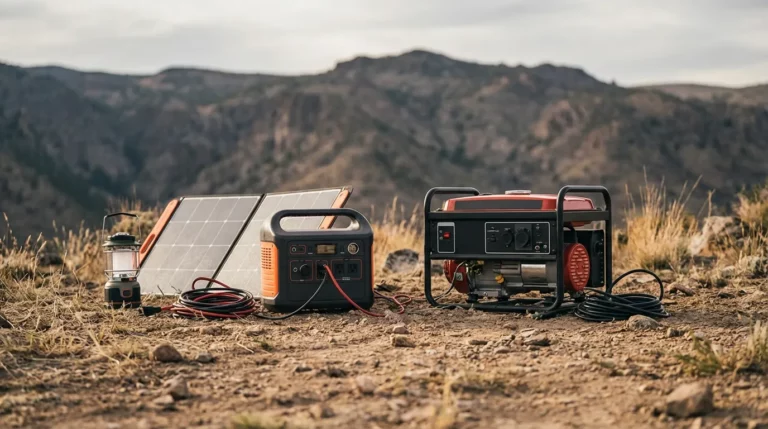
The generator debate never ends in prepper circles — and for good reason. Solar and gas generators solve different problems, and picking the wrong one could leave you powerless at the worst moment. This guide gives you side-by-side specs on the top models, a real wattage calculator, and a clear recommendation based on your situation.
Table of Contents
- The Quick Answer: Solar vs Gas by Scenario
- Wattage Calculator: What Do You Actually Need to Run?
- Top Solar Power Stations for Preppers in 2026
- Top Gas Generators for Preppers in 2026
- The 2026 Hybrid Strategy: Solar + Gas Together
- Full Side-by-Side Comparison
- Fuel Storage: Critical Safety Rules
- Safety Rules You Can’t Break
- Dan’s Pick by Family Profile
- Common Mistakes
- FAQ
The Quick Answer: Solar vs Gas by Scenario
| Situation | Best Choice | Why |
|---|---|---|
| Short outage (1–3 days), urban home | Solar power station | Silent, safe indoors, no fuel needed |
| Extended outage (4–14+ days) | Gas or dual-fuel | Higher wattage, refuelable on demand |
| Bug-out vehicle / mobile use | Solar power station | Portable, recharges while driving or from sun |
| Running well pump, HVAC, or power tools | Gas generator | Solar can’t match the wattage requirements |
| Apartment or suburban home | Solar power station | No exhaust, silent, usable indoors |
| Rural property, whole-home backup | Dual-fuel + solar combo | Solar for daily use, gas for surge loads |
Wattage Calculator: What Do You Actually Need to Run?
Before buying anything, calculate your actual wattage needs. Add up the watts for everything you need running simultaneously — not just one at a time. The starting/surge wattage is what trips up most buyers.
| Appliance | Running Watts | Starting Watts (surge) |
|---|---|---|
| Refrigerator (medium) | 150–400W | 800–1,200W |
| Chest freezer | 100–200W | 400–700W |
| Window AC (8,000 BTU) | 900W | 2,700W |
| Electric space heater | 1,500W | 1,500W |
| Well pump (1/2 HP) | 750W | 2,000W |
| Sump pump | 800W | 1,300W |
| Laptop + phone charging | 150W | 150W |
| LED lights (10 bulbs) | 100W | 100W |
| CPAP machine | 30–60W | 30–60W |
| Router + modem | 25W | 25W |
Rule of thumb: If you only need fridge + lights + phones, you need 500–800W running — a solar power station handles this easily. If you need AC + fridge + well pump simultaneously, you’re at 3,000–5,000W running — that’s gas generator territory.
Top Solar Power Stations for Preppers in 2026
| Model | Capacity | Output (W) | Recharge Options | Best For |
|---|---|---|---|---|
| EcoFlow Delta Pro | 3,600 Wh | 3,600W (7,200W surge) | Solar, AC, car, EV station | Whole-home short-term backup |
| Jackery Explorer 2000 Plus | 2,042 Wh (expandable to 24 kWh) | 3,000W | Solar, AC, car | Scalable long-term solar prep |
| Bluetti AC200MAX | 2,048 Wh | 2,200W | Solar, AC, car, dual AC | Off-grid families |
| EcoFlow River 2 Pro | 768 Wh | 800W | Solar, AC (1hr recharge) | Budget entry, small apartments |
| Goal Zero Yeti 1500X | 1,516 Wh | 2,000W | Solar, AC, car | Premium reliability, rugged use |
Top Gas Generators for Preppers in 2026
| Model | Wattage (Running/Peak) | Fuel Type | Runtime | Noise Level |
|---|---|---|---|---|
| Honda EU2200i | 1,800W / 2,200W | Gas | 8.1 hrs at 25% load | 48–57 dB (very quiet) |
| Champion 3500W Dual Fuel | 3,500W / 4,000W | Gas + Propane | 12 hrs (gas), 10.5 hrs (propane) | 68 dB |
| DuroMax XP12000EH | 9,500W / 12,000W | Gas + Propane | 8 hrs at 50% load | 74 dB |
| Westinghouse iGen4500 | 3,700W / 4,500W | Gas | 18 hrs at 25% load | 52 dB (inverter) |
| Generac GP3500iO | 3,000W / 3,500W | Gas | 7.5 hrs | 58 dB |
The 2026 Hybrid Strategy: Solar + Gas Together
The smartest preppers in 2026 aren’t choosing one or the other — they’re running both. Here’s how it works for a family of 4:
- Days 1–3: Solar power station handles everything — lights, phone charging, fridge cycling, CPAP. Silent, no fuel cost, no exhaust.
- Day 3+, if outage continues: Gas generator runs 2–3 hours per day to recharge the solar station AND power high-draw appliances simultaneously. This slashes fuel consumption compared to running gas 24/7.
- With solar panels added: A 200W portable panel recharges an EcoFlow Delta Pro by ~600Wh/day in good sun — enough to run fridge and lights indefinitely without any gas.
A family of 4 using this hybrid approach can survive a 2-week outage on approximately 15–20 gallons of stored gasoline instead of the 60–80 gallons needed for 24/7 gas use. That’s a 75% reduction in fuel cost and storage requirements.
Full Side-by-Side Comparison
| Factor | Solar Power Station | Gas Generator | Dual-Fuel Generator |
|---|---|---|---|
| Max Wattage | Up to 7,200W (EcoFlow) | Up to 15,000W+ | Up to 12,000W |
| Ongoing fuel cost | $0 (solar) | $4–6/gallon, ~1 gal/hr | Gas or propane (propane stores longer) |
| Noise | 0 dB (silent) | 48–74 dB | 52–74 dB |
| Indoor safe | Yes | No (CO risk) | No (CO risk) |
| Runtime without refuel | Varies (sun-dependent) | 6–18 hours per tank | 8–12 hours per tank |
| Startup time | Instant | 5–30 seconds | 5–30 seconds |
| Maintenance | Minimal (battery checks) | Oil changes, air filter, fuel stabilizer | Same as gas + dual carburetor |
| Lifespan | 2,000–3,500 cycles (10–15 yrs) | 1,000–2,000 hrs (10–15 yrs) | Same as gas |
Fuel Storage: Critical Safety Rules
- Maximum home storage: Most fire codes limit gasoline storage to 25 gallons. Check your municipality.
- Fuel stabilizer is mandatory: Untreated gas degrades in 30–60 days. STA-BIL or PRI-G extends treated gas to 12–24 months.
- Propane advantage: Propane stores indefinitely with no stabilizer. A 20-lb tank holds 4.7 gallons equivalent. 100-lb tanks give serious reserve capacity.
- Rotation schedule: Use stored gas in your car or lawn equipment every 6 months and replace it. Never run a generator on old, varnished fuel.
Safety Rules You Can’t Break
- Gas generators NEVER indoors or in garages. Carbon monoxide kills in minutes. Run only outside, minimum 20 feet from any window or door.
- Install a CO detector. Even outdoor use near open windows has caused deaths. A battery CO detector is non-negotiable if you own a gas generator.
- Transfer switch for whole-home hookup. Never backfeed power to the grid through your panel — it’s illegal and can electrocute utility workers. A licensed electrician installs a transfer switch for $500–$1,500.
- Solar battery safety: Keep lithium power stations away from heat over 104°F. Don’t charge and discharge simultaneously at high rates.
Dan’s Pick by Family Profile
| Profile | Recommended Setup |
|---|---|
| Urban apartment, 1–2 people | EcoFlow River 2 Pro + 160W solar panel |
| Suburban home, family of 4 | EcoFlow Delta Pro + 400W solar + Champion Dual Fuel 3500W |
| Rural property, extended self-sufficiency | Bluetti AC300 + 2x 200Ah battery + DuroMax 12000W dual-fuel |
| Budget prepper, just getting started | Jackery Explorer 300 Plus + Champion 2000W gas (inverter) |
Common Mistakes When Choosing a Generator
- Buying based on peak watts, not running watts. A “4,000W generator” might only sustain 3,200W continuously. Your refrigerator starts at 1,200W and runs at 200W — what matters is whether the generator handles the starting surge without tripping.
- Going solar-only for rural or long-duration outages. Solar power stations are excellent for urban short outages. They’re insufficient as a sole backup if you run a well pump, if you get multiple cloudy days in a row, or if your outage extends beyond a week.
- Storing gasoline without stabilizer. Gas left in a generator’s carburetor or storage can for 60+ days turns to varnish. This is the #1 reason generators don’t start when you need them. Add stabilizer to every gallon you store.
- Skipping the transfer switch. Plugging appliances directly into a generator with extension cords is fine for basics. Running your whole home requires a transfer switch — and doing it without one can kill utility workers restoring your power.
- Not calculating wattage before buying. Most people buy a generator that’s either too small (can’t run AC and fridge simultaneously) or too large (overkill, wasted money). The wattage table above takes 10 minutes to use — do it first.
FAQ
Can a solar generator run a refrigerator for a family of 4?
Yes. A medium fridge uses 1–2 kWh per day. The EcoFlow Delta Pro (3,600 Wh) runs it for 36–72 hours without recharging. Add a 200W solar panel and you can run the fridge indefinitely in good sun. The key number is watt-hours (Wh), not watts — make sure you’re comparing the right spec.
How much gas does a generator use per day?
A 3,500W gas generator at 50% load uses 0.5–0.7 gallons per hour, or 12–17 gallons per 24 hours continuous. Running it 4–6 hours per day for critical loads drops that to 2–4 gallons daily. At $4/gallon, a 2-week outage with smart rationing costs roughly $112–$224 in fuel — manageable with 25 gallons stored.
Is a dual-fuel generator worth it for preppers?
Yes — dual-fuel is the most practical choice for preppers. Propane stores indefinitely (no degradation), is safer to store than gasoline, and many rural homes already have large propane tanks for heat. The ability to switch fuels mid-outage is a real preparedness advantage, and the price premium over gas-only is usually small.
How long do solar generator batteries last?
LiFePO4 batteries (EcoFlow, Bluetti, Jackery) last 2,000–3,500 charge cycles before dropping to 80% capacity. At one charge per day, that’s 10–15+ years. Older lithium NMC batteries last 500–1,000 cycles. Always check battery chemistry before buying — it’s the most important long-term spec and rarely featured in marketing materials.
Bottom Line
For most suburban families of 4, the right answer in 2026 is the hybrid setup: an EcoFlow Delta Pro for silent daily-use backup and a Champion 3500W Dual Fuel for the extended outages when solar capacity runs short. Together they cover every scenario at a reasonable cost. For the rest of your power outage plan, see How to Survive a Long-Term Blackout — the generator is just one piece of it.
Last Updated: April 2026

Dan Lockland is a preparedness instructor and survival skills educator with over 15 years of hands-on experience. He shares practical, no-nonsense guidance on emergency preparedness, self-reliance, and sustainable living at PreparingWithDan.com.