
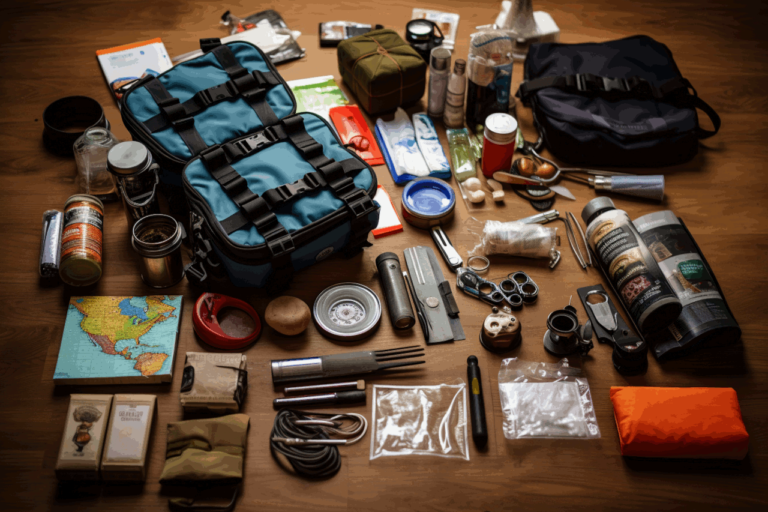
A folding solar panel produces nothing after sunset and, per the Department of Energy’s solar basics, a fraction of its rating whenever the sun is low, the sky is hazy or the panel is flat on the ground instead of facing the sun. So the buying decision is not the watts on the box; it is what the panel feeds. A 28 W panel keeps a phone and a power bank alive indefinitely. A 100 W panel can refill a small power station over a good day. Nothing on this page runs a refrigerator.
Five panels below, from 28 W to 200 W, compared on what the listings state — rated output, weight, connectors, weather rating — and on the honest job each can do in an outage. No scores, no prices. If you have not yet chosen the battery the panel will charge, start with our off-grid power overview; the panel is the second purchase.
What a panel can and cannot do
- Rated watts are the ceiling. The number is measured at full, perpendicular sun. Energy.gov’s solar radiation basics list what reduces it in practice: the sun’s angle, time of day, season, local weather and landscape. Plan on a fraction of the rating over a day, more in June than in January, and tilt the panel toward the sun rather than laying it flat.
- Night is half the day. A panel with no battery is useless from dusk to dawn, which is when you want light and a charged phone. Every panel here needs a power bank or power station with pass-through charging to be worth carrying.
- Match the connector before the wattage. Phone-sized panels have USB ports; power-station panels use a DC barrel, Anderson or MC4 connector, and each brand recommends its own. A 200 W panel with the wrong plug charges nothing.
- Weight is the apartment question. A 14 lb panel lives in a car or on a balcony; a 1.2 kg one goes in a go-bag.
At a glance
| Product | Best for | Rated output / weight (listing) |
|---|---|---|
| BigBlue 28 W folding charger | The go-bag and the balcony: phones and power banks | 28 W / weight not stated |
| FlexSolar 60 W portable panel | A family’s phones plus a small power station, in a pack | 60 W / 1.2 kg |
| Jackery SolarSaga 100 W Air (bifacial) | Owners of a Jackery station who want the matching panel | 100 W / 7 lb |
| Goal Zero Boulder 50 | A rugged panel to leave set up in a yard | 50 W / 12.4 lb |
| Renogy 200 W portable panel | Refilling a 1 kWh-class station between sunny days | 200 W / 13.9 lb |
Phone and power-bank panels
Enough to keep phones, a radio and a headlamp charged through a long outage, given sun.

BigBlue 28 W folding charger
For: The go-bag and the balcony: phones and power banks
What the listing says: 28 W folding panel with two USB outputs and smart charging IC; folds flat; water-resistant panels.
Before you buy: It does not store power: with no bank plugged in, a cloud resets everything. Charge a power bank in the day and the phone from the bank at night. Output in shade or through a window is a small fraction of 28 W.

FlexSolar 60 W portable panel
For: A family’s phones plus a small power station, in a pack
What the listing says: 60 W panel with USB-C PD and QC USB-A outputs plus DC output, IP67 rating, about 1.2 kg, carabiners and cables included.
Before you buy: The USB-C PD port is the reason to buy it: it charges modern phones and small power stations directly. Check that your station accepts USB-C input at that wattage; older ones only take their own DC plug.
Power-station panels
For refilling a portable battery station that runs a CPAP, a router or a small fridge for hours.
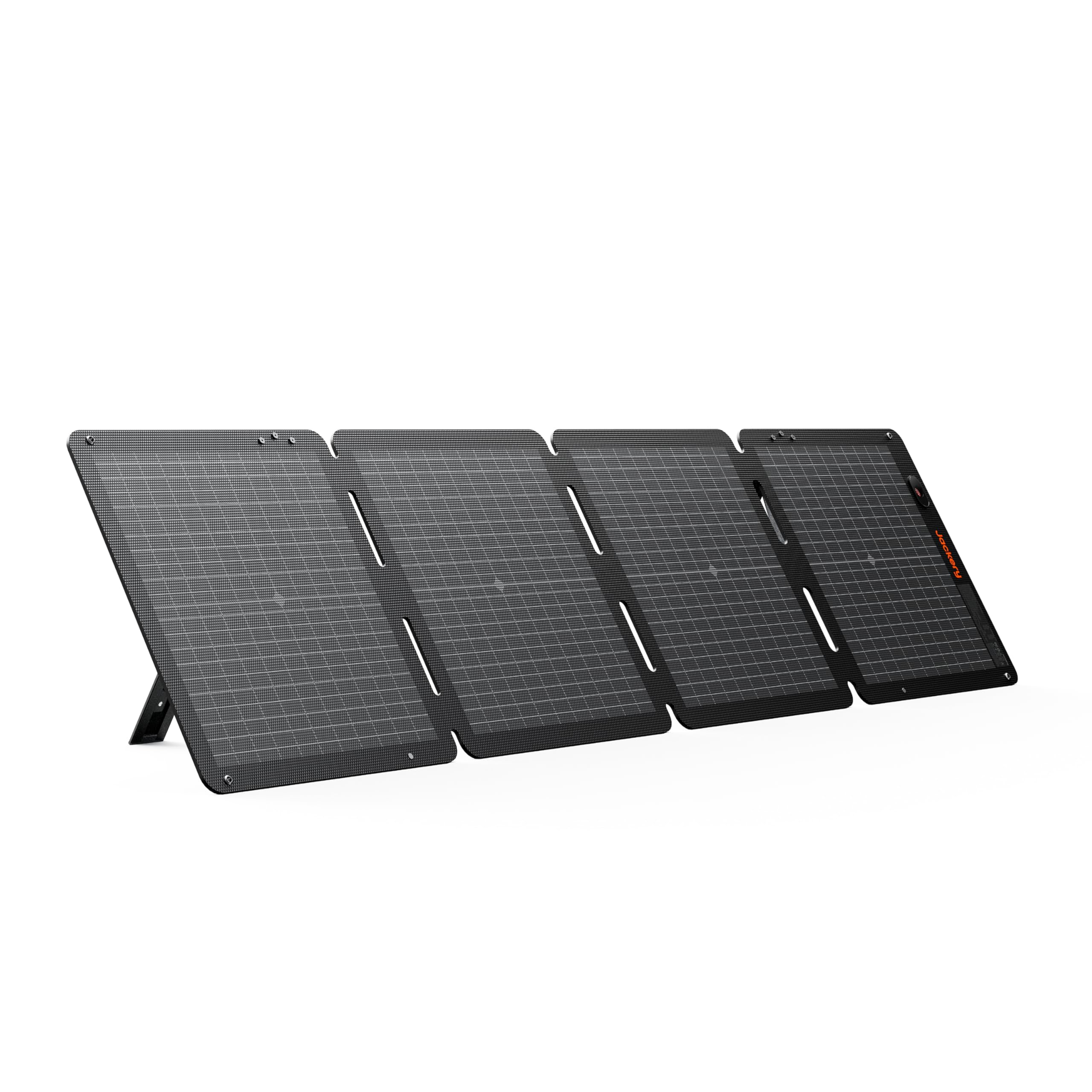
Jackery SolarSaga 100 W Air (bifacial)
For: Owners of a Jackery station who want the matching panel
What the listing says: 100 W bifacial panel, about 23% conversion, IP65, adapters and storage bag included, about 7 lb.
Before you buy: Jackery recommends its own panels and adapters for its stations; that is the fit you are paying for. The bifacial rear face only earns its keep on a bright, reflective surface. If your station is another brand, check the connector before this one.

Goal Zero Boulder 50
For: A rugged panel to leave set up in a yard
What the listing says: 50 W monocrystalline panel in a rigid frame with kickstand, about 22.6% efficiency, about 12.4 lb, 8 mm output for Goal Zero Yeti stations.
Before you buy: Twelve pounds for 50 W: it is a fixed-position panel, not a folding one, and the rigid frame is what you are paying for. Its plug is Goal Zero’s; other stations need an adapter.
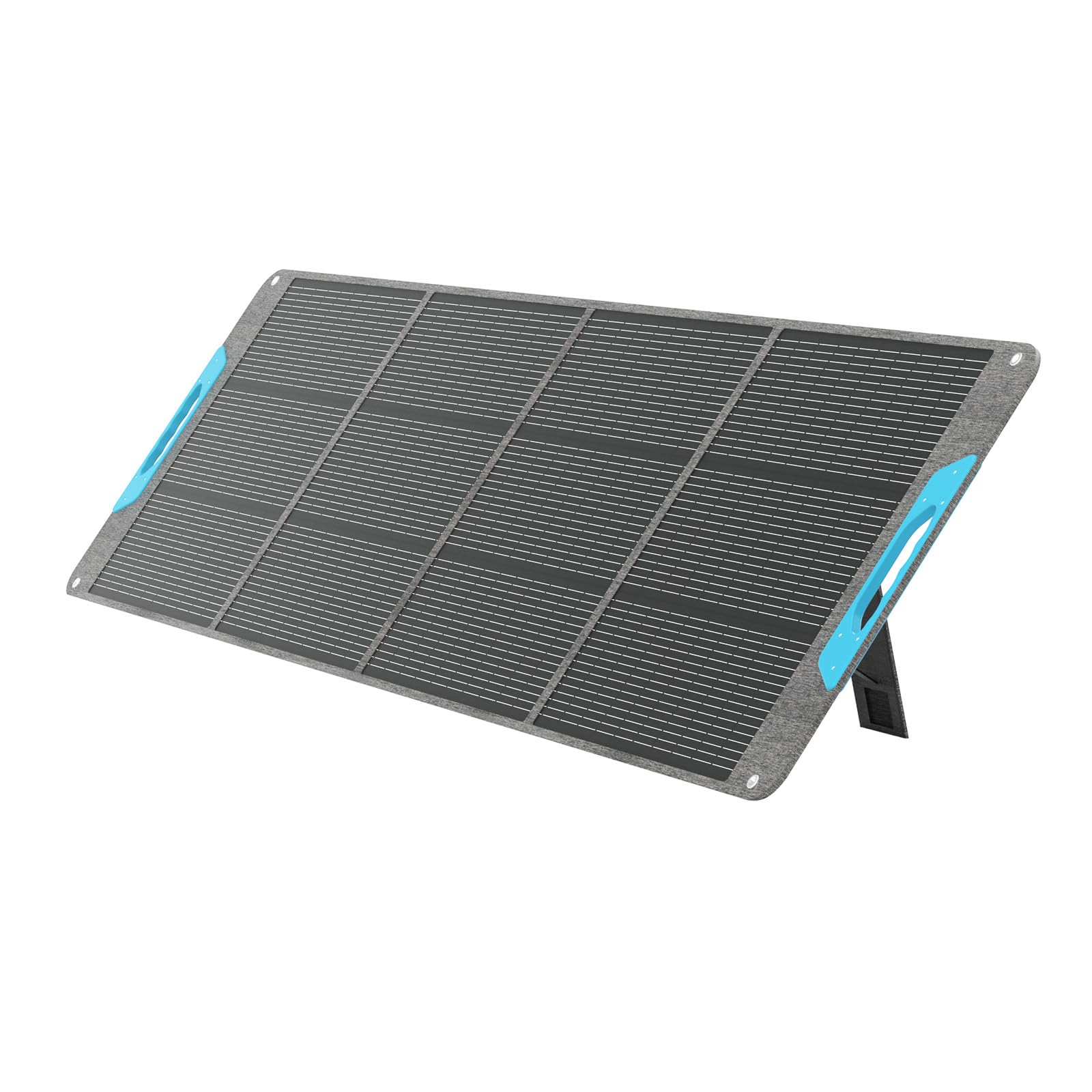
Renogy 200 W portable panel
For: Refilling a 1 kWh-class station between sunny days
What the listing says: 200 W folding panel with N-type cells, about 25% efficiency, IP65, about 13.9 lb.
Before you buy: Two hundred watts needs a station whose input accepts it; many small stations cap solar input at 100 W or less and waste the rest. Check the station’s maximum solar input, and the connector, before buying the biggest panel.
Sizing it for a real outage
Work backwards from the load. A phone is roughly 15-20 Wh a day; a hand-crank radio and a headlamp, a few more. A 28 W panel in decent sun covers that with margin. A CPAP or a router is tens of watt-hours per hour and needs a power station in the hundreds of watt-hours, refilled by a 100 W panel over a full sunny day. A refrigerator is beyond anything folding: that is a generator question, covered in our solar vs gas generator guide. The supply calculator sizes the rest of the kit; for lighting, our lantern review explains why runtime beats lumens.
Before the storm, not during
Ready.gov’s power-outage guidance is to plan alternative power sources in advance and keep devices charged before severe weather. The panel’s job starts on day two, when the banks are flat; it cannot rescue a household that begins the outage at 12%. Charge everything from the wall while the wall still works.
FAQ
Can a folding solar panel power a house during an outage?
No. The panels here charge phones, power banks and portable power stations. Anything with a compressor or a heating element needs a generator or a large battery system.
How many watts do I need?
For phones and small electronics, 20-30 W with a power bank. For a portable power station that runs a medical device or a router, 100 W or more, sized to the station’s maximum solar input.
Do they work through a window?
Poorly. Glass and the indoor angle cut output sharply. Put the panel outside, tilted toward the sun, and run the cable in.
Preparing with Dan is reader-supported: as an Amazon Associate we earn from qualifying purchases. Product details are as stated on the retailer listings at the time of writing; check the listing before you buy.
Official sources & further reading
The guidance in this article comes from official sources. Consult them directly for the authoritative version:

Dan Lockland is a preparedness instructor and survival skills educator with over 15 years of hands-on experience. He shares practical, no-nonsense guidance on emergency preparedness, self-reliance, and sustainable living at PreparingWithDan.com.