
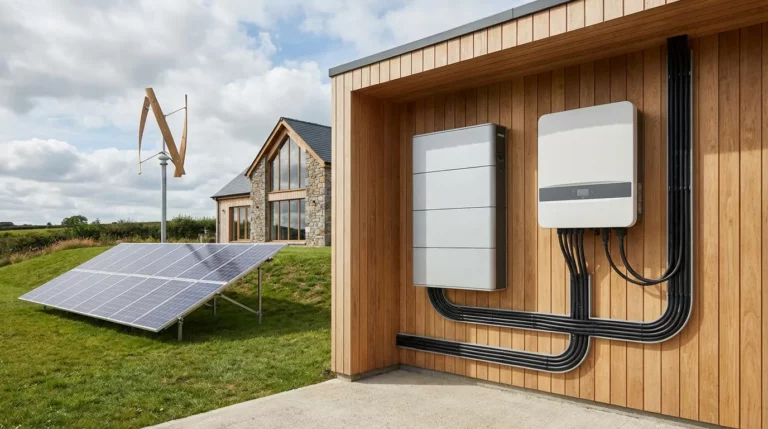
Full energy independence — running your house entirely on power you generate yourself, with no utility bill and no grid dependence — is possible. But for most families of 4 in suburban or urban settings, the path there is not a single step. It is a series of decisions that get you progressively less dependent on the grid, each with its own cost and benefit. A $400 portable power station that keeps your fridge running for 24 hours during an outage is an off-grid solution. So is a $50,000 solar-plus-battery system that disconnects your house from the utility entirely. Both count. The question is where on that spectrum makes sense for your family right now.
This guide covers the realistic options: what they cost, what they actually deliver, what the limitations are, and how to build toward greater energy independence over time without making a $25,000 mistake.
Calculating Your Actual Energy Needs
Before spending anything, understand what you are trying to power. A family of 4 in the US uses an average of 10,500 kWh per year — about 877 kWh per month. But averages hide a lot. Your number could be 400 kWh/month in a well-insulated apartment or 1,800 kWh/month in a large house with electric heat and a pool.
Pull the last 12 months of utility bills and find your monthly kWh usage. This is your baseline. Then identify your critical loads — the things you absolutely must power during an emergency:
| Appliance | Typical Wattage | Daily Hours Used | Daily kWh |
|---|---|---|---|
| Refrigerator | 150W average | 24 (cycles on/off) | ~1.5 kWh |
| Chest freezer | 30–100W average | 24 (cycles on/off) | 0.7–2.4 kWh |
| Window AC (small) | 500–900W | 8 | 4–7.2 kWh |
| LED lighting (whole house) | 100–200W | 5 | 0.5–1 kWh |
| Router/modem | 15W | 24 | 0.36 kWh |
| Phone charging (4 devices) | 20W total | 4 | 0.08 kWh |
| Medical device (CPAP) | 30–60W | 8 | 0.24–0.48 kWh |
| Electric water heater | 4,000–5,500W | 3–4 | 12–22 kWh |
| Electric stove (one burner) | 1,000–2,500W | 1–2 | 1–5 kWh |
Notice the electric water heater. It is often the single largest energy consumer in a home — and one of the first things to eliminate or modify when planning any off-grid system. Switching to a gas tankless water heater or adding a timer to your electric heater has a huge impact on how large your solar and battery system needs to be.
Level 1: Emergency Backup Power (Starting Point)
Before investing in a full solar system, most families benefit from having emergency backup power that bridges outages lasting 24–72 hours. Two practical options:
Portable Power Stations
Battery-based stations that charge from the wall, a car, or solar panels. No emissions, no noise, no fuel storage. Good for keeping a fridge, lights, phones, and medical devices running.
- EcoFlow Delta 2 (1kWh, $700–$900): Powers a mini-fridge, lights, and device charging for 24+ hours. Recharges in 80 minutes from a wall outlet. Expandable to 2kWh with an extra battery. Good entry-level option.
- EcoFlow Delta Pro (3.6kWh, $2,500–$3,000): Powers a full-size refrigerator for 2+ days, can run a window AC for several hours. Chainable to 7.2kWh. This is the family-of-4 serious option.
- Jackery Explorer 2000 Pro (2kWh, $1,500–$2,000): Lighter than EcoFlow, good for families who want portability.
- Goal Zero Yeti 3000X (3kWh, $3,000): Premium build quality, compatible with a whole ecosystem of accessories.
Gas Generators
More power, more runtime, but requires fuel storage and produces carbon monoxide (outdoor use only). For a family of 4 needing to run a refrigerator, some lighting, and a window AC:
- Champion 3500W dual-fuel generator ($450–$550): Runs on gas or propane. 3,500 running watts is sufficient for a fridge + lights + one window AC. A standard 20 lb propane tank gives about 8 hours of runtime. Store 3–4 tanks and you have 24–32 hours of power.
- Honda EU2200i ($1,000–$1,200): Super quiet (49 dB), inverter generator, fuel-efficient. Lower power (2,200W) but runs 8 hours on less than a gallon. Premium quality, worth it if noise matters in your neighborhood.
- Generac 22kW standby generator ($4,000–$6,000 installed): Permanently installed, runs on natural gas or propane, starts automatically when power goes out. Powers the whole house. Requires a transfer switch and professional installation.
Level 2: Grid-Tied Solar with Battery Backup
This is where most suburban families should focus. A grid-tied solar system with battery storage lets you:
- Generate most or all of your own electricity during the day
- Store excess in batteries for evening and night use
- Power critical loads during grid outages
- Sell excess electricity back to the grid (where net metering is available)
Solar System Sizing for a Family of 4
A typical family of 4 using 900 kWh/month needs about a 7–10 kW solar array to cover most of their usage (assuming 4–5 peak sun hours per day, which varies by location). Rough sizing:
| Monthly Usage | System Size Needed | Panels Required (400W each) | Roof Space Needed |
|---|---|---|---|
| 500 kWh | 4–5 kW | 10–13 panels | 200–260 sq ft |
| 900 kWh | 7–9 kW | 18–23 panels | 360–460 sq ft |
| 1,500 kWh | 12–15 kW | 30–38 panels | 600–760 sq ft |
System cost (2026): Installed solar costs $2.50–$3.50 per watt before incentives. A 8 kW system runs $20,000–$28,000 installed. After the federal Investment Tax Credit (30% through at least 2032), that is $14,000–$19,600. Many states add additional incentives on top of the federal credit.
Battery Storage
Battery storage is what turns a grid-tied system into a genuine resilience asset. Without storage, your solar panels go dark during a grid outage — by code, grid-tied inverters must shut down when the grid fails, to protect utility workers. With storage, you have a dedicated emergency power supply.
- Tesla Powerwall 3 (13.5 kWh, $12,000–$15,000 installed): The market standard. Powers a home with typical critical loads for 1–2 days. Built-in inverter. Can be stacked. Waiting lists vary by region.
- Enphase IQ Battery 5P (5 kWh per unit, $5,000–$8,000 installed): Modular — add more units as budget allows. Compatible with Enphase microinverters (very common in residential solar).
- Franklin Electric apower (13.6 kWh, $8,000–$12,000 installed): Competitive with Powerwall, growing market share, often faster availability.
A single 13.5 kWh battery covers approximately: refrigerator (1.5 kWh) + lighting (0.5 kWh) + device charging (0.5 kWh) + CPAP (0.5 kWh) + router (0.4 kWh) = 3.4 kWh critical load per day — giving you about 4 days of critical load power without any solar recharge. Add daily solar production and you are effectively indefinite during daylight hours.
Level 3: True Off-Grid Systems
Full disconnection from the utility is a different category of commitment — financially and logistically. Reasons a family of 4 might pursue this:
- Rural property where grid connection would cost $15,000–$50,000+ in line extension fees
- Ideological commitment to full energy independence
- Area with very frequent or extended grid outages
A true off-grid system for a family of 4 requires significantly more battery storage (typically 30–60 kWh to cover multiple cloudy days) and often includes a backup generator. Realistic cost: $50,000–$100,000 for a well-designed system. This is not a weekend DIY project — it requires a licensed electrician and often a solar system designer.
For most suburban families, Level 2 (grid-tied solar with battery backup) achieves 80–95% of the resilience benefit of Level 3 at a fraction of the cost.
Wind, Hydro, and Other Sources: Honest Assessment
Small wind turbines for residential use are rarely cost-effective. A turbine that produces meaningful electricity requires average wind speeds above 10–12 mph, which most suburban and urban locations do not have. Small turbines (1–10 kW) cost $15,000–$75,000 installed, have significant noise and aesthetic objections from neighbors and HOAs, and underperform in typical residential settings. Solar is almost always the better choice in populated areas.
Micro-hydro is highly effective — if you have a year-round stream with sufficient flow and elevation drop on your property. Most suburban families do not. If you do have this resource, a micro-hydro system provides the most consistent renewable power of any option (24/7, weather-independent). Costs vary widely ($5,000–$30,000) depending on site conditions.
Biomass/biogas digesters (HomeBiogas systems, $900–$1,500) turn kitchen scraps and animal waste into cooking gas. Genuinely useful as a supplemental cooking fuel source, especially for homesteaders. Not a primary power source for a suburban family.
Permits and Practical Considerations
Any permanent solar or generator installation requires permits. Do not skip this step — unpermitted systems can void homeowner’s insurance, create problems at sale, and create safety risks.
- Solar systems: Require a building permit, electrical permit, and utility interconnection agreement. Most reputable solar installers handle all of this. Permitting typically adds 2–6 weeks to the timeline.
- Standby generators: Require a permit for the gas line connection and a separate permit for the transfer switch. Electrician and gas plumber installation required.
- HOA restrictions: Check your HOA rules before any installation. Many states have solar access laws that restrict HOAs from prohibiting solar, but enforcement varies.
- Battery storage: Some municipalities require permits for battery installations above a certain size. Your installer should know local requirements.
Common Mistakes Families Make with Off-Grid Power
1. Buying a generator without planning for fuel storage
A generator is only useful if you have fuel for it. A 3,500W gas generator burns about 0.5 gallons per hour at 50% load — that is 12 gallons per day for continuous critical load operation. Storing gasoline is difficult (degrades in 30–90 days without stabilizer, creates fire hazard). The better solution: a dual-fuel generator running on propane, with 3–4 full 20 lb tanks stored properly. Propane stores indefinitely and is much safer.
2. Assuming solar panels produce full rated output
A 10 kW solar array does not produce 10 kW continuously. In practice, accounting for shading, panel angle, temperature, and non-peak hours, a 10 kW system in a mid-latitude US location produces about 1,200–1,500 kWh per month on average — not the theoretical maximum. Size your system to your actual average production, not peak wattage.
3. Installing solar without battery storage and then being surprised during outages
This is the most common solar disappointment. Families install $20,000 of solar panels expecting power during outages — and discover that grid-tied inverters legally must shut down when the grid fails. Without batteries, your solar system is useless during the exact situation you prepared for. If outage protection matters to you, budget for at least one battery unit from the start.
4. Undersizing the battery bank
A single Tesla Powerwall (13.5 kWh) running critical loads for a family of 4 without solar recharging will last about 3–4 days. A multi-day winter storm is 5–7 days. Either size the battery bank for your target outage duration, plan for solar recharging, or keep a generator as backup.
5. Not checking net metering rules before going solar
Net metering (selling excess solar back to the grid at retail rates) significantly affects solar payback calculations. Many utilities have reduced or eliminated net metering in recent years — check your current utility tariff before running payback projections. In some states, excess power is credited at wholesale rates (3–5 cents/kWh), not retail rates (12–18 cents/kWh), which changes the economics significantly.
FAQ
How much does a solar system with battery backup actually cost for a family of 4?
For a typical family of 4 using 900 kWh/month, a grid-tied 8 kW solar system with one Tesla Powerwall runs about $30,000–$40,000 before incentives. After the 30% federal tax credit, that is $21,000–$28,000. Add state incentives and the net cost often comes in at $18,000–$25,000. At $0.15/kWh electricity rates and 80% solar offset, annual savings are approximately $1,300–$1,600 — putting payback at 12–16 years. With electricity rates increasing (average US rate has increased about 4% per year historically), actual payback is often closer to 8–12 years.
What is the minimum viable backup power setup for a family of 4?
A $700–$900 EcoFlow Delta 2 (1 kWh) keeps a refrigerator, basic lighting, phone charging, and a CPAP machine running for 18–24 hours. A $2,500 EcoFlow Delta Pro (3.6 kWh) extends that to 2–3 days and can run a window AC for several hours. Pair either with 200W of portable solar panels ($150–$300) to recharge during daylight, and you have a system that can sustain a family indefinitely on critical loads during daylight hours. This is the most cost-effective emergency power setup for most families.
Can I go fully off-grid in a suburban home?
Technically yes, practically difficult. Most suburban municipalities do not allow full disconnection from the utility if grid connection is available. Physically, you can install a large enough solar and battery system to meet your needs — but you may still be required to maintain a grid connection (and pay a minimum monthly connection fee). True off-grid is most practical for rural properties where the grid is genuinely unavailable or where utility connection would be very expensive.
How long do solar panels and batteries actually last?
Modern solar panels degrade at about 0.5% per year — after 25 years they are producing about 88% of original output. Most manufacturers warranty panels for 25 years. In practice, panels from the 1990s are still producing meaningful power today. Batteries are the limiting factor: lithium-ion batteries (Powerwall, etc.) typically warranty for 10 years with 70% capacity retention. After 10 years you may have 60–70% of original storage capacity. Battery replacement is the major ongoing cost in any battery storage system.
Bottom Line
Energy independence for a family of 4 is not an all-or-nothing decision. Start where the math makes sense: a $800 portable power station and a $450 dual-fuel generator covers most families through a week-long outage for under $1,300. If you own your home and have a good roof, grid-tied solar with one battery unit is worth running the numbers on — the 30% federal tax credit makes it more cost-competitive than it has ever been.
The worst approach is paralysis. A generator that sits unused in a garage for 10 years is still worth having when the ice storm hits. Build the system incrementally, starting with the layer of protection that fits your current budget, and add to it over time.
Official sources & further reading
The guidance in this article aligns with official emergency-preparedness resources. Consult them for the authoritative version:

Dan Lockland is a preparedness instructor and survival skills educator with over 15 years of hands-on experience. He shares practical, no-nonsense guidance on emergency preparedness, self-reliance, and sustainable living at PreparingWithDan.com.