
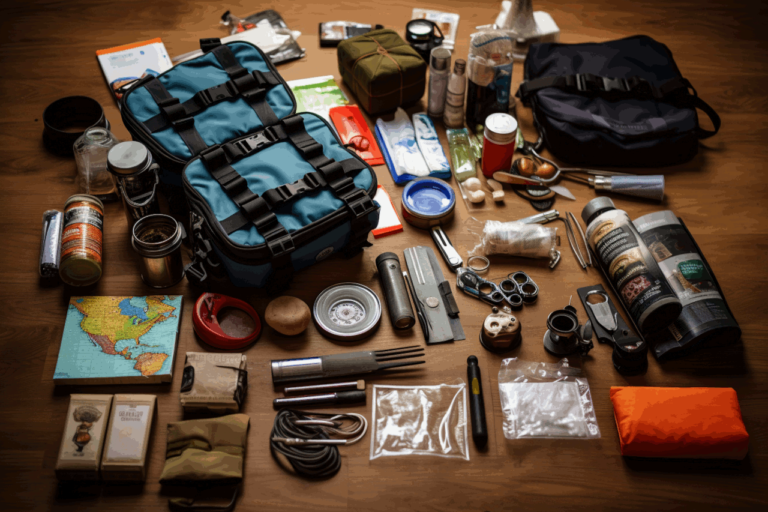
Sealed in a foil-laminate (“Mylar”) pouch with an oxygen absorber, white rice keeps for 25 to 30 years — Utah State University Extension’s figure, backed by a 30-year BYU study. The same two products used on the wrong food do the opposite: USU’s packaging guidance limits absorbers to bulk dry products low in moisture and oil, because removing oxygen from a moist food is exactly the condition in which the botulism organism grows. The bags below are interchangeable commodities; the food you put in them is the decision.
Five packs compared on what the listing says — bag size, thickness where stated, absorber capacity in cubic centimetres — with the catch for each. No scores, no prices. For what to put in the bags and how much, see our prepper pantry guide and the supply calculator.
Seal this, never that
| Seal with an absorber | Do not seal with an absorber |
|---|---|
| White rice, wheat, oats, pasta, dried beans, white flour, sugar-free dry mixes, powdered milk | Anything moist: jerky that is not bone-dry, home-dried fruit, nuts and brown rice (oils go rancid regardless), sugar and salt (they do not need it and cake with it), anything that needed a fridge |
USU’s packaging page also notes that vacuum packaging is not a preservation method by itself and that removing oxygen increases the ability of the botulism bacteria to grow in foods that needed refrigeration. Dry is the whole condition: if it snaps, seal it; if it bends, do not.
Sizing the absorber
Absorber capacity is rated in cc of oxygen. The usual manufacturer guidance is 300-400 cc for a 1-gallon bag of dense food and 2,000-2,500 cc for a 5-gallon bucket; follow the packet, and use one size up rather than down if the food is coarse (pasta, beans) because there is more air between the pieces. Absorbers start working the moment their packaging is opened: work in batches, seal the unused ones in a small Mylar bag immediately, and treat a packet that has been open for a day as spent.
At a glance
| Product | Best for | Size / absorber (listing) |
|---|---|---|
| SYMYNELEC Mylar bags, 100 bags with 400 cc absorbers | Portioning a bulk pantry into 1-gallon bags | 100 bags + 100 × 400 cc |
| Wallaby 1-gallon gusset bags, 30 count | A thicker bag for the buckets you open and close | 30 × 1 gal, zipper |
| ROYLO GLOBE 120 bags with 150 absorbers | The most bags per box for a large pantry | 120 bags + 150 absorbers |
| Wallaby MRE-size bags, 30 count | Single meals, spices, seeds, the go-bag | 30 × 0.4 L |
| Home Sensei 2,500 cc oxygen absorbers, 20 count | 5-gallon buckets and large bags | 20 × 2,500 cc |

SYMYNELEC Mylar bags, 100 bags with 400 cc absorbers
For: Portioning a bulk pantry into 1-gallon bags
What the listing says: 100 PET/aluminium foil/PE bags with 100 matching 400 cc oxygen absorbers.
Before you buy: A hundred absorbers arrive in one sealed pack. Once you open it the clock starts on all of them; plan a packing session of the whole batch, or lose most of the absorbers to the air.

Wallaby 1-gallon gusset bags, 30 count
For: A thicker bag for the buckets you open and close
What the listing says: 30 stand-up gusseted 1-gallon Mylar bags, polyethylene/Mylar laminate, resealable zipper.
Before you buy: Absorbers are not included; buy the 300-400 cc size separately. The zipper is a convenience for the bag you are using, not a seal: heat-seal above it for storage and use the zipper after you cut it open.

ROYLO GLOBE 120 bags with 150 absorbers
For: The most bags per box for a large pantry
What the listing says: 120 1-gallon aluminium Mylar bags with 150 oxygen absorbers.
Before you buy: The absorber size is the number to check on the listing before ordering: a 1-gallon bag of rice needs 300-400 cc, and a small absorber in a big bag leaves oxygen behind. Buy for the food, not the count.

Wallaby MRE-size bags, 30 count
For: Single meals, spices, seeds, the go-bag
What the listing says: 30 small (about 0.4 litre) Mylar bags for single portions.
Before you buy: The right bag for a week of oatmeal portions or a seed vault; the wrong bag for a 20 lb sack of rice. Small bags need small absorbers (50-100 cc): the 400 cc packet sold with gallon bags is wasted here.
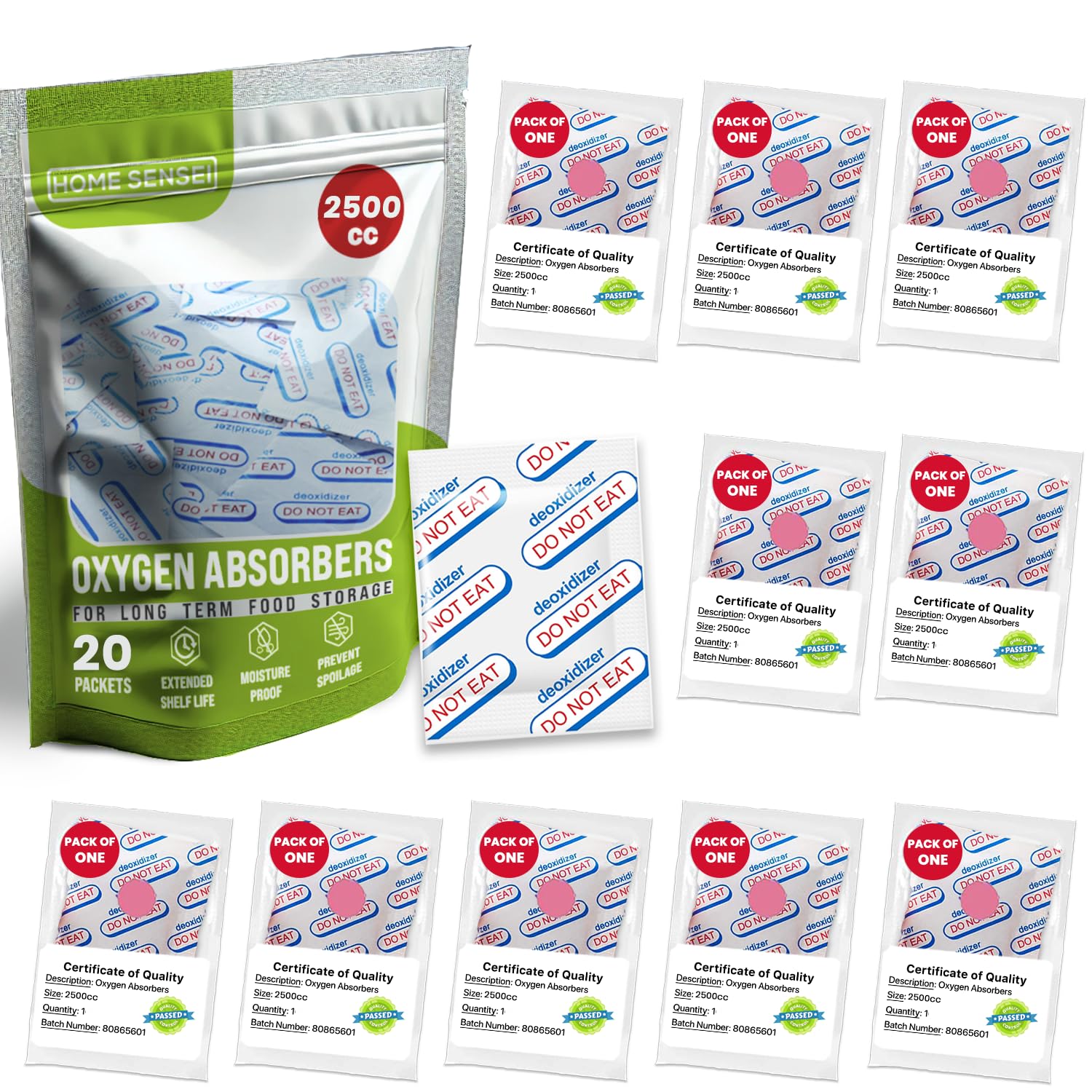
Home Sensei 2,500 cc oxygen absorbers, 20 count
For: 5-gallon buckets and large bags
What the listing says: 20 oxygen absorbers rated 2,500 cc, for 5-gallon buckets or equivalent.
Before you buy: One per 5-gallon bucket of dense food, not per gallon bag — in a gallon bag it does no harm but wastes money. Keep the unused ones sealed; twenty is two or three packing sessions, not twenty.
The packing session, in order
- Cool, dry day; food at room temperature; bags labelled with contents and date before filling.
- Fill, leaving enough headroom to seal; drop the absorber on top; press out the air.
- Heat-seal with a clothes iron or hair straightener on a flat edge — a proper seal is a continuous line with no channels.
- Bagged food goes into a bucket or bin: Mylar stops oxygen and light, not rodents or a dropped hammer.
- Store as cool as the house allows. USU’s rice figure is 10 years at a constant 70°F and up to 30 in a cooler space; a garage that hits 100°F in August costs you decades.
- Seal the leftover absorbers immediately in a small bag.
What the bag will not do: fix food that was already stale, protect brown rice or nuts from going rancid, or make a moist food safe. Our guides on building a prepper pantry and freeze-dried foods cover what goes in.
FAQ
How long does food last in Mylar with an oxygen absorber?
For low-moisture, low-oil staples such as white rice, wheat and beans, USU Extension cites 25 to 30 years when sealed with an absorber and stored cool. Oily and moist foods do not get that benefit, whatever the packaging.
Can I reuse oxygen absorbers?
No. An absorber is spent once it has taken up its rated volume of oxygen, and it begins doing that as soon as its packaging is opened. Unused absorbers survive only if resealed airtight straight away.
Do I need a vacuum sealer?
No. A household iron or hair straightener heat-seals a Mylar bag; the absorber removes the oxygen that a vacuum would. A vacuum sealer on its own, per USU, is not a preservation method.
Preparing with Dan is reader-supported: as an Amazon Associate we earn from qualifying purchases. Product details are as stated on the retailer listings at the time of writing; check the listing before you buy.
Official sources & further reading
The guidance in this article comes from official sources. Consult them directly for the authoritative version:

Dan Lockland is a preparedness instructor and survival skills educator with over 15 years of hands-on experience. He shares practical, no-nonsense guidance on emergency preparedness, self-reliance, and sustainable living at PreparingWithDan.com.