
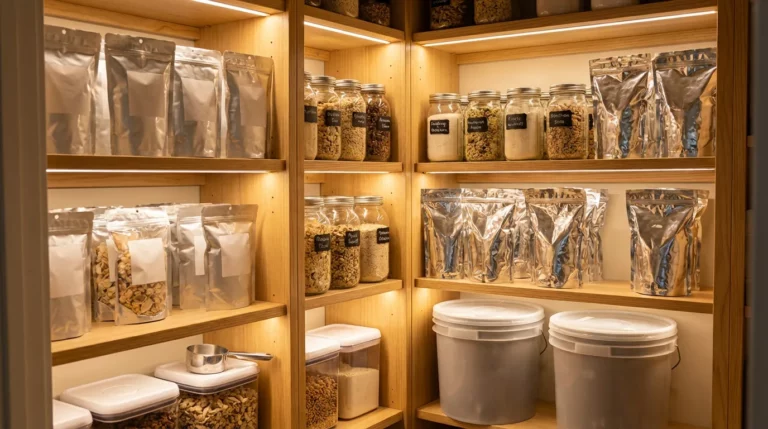
Not all freeze-dried food is worth storing. Some products are expensive, calorie-light, and will sit unused in your pantry for decades because nobody actually wants to eat them in an emergency. After years of building and rotating emergency food supplies for my family of 4, I have narrowed down the freeze-dried foods that are actually worth buying: high calorie density, things my family will realistically eat, products that work in multiple recipes, and brands that consistently deliver.
This is not a list of everything you can freeze-dry. It is a prioritized list of what delivers the most value per dollar and per cubic foot of storage space.
The List: 10 Freeze-Dried Foods That Actually Belong in Your Pantry
1. Freeze-Dried Chicken (Diced or Shredded)
Protein is the hardest macronutrient to store long-term without freeze-drying. Freeze-dried chicken solves this problem completely. It rehydrates in 10 minutes to a texture and flavor that works in soups, rice dishes, pasta, and stews. A single #10 can (the large institutional can used by most brands) contains about 30 oz of actual chicken — enough protein for a family of 4 over several meals.
Best options:
- Mountain House Chicken Dices: #10 can, $90–$110, 25+ year shelf life. Consistently the best rehydration texture.
- Thrive Life Freeze Dried Chicken: #10 can, $95–$120. Slightly better flavor. Subscription model available.
- Augason Farms Chicken Chunks: #10 can, $70–$85. More affordable, good quality.
Storage recommendation for a family of 4: 6–12 #10 cans for a 3-month supply.
2. Freeze-Dried Whole Eggs
Eggs are the most nutritionally complete food you can store. Freeze-dried whole eggs reconstitute with water to make scrambled eggs, baked goods, omelets, and egg-based sauces. A single #10 can equals approximately 240 whole eggs — that is 60 dozen eggs at a fraction of the refrigerated cost, shelf-stable for 10+ years. This is the single best value item on this list.
Best options:
- Nutristore Freeze Dried Whole Eggs: #10 can, $50–$60. Best value per egg.
- Augason Farms Morning Moo Scrambled Eggs: #10 can, $45–$55. Slightly different formulation; very popular.
- Mountain House Scrambled Eggs with Bacon: $12–$15 per serving pouch. More expensive but excellent taste — good for go-bags.
Storage recommendation: 4–6 cans minimum. Eggs replace at least one meal per day in most households.
3. Freeze-Dried Butter and Powdered Dairy
Calorie density is critical in an emergency food supply — you need enough calories to sustain energy, and fat is the most calorie-dense macronutrient. Freeze-dried butter reconstitutes to near-normal butter and adds a massive calorie and flavor boost to any meal. Combine this with powdered whole milk and cheese powder for a complete dairy category.
Best options:
- Hoosier Hill Farm Butter Powder: 2 lb bag, $25–$35. Best value butter powder.
- Augason Farms Butter Powder: #10 can, $40–$50.
- Thrive Life Freeze Dried Cheddar Cheese: #10 can, $80–$100. Actual cheese, not processed cheese product — rehydrates well.
- Augason Farms Morning Moo Low Fat Milk Alternative: #10 can, $35–$45. Not pure milk but functional for cooking.
4. Freeze-Dried Strawberries
Morale matters in an extended emergency. Freeze-dried strawberries are the best morale-per-dollar item on this list — kids eat them straight out of the can, adults put them on oatmeal and in smoothies, and they provide significant vitamin C (100% of daily value per serving). When everything else in your emergency pantry feels like survival food, freeze-dried strawberries taste like a treat.
Best options:
- Nutristore Freeze Dried Strawberries: #10 can, $40–$55. Best value for volume.
- Thrive Life Freeze Dried Strawberry Slices: $45–$60. Premium flavor.
- Amazon basics brand: Various smaller packages, $12–$20 per bag for sampling.
Also worth stocking: freeze-dried blueberries (#10 can, $60–$80 — more expensive but antioxidant-dense) and mixed berry blends.
5. Freeze-Dried Sweet Corn
Sweet corn is one of the most versatile and calorie-dense vegetables in the freeze-dried category. It rehydrates in minutes, works in soups, chili, rice dishes, and casseroles, and kids will actually eat it without complaint. A #10 can contains roughly 60 servings and costs $35–$50. Cost per serving: $0.60–$0.85. That is excellent value for a freeze-dried vegetable.
Best options:
- Augason Farms Freeze Dried Whole Kernel Corn: #10 can, $35–$45.
- Thrive Life Freeze Dried Sweet Corn: $40–$55. Slightly sweeter flavor.
6. Freeze-Dried Peas
Green peas provide protein (4g per serving), fiber, vitamins K and C, and iron. They are one of the few vegetables that pull double duty as both a vegetable and a protein supplement. Like corn, they rehydrate quickly and work in almost any savory dish. They are also among the cheapest freeze-dried vegetables.
Best options:
- Augason Farms Freeze Dried Peas: #10 can, $30–$40.
- Nutristore Freeze Dried Green Peas: #10 can, $35–$45.
7. Freeze-Dried Broccoli
Broccoli is nutritionally dense in a way that few other vegetables are: 1 cup provides 135% of daily vitamin C, 116% of vitamin K, and meaningful amounts of folate, potassium, and fiber. In a long-term emergency food scenario, scurvy and other deficiency diseases are real risks if vegetables are not part of the diet. Broccoli addresses multiple deficiencies at once. It rehydrates well in soups and stir-fry dishes.
Best options:
- Thrive Life Freeze Dried Broccoli: #10 can, $55–$70. Best rehydration quality.
- Augason Farms Freeze Dried Broccoli Florets: #10 can, $45–$60.
8. Freeze-Dried Potato Dices
Potatoes are a calorie-dense, filling, kid-friendly staple that works in soups, stews, hash, and as a side dish. Freeze-dried potato dices rehydrate better than dehydrated potatoes — the texture is closer to freshly cooked. A #10 can has 40–50 servings at $30–$45. Combined with freeze-dried butter and eggs, potatoes form the backbone of several high-calorie emergency meals that actually taste good.
Best options:
- Mountain House Diced Potatoes: #10 can, $45–$55.
- Nutristore Freeze Dried Potatoes: #10 can, $35–$50.
9. Freeze-Dried Ground Beef
Ground beef expands the meal possibilities dramatically. Reconstituted freeze-dried ground beef tastes better than most people expect — it works in chili, tacos, pasta sauce, hash, and soups. Combined with canned tomatoes and beans from your regular pantry, freeze-dried ground beef enables genuinely satisfying meals rather than just survival nutrition. It is expensive ($90–$130 per #10 can) but worth it for variety and morale.
Best options:
- Mountain House Freeze Dried Ground Beef: #10 can, $110–$130. Best flavor and texture.
- Nutristore Freeze Dried Beef: #10 can, $90–$115. Good value alternative.
10. Mountain House Complete Meals (For Go-Bags and Convenience)
The final category is not an ingredient but a complete meal — specifically for your go-bag and for situations where you need a hot, complete, balanced meal with no cooking creativity required. Mountain House just-add-water pouches deliver a full 400–700 calorie meal in a single serving pouch in 10 minutes. The pasta primavera, beef stew, and chicken and rice are genuinely good.
What to buy:
- Mountain House 72-hour emergency food kit: $75–$90, 18 servings (6 per person for 2 days for a 3-person group, or 4.5 days for 1 person). Good starting point.
- Mountain House Pro-Pack pouches: Individual pouches, $10–$15 each. Buy a variety, eat one from each type you buy before stocking up — taste test before committing to a case.
- Wise Company 72-hour kit: $50–$70. More budget-friendly; taste is not quite as good as Mountain House but acceptable.
Storage: How to Make Your Freeze-Dried Investment Last
Freeze-dried foods can last 25–30 years — but only under the right conditions. The three enemies are heat, moisture, and light:
- Temperature: Store at 55–70°F (13–21°C). Each 10°F increase above 70°F roughly halves the effective shelf life. A garage that reaches 90°F in summer degrades 25-year food to 6–10 year food. A basement or interior closet is better.
- Moisture: Sealed #10 cans and mylar pouches handle this. Once opened, a #10 can should be covered and used within 12–24 months. Store open cans with a plastic lid (sold separately, about $2 each) in a cool, dry location.
- Light: Keep food in cardboard cases or in a dark pantry. UV light degrades the packaging and eventually the food inside.
For opened containers: transfer leftover freeze-dried food into a clean quart mason jar with a food-safe oxygen absorber (available on Amazon, $10 for 50 packs). Seal the jar. This gives you a resealable, airtight container that maintains shelf life for months after opening.
Common Mistakes with Freeze-Dried Food Storage
1. Buying food your family will not eat
A #10 can of freeze-dried pinto beans sounds practical. If nobody in your family eats pinto beans in normal life, they will not eat them in a stress-filled emergency either — and you just wasted $40 and storage space. Before buying large quantities of anything, buy the single-serving pouch version, prepare it, and actually eat it. Mountain House sells individual pouches of almost everything. Spend $50 on taste testing before spending $500 on cases.
2. Storing everything in a hot garage
A garage in Phoenix, Texas, or Florida reaches 100°F+ in summer. Storing 25-year freeze-dried food in those conditions reduces effective shelf life to 5–10 years. Move your food storage to an interior closet, basement, or climate-controlled space. If those options are not available, at minimum insulate the storage area and monitor temperatures.
3. Buying only complete meals and skipping ingredients
Complete meals are convenient but expensive on a per-calorie basis and offer limited cooking flexibility. A fully freeze-dried meal from Mountain House runs $10–$15 for 2 servings = $5–$7.50 per serving. Building the same meal from ingredient cans (chicken, potato dices, vegetables, butter) costs $1–$2.50 per serving. Stock both, but weight your inventory toward ingredients for cost efficiency.
4. Not planning water requirements
Every freeze-dried food requires water to rehydrate. A typical freeze-dried meal needs 1–2 cups of water per serving. For a family of 4 eating 3 meals per day from freeze-dried food, you need 3–6 additional gallons of water per day just for food preparation — on top of drinking water. Make sure your water storage plan accounts for this.
5. Neglecting calorie density
Freeze-dried fruits and vegetables are nutritionally valuable but calorie-light. Strawberries: 35 calories per serving. Broccoli: 25 calories per serving. An adult needs 1,800–2,500 calories per day. Do not build a freeze-dried pantry of mostly fruits and vegetables and expect to be well-fed. Balance with high-calorie items: eggs (70 calories each), chicken (120 cal per serving), butter powder (130 cal per tablespoon), and supplement with bulk calorie bases like rice, pasta, and beans.
FAQ
What is the difference between freeze-dried and dehydrated food?
Dehydrated food is dried with heat, which removes most moisture but also degrades some nutrients and flavor compounds. Shelf life is typically 2–10 years. Freeze-dried food is frozen and then moisture is removed through a vacuum process (sublimation) that converts ice directly to vapor without heat. This preserves 90%+ of nutrition and flavor, and enables shelf lives of 25–30 years. Freeze-dried food rehydrates more quickly and to a better texture than dehydrated food. The cost is 2–5x higher per calorie.
How much freeze-dried food does a family of 4 need for 1 month?
A family of 4 needs approximately 8,000–10,000 calories per day total (2,000–2,500 per person). If freeze-dried food is your primary food source, you need about 240,000–300,000 calories for 30 days. That is a large and expensive stockpile if freeze-dried food is your only source. More practical: use freeze-dried food to supplement a base of cheap, calorie-dense bulk staples (rice, beans, pasta, oats) that cover 60–70% of calories. Freeze-dried fills the protein, produce, and dairy gaps the bulk staples miss.
What brands are most reliable for freeze-dried food?
Mountain House (owned by Oregon Freeze Dry, in the business since 1963) is the most consistently reliable brand for taste and shelf life. Thrive Life (formerly Shelf Reliance) has excellent quality, especially for fruits and vegetables, at slightly higher prices. Nutristore offers the best value for eggs and basic vegetables. Augason Farms is widely available at Walmart and offers good mid-range quality. Wise Company is the most budget-friendly option; quality is acceptable but not as good as Mountain House. Avoid generic or unknown brands — the processing quality matters significantly for 25-year shelf life claims.
Can I eat freeze-dried food without cooking it?
Yes, and for some products this is actually preferred. Freeze-dried fruits (strawberries, peaches, blueberries) taste excellent crunchy, straight from the can — many people prefer them this way as a snack. Freeze-dried vegetables can be eaten dry as chips. Complete meals technically only require rehydration with cold water, but hot water produces much better results. Freeze-dried meat and eggs should always be fully rehydrated before eating.
Bottom Line
The most useful freeze-dried foods for a family of 4 are: chicken and eggs for protein, butter and cheese for calories, and a mix of strawberries, corn, peas, broccoli, and potatoes for nutrition and variety. Complete Mountain House meal pouches go in the go-bag. Everything else supplements your existing pantry staples.
Start with the eggs. A #10 can of freeze-dried scrambled eggs is the best single purchase you can make for your emergency food supply — high calorie, high protein, versatile, and shelf-stable for a decade. Buy that first. Then build from there.

Dan Lockland is a preparedness instructor and survival skills educator with over 15 years of hands-on experience. He shares practical, no-nonsense guidance on emergency preparedness, self-reliance, and sustainable living at PreparingWithDan.com.