
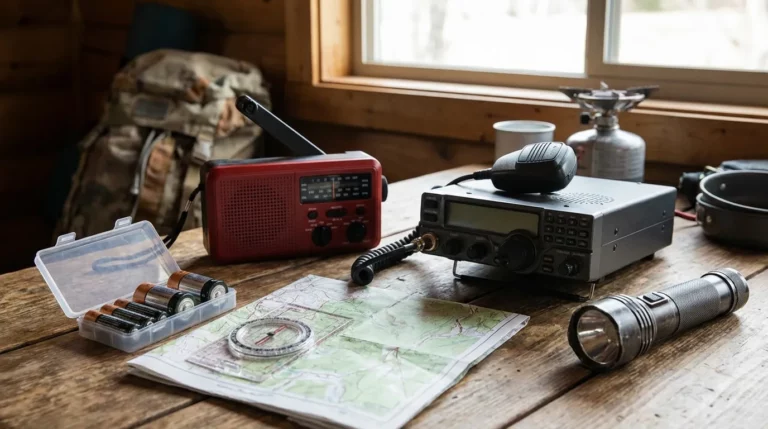
When networks fail, use three tiers: a primary channel (mobile), a backup that works without towers (two-way radio), and a way to receive official alerts (NOAA weather radio). Give everyone one out-of-area contact to text – local lines jam first, while long-distance often still gets through.
The first thing that fails in a major emergency is usually the cell network. It doesn’t go down because the towers are destroyed — it goes down because thousands of people in the same area try to call simultaneously, and the system gets overwhelmed. During Hurricane Sandy, cell networks in some areas were congested for 72+ hours. During the September 11 attacks, New York’s cell network was essentially unusable for most of the day.
Your family communication plan can’t assume the cell network works. It needs to function when cell is congested, when the internet is down, and in the worst case, when all infrastructure has failed. That requires a layered plan built around specific tools and pre-made decisions.
Why Your Current Communication Plan Will Fail
Most families have an informal plan that looks like this: “Call me if something happens.” That plan has three critical failure modes:
- Cell network congestion: In a local emergency, everyone nearby is calling simultaneously. Your call may not connect for hours.
- Separated family members: Your kids are at school, you’re at work, your spouse is across town. Everyone knows to “call,” but nobody knows where to go if calls don’t connect.
- No information source: You don’t know what’s happening, where the threat is, or what’s safe to do — because you’re relying on news apps that require internet.
A real emergency communication plan addresses all three. It takes 30–60 minutes to set up, a single laminated card to document, and costs $50–150 in gear.
The Three-Tier Communication System
| Tier | Scenario | Primary Tools |
|---|---|---|
| 1 — Cell/internet working | Minor emergency, local disruption | Cell phone calls, Signal encrypted group chat, text messages |
| 2 — Cell congested, internet slow or down | Major local emergency, first 12–72 hours | SMS text (uses less bandwidth than calls), GMRS radio for short range, pre-arranged plans |
| 3 — Full infrastructure failure | Grid-down, prolonged disaster, multi-day outage | GMRS/ham radio, physical rally points, out-of-area contact via landline, satellite communicator |
Building Your Family Communication Plan
The Written Document
The family communication plan needs to exist as a physical document — printed and laminated — not just in someone’s head. When you’re stressed, rushed, or separated, you can’t rely on memory.
What the document includes:
- Every family member’s cell number, memorized. Also written down in case the phone is inaccessible. Kids who can’t memorize a full number should know at minimum: mom’s cell, dad’s cell, the out-of-area contact number.
- Out-of-area contact: A family member or close friend in a different city/state. In a localized emergency, long-distance calls often get through when local calls can’t. Everyone calls the same out-of-area person and checks in. That person relays messages between family members who can’t reach each other directly.
- Rally points: Two physical locations where the family meets if communication fails completely.
- Rally Point 1 (Near): A specific spot near home — front corner of the yard, a particular neighbor’s house, the mailbox. Used if evacuation from home is needed but the area is safe.
- Rally Point 2 (Far): A specific location 5–15 miles away. Used if the neighborhood is evacuated. A relative’s home, a church, a named intersection that everyone knows.
- School/work pickup plan: Who picks up which child, and what the backup plan is if that person can’t get there. Schools have their own emergency procedures — know them.
- Radio channel: The specific GMRS channel and sub-code your family uses. Everyone with a radio knows this before any emergency.
Keep one copy in each family member’s bag, one at home, one in each car. Laminated card is ideal — weatherproof and durable.
The Out-of-Area Contact in Practice
The reason the out-of-area contact works: during a localized disaster, local cell circuits are overloaded, but long-distance circuits often have more capacity. The contact acts as a relay station and message board. Your procedure: “I’m safe, I’m at X location, I’ve reached Y family member, waiting for Z.” They log it and relay when others check in.
Choose someone reliable who is home during the day, is reachable by phone, and understands their role. Brief them in advance — they should know they’re designated, know your family members’ names, and know to expect a call from any of you in an emergency.
Radio Communication: Your Cell Phone Backup
GMRS Radios: The Family Standard
GMRS (General Mobile Radio Service) is the right choice for most prepper families. No test required, family license covers everyone in the household ($35 for 10 years), 30–36 mile rated range (practical 1–5 miles in urban/suburban areas, much more in open terrain), and reliable voice communication independent of any infrastructure.
- Midland GXT1000VP4 (~$55/pair): The standard recommendation. 36-mile rated range, 50 GMRS channels, weather alerts, NOAA scan mode, FRS/GMRS hybrid. Waterproof. The best value GMRS radio pair on the market.
- Motorola T800 GMRS (~$100/2-pack): Bluetooth connectivity, 35-mile range, more features. Good option if you want the extra capability.
- Midland MXT275 GMRS Mobile Radio (~$120): Vehicle-mounted unit. Much more powerful (15W vs. 5W for handhelds). For those who want longer range or are using radios from a vehicle as a base station.
Practical setup: Buy at minimum 4 radios (one per adult family member + one spare). Program them all to the same channel and CTCSS sub-code before any emergency. Test them monthly.
Ham Radio: Extended Range and Capabilities
A Technician license (no-code, written test, ~$15 fee) opens up ham radio frequencies with far more range and flexibility than GMRS. Key advantages: repeater access (can extend your radio’s range to 50+ miles through local infrastructure), the 2-meter and 70cm bands, and the ability to communicate with other licensed hams for mutual aid and information.
- Baofeng UV-5R (~$25): The entry point. Works on GMRS (with caveats), ham 2-meter/70cm, and weather frequencies. Get the license before transmitting on ham bands.
- Yaesu FT-65R (~$100): More reliable build quality than Baofeng, same basic functionality. Worth the upgrade for a primary radio.
For most prepper families, GMRS handles 95% of communication needs. Ham adds capability for those willing to get licensed.
Getting Information In: Weather Radio and Monitoring
Communication isn’t just about talking to your family — it’s about knowing what’s happening so you can make decisions. Your information-in layer needs to work without internet.
- Midland ER310 Emergency Crank Radio (~$50): Receives NOAA weather radio (the most critical alert channel for severe weather and local emergencies), AM, FM, and shortwave. Hand-crank backup, solar panel backup, USB phone charging. This is the essential “what’s happening” tool for any grid-down scenario.
- Midland WR400 Weather Radio (~$50): Dedicated NOAA weather alert radio. Sounds an alarm specifically for your county when a watch or warning is issued. Plugs into wall with battery backup. Keep one in the bedroom — a tornado or severe storm warning at 2 AM without this means you may not know until it’s too late.
- AM radio during disasters: AM frequencies travel farther than FM and often have redundant transmitters. Local AM stations are frequently the most reliable news source in a regional emergency when cell is down. The Midland ER310 covers AM.
Satellite Communication for Extreme Scenarios
When all terrestrial infrastructure is down — a scenario that has occurred in major natural disasters affecting large geographic areas — satellite communication is the only option. This is niche and expensive, but worth knowing:
- Garmin inReach Mini 2 (~$350 + $15–50/month plan): Two-way satellite text messaging, GPS location sharing, SOS emergency beacon. Works anywhere on Earth with sky view. The practical tool for serious preppers who may need to communicate during a complete infrastructure failure or from remote locations.
- Spot Gen4 (~$150 + subscription): One-way messaging and SOS. Cheaper but limited — can’t receive messages. Good for letting family know you’re safe, not for two-way conversation.
For most suburban prepper families, satellite comms are overkill. But if you have a cabin or bug-out location in a remote area, or if you’re planning for truly catastrophic scenarios, the Garmin inReach Mini 2 is the right tool.
Common Mistakes
- No physical communication plan written down. “We’ll figure it out” is not a plan. A family separated at the start of a major emergency needs pre-made decisions, not improvisation under stress. Write it down and put it in everyone’s bag.
- No out-of-area contact designated. The out-of-area relay is one of FEMA’s most recommended practices — and one of the most commonly skipped. Designate someone now and brief them.
- Radios never tested. A radio in a drawer that hasn’t been tested in two years may have dead batteries, programming that’s drifted, or a dead display. Test every radio in your kit twice a year.
- No NOAA weather radio. Cell phone emergency alerts have gaps and delays. NOAA weather radio is the most reliable, direct, fastest-updating severe weather alert system in the US. A $50 unit with a fresh battery may be the most important warning you ever receive.
- Children who don’t know the plan. Children who know the out-of-area contact number (or at least mom’s and dad’s cell numbers), understand what the rally points are, and know what to do if they can’t reach a parent — those children have dramatically better outcomes in emergency separations. Practice with them annually.
FAQ
Does texting work when calling doesn’t?
Yes, usually. SMS messages use far less bandwidth than voice calls and queue when the network is congested, often delivering when calls fail. This is particularly reliable during major events where cell towers are intact but overloaded. During a major emergency, try texting first. If SMS is failing too, consider iMessage (Apple) or Signal which route over data rather than the traditional SMS path and can sometimes get through when SMS is congested.
What’s the GMRS license process?
Go to FCC.gov, create an FRN (account), and apply for a GMRS license under the personal use category. It costs $35 (fee as of 2026) and is valid for 10 years. It covers you and all immediate family members in your household. No test required. Your license number goes on every GMRS radio you use. From application to license is typically 1–3 business days online.
How do I set up my family on the same GMRS channel?
GMRS has 22 channels (channels 1–7 are shared with FRS, 8–22 are GMRS-specific). Choose a less-crowded channel (typically channels 15–22 see less traffic). Pick a CTCSS sub-code (tone squelch) — these aren’t privacy codes (anyone with the right radio can still hear you), but they prevent your radio from beeping every time strangers on the same channel talk. Write the channel number and CTCSS code on your communication plan card. Program all family radios identically.
Should I get my ham radio license?
For serious preparedness, yes. The Technician license takes 2–4 weeks of casual study, costs ~$15 to test, and opens up communication options far beyond GMRS — especially repeater access for extended range and the ability to coordinate with local ham emergency response networks (ARES/RACES) in a major disaster. HamStudy.org has free practice exams. The question pool is published — you literally study from the test bank.
What’s the most important communication prep for a family with young kids?
Two things: (1) Every child old enough to dial a phone should memorize the out-of-area contact number plus one parent’s cell number. Make them repeat it until it’s automatic — the same way you’d teach a home address. (2) Run a 15-minute communication drill once a year where you practice what each person does if a disaster happens when the family is separated. Kids who have practiced the plan stay calmer than kids who have only heard about it.
Bottom Line: Emergency communication for a family of 4 requires four things: a written plan (laminated card in every bag) with out-of-area contact and two rally points, a pair of GMRS radios ($55) programmed to a family channel and tested monthly, a NOAA weather radio in the bedroom ($50), and the ability to send texts when calls fail. Set this up in one afternoon. The gear costs $100–150 total. The decision about where to meet and who to call when everything goes wrong needs to be made now, not during the emergency.
Official sources & further reading
The guidance in this article aligns with official emergency-preparedness resources. Consult them for the authoritative version:

Dan Lockland is a preparedness instructor and survival skills educator with over 15 years of hands-on experience. He shares practical, no-nonsense guidance on emergency preparedness, self-reliance, and sustainable living at PreparingWithDan.com.