
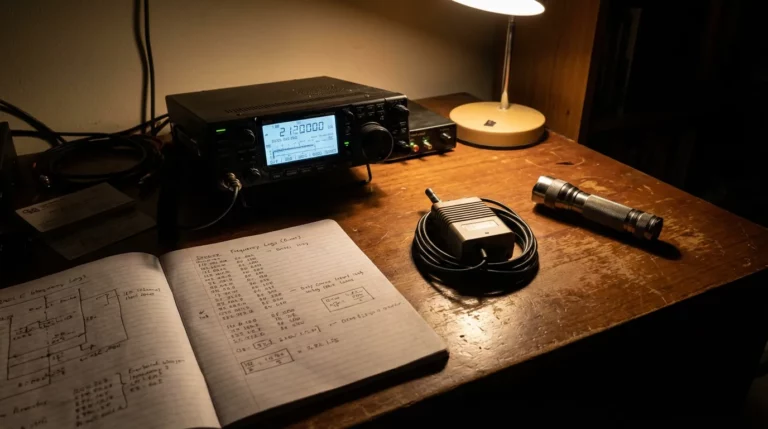
Ham radio is the communication system that works when everything else has failed — when cell towers are down, the internet is out, and your NOAA radio is receive-only. With a ham radio license, you can transmit as well as receive, talk to other operators in your area, coordinate with emergency services, and reach relay networks that can pass messages across the country. You can get your Technician license (the entry-level requirement) in 3–4 weeks of part-time study, for a $15 exam fee. This guide covers everything to get you operational.
Table of Contents
- Why Ham Radio vs. CB, FRS, or NOAA
- Getting Licensed: The Technician Exam
- Your First Radio: Best Picks for Preppers
- Key Frequencies and Protocols
- Emergency Networks to Know
- Power Options for Grid-Down Operation
- Common Mistakes
- FAQ
Why Ham Radio vs. CB, FRS, or NOAA
| Radio type | License required? | Transmit capability | Range | Emergency use |
|---|---|---|---|---|
| NOAA Weather Radio | No | Receive only | N/A (broadcast) | Best for receiving alerts; no two-way |
| FRS (Family Radio Service) | No | Yes, low power | ½ to 2 miles (line of sight) | Short-range family coordination; limited by power cap |
| CB (Citizens Band) | No | Yes, 4W max | 1–5 miles (higher with skip) | Vehicle-to-vehicle; some trucker emergency channels (Ch. 9) |
| GMRS | Yes ($35/10yr, no exam) | Yes, up to 50W | 5–20 miles; access to repeaters | Family communication with repeater access; good midpoint |
| Ham Radio (Technician) | Yes (free exam, $15 fee) | Yes, up to 1,500W (VHF/UHF practical: 5–50W) | Local: 5–50 miles; with repeaters: regional; with HF: worldwide | Best for two-way emergency communication; connects to professional emergency networks |
Ham radio’s advantage over all alternatives is the combination of power, frequency flexibility, and network access. During Hurricane Maria in Puerto Rico (2017), ham radio operators provided the only functioning communication for several days after all cellular and internet infrastructure failed. ARES (Amateur Radio Emergency Service) volunteers were activated within hours of the storm. That network is in every US region — and it activates on a real event, not in theory.
Getting Licensed: The Technician Exam
The FCC Technician license is the entry-level amateur radio license in the US. It requires passing a 35-question exam (from a published question pool), costs $15, and takes most people 2–4 weeks to prepare for with part-time study.
The three license levels:
- Technician: Access to all VHF/UHF amateur bands (2 meters, 70 cm) plus limited HF privileges. Sufficient for local emergency communication, repeater access, and most preparedness use cases.
- General: Adds most HF band privileges — ability to communicate hundreds to thousands of miles without relying on repeaters. Recommended as a follow-up within 6–12 months of Technician.
- Amateur Extra: Full HF privileges plus additional spectrum. Not necessary for most preparedness users.
How to prepare and test:
- Study: Use hamstudy.org (free, adaptive flashcard system) or the ARRL Technician manual ($30). The question pool is published and fixed — you’re studying exact questions that appear on the exam.
- Find an exam session: ARRL.org lists in-person and online exam sessions. Online exams through HamStudy.org are available most weekends.
- Take the exam: 35 questions, 26 correct required to pass ($15 fee). Exam results are typically processed by the FCC within 1–3 business days; your license appears in the FCC database before your paper license arrives.
- Get on the air: Once your call sign appears in the FCC database, you can transmit legally.
Your First Radio: Best Picks for Preppers
Best for most beginners: Yaesu FT-60R (~$160)
The Yaesu FT-60R is the most recommended first radio in the preparedness community. It’s a handheld dual-band (2m/70cm) radio with 5W transmit power, wide receive capability (including aircraft and weather bands), and an extremely durable construction. Runs on a rechargeable Li-ion battery or AA batteries as backup — critical for grid-down operation. The menu system is dated but functional. This is the “buy it once” option in this category.
Budget learner: Baofeng UV-5R (~$25)
The Baofeng UV-5R is cheap enough to buy while studying, program, and learn on before committing to a better radio. It transmits and receives on 2m/70cm, supports CTCSS tones for repeater access, and allows you to receive NOAA weather channels. Limitations: build quality is lower, the default firmware has quirks, and the antenna is mediocre. Use Chirp software (free, open source) to program it — the manual is nearly unusable. A fair learning tool; not a reliable emergency radio.
Mobile unit (for home or vehicle): Yaesu FT-7900R (~$200)
A mobile radio installed in your home or vehicle dramatically increases range and capability. The Yaesu FT-7900R outputs 50W on 2m and 45W on 70cm — 10× the power of a handheld. Connected to a simple vertical antenna, this reaches repeaters 50–100 miles away in most regions. This is the home base station for serious emergency communication. Power it with a 12V deep-cycle battery during grid outages.
Key Frequencies and Protocols
National calling frequencies (where people listen for contacts):
- 146.520 MHz (2m simplex national calling): The most-used simplex (no repeater) frequency for VHF; standard channel to call CQ (general call) or make contact in an emergency when repeaters are unavailable
- 446.000 MHz (70cm simplex national calling): 70cm equivalent of the 2m calling frequency
- 7.200 MHz (40m HF — General license and above): Primary HF emergency frequency for nationwide and regional communication; highly active during disasters
Repeaters: Repeaters are mountaintop or high-building antennas that receive your signal on one frequency and rebroadcast it on another, dramatically extending range. To find local repeaters: repeaterbook.com — search your county. Program your top 5 local repeaters into your radio now, before an emergency. Include the input offset and any CTCSS tone required to access each repeater.
NOAA Weather Radio frequencies on ham radios: Most ham radios also receive NOAA weather broadcasts (162.400–162.550 MHz). Program these into your radio’s memory as well — one radio for both emergency information and two-way communication.
Emergency Networks to Know
ARES (Amateur Radio Emergency Service): The primary amateur radio emergency network in the US. ARES volunteers register with their county emergency management agencies, train on emergency communication protocols, and activate during disasters to provide communication support for Red Cross, hospitals, EOCs (Emergency Operations Centers), and government agencies. Find your local ARES group at arrl.org/ares. Joining ARES is the single highest-value action a licensed ham radio operator can take for both community preparedness and personal skill development.
RACES (Radio Amateur Civil Emergency Service): A parallel network to ARES, officially sponsored by local government emergency management. RACES activates under civil emergency declarations. Some counties use ARES/RACES interchangeably; others maintain both. Your county emergency management office will tell you which is active locally.
SKYWARN: National Weather Service’s volunteer network of weather spotters. Many ham operators participate in SKYWARN to report weather conditions in real time during storm events. Excellent way to connect with local ARES members and develop emergency communication skills.
Winlink (radio email): A system that allows email-style messages to be passed over ham radio frequencies without internet. Useful in extended grid-down events for sending welfare messages and requesting resources. Requires an additional software setup (Winlink Express, free) but is a meaningful capability for serious emergency operators.
Power Options for Grid-Down Operation
| Power source | Use case | Runtime estimate | Notes |
|---|---|---|---|
| Rechargeable Li-ion battery pack (handheld) | Normal use | 8–12 hours of typical use | Charge before any anticipated event |
| AA battery adapter (Yaesu FT-60R) | Grid-down extended | 4–6 hours on 6 AA batteries | Keep a stock of AA lithium batteries for long storage life |
| 12V deep-cycle battery (mobile unit) | Home base station | 20–40 hours continuous receive at 12Ah draw | Charge with solar panel or car charger; 100Ah battery runs a mobile radio for days |
| Solar panel (10–20W) | Indefinite grid-down | Indefinite with adequate sunlight | A 20W panel + 100Ah battery is a complete off-grid ham radio station |
Common Mistakes When Starting Emergency Ham Radio
- Buying a radio before getting licensed. You can listen without a license, but you can’t legally transmit. More importantly, most of the value of ham radio — the emergency networks, the repeater systems, the community — requires transmitting capability. Get the license first. Study time: 10–15 hours. It’s not a barrier.
- Only buying a Baofeng and thinking you’re set. A Baofeng UV-5R is a learner radio. The build quality, antenna quality, and firmware reliability are not what you want in an emergency. Once licensed, upgrade to a Yaesu FT-60R as your primary radio. Keep the Baofeng as a backup or loan it to a family member learning.
- Never programming local repeaters. A radio with no repeaters programmed is like a phone with no contacts. Find your county’s primary emergency repeater through ARES or repeaterbook.com, program it in before an emergency, and test it. Trying to program a repeater during a power outage is not the time to learn Chirp.
- Getting licensed but never getting on the air. A license that’s never been used produces a nervous operator in an emergency. Join your local ARES group, check in to weekly nets (scheduled on-air meetings), and participate in drills. 20 minutes a week of radio practice builds the confidence and familiarity that matters when it counts.
- No antenna upgrade. The rubber duck antenna that comes with handheld radios is deliberately mediocre — it’s sized for portability, not performance. A $15–$25 replacement antenna (Diamond RH-77CA or Diamond SRH77CA) improves range by 30–50% with a 5-minute swap.
FAQ
How hard is the ham radio Technician exam?
Most people with 10–15 hours of focused study pass on the first attempt. The question pool is published and fixed — you’re studying exact questions. HamStudy.org shows your estimated pass probability and focuses on your weak areas. The exam is 35 questions from a pool of ~300; you need 26 correct. A weekend of focused study is usually enough for someone with moderate technical background.
Do I need a license to listen to ham radio?
No — receiving is legal without a license. You only need a license to transmit. A Baofeng UV-5R or Yaesu FT-60R can receive ham frequencies, NOAA weather, aviation, and some public safety bands without a license. However, the real value of ham radio in emergencies is two-way communication — getting the license turns a radio scanner into a communication system.
What’s the range of a handheld ham radio?
Simplex (radio to radio, no repeater): ½ to 5 miles depending on terrain and power. With a local repeater: 20–50 miles in most regions. With a mobile or base station radio (50W): 50–100 miles to a repeater, or 5–15 miles simplex. The biggest range upgrade is connecting to repeaters, not increasing transmit power.
Can a family use ham radio without everyone being licensed?
In an emergency under FCC Part 97.403, unlicensed persons may use a licensed station to handle a distress situation that immediately threatens life or property. For regular preparedness communication, GMRS ($35 FCC license, no exam, covers a family) is a better option for unlicensed family members. One family member with a ham Technician license and a GMRS license covers both needs.
What’s the difference between ham radio and NOAA weather radio?
NOAA weather radio is a receive-only broadcast system — you listen to official National Weather Service alerts. Ham radio is a two-way communication system — you can both receive and transmit, talk to other operators, access repeater networks, and coordinate with emergency services. For emergency preparedness, you want both: NOAA for reliable alert reception, ham for two-way communication capability.
Bottom Line
Get your Technician license (3 weeks of study, $15 exam), buy a Yaesu FT-60R (~$160), program your top 5 local repeaters, and join your county ARES group. That’s the complete beginner setup — total investment under $200, total capability that works when every other communication system has failed. For the broader communication plan that ham radio fits into, see How to Build a Custom Family Emergency Plan. For your receive-only emergency radio needs, see Best Hand Crank Emergency Radios.
Last Updated: April 2026

Dan Lockland is a preparedness instructor and survival skills educator with over 15 years of hands-on experience. He shares practical, no-nonsense guidance on emergency preparedness, self-reliance, and sustainable living at PreparingWithDan.com.