
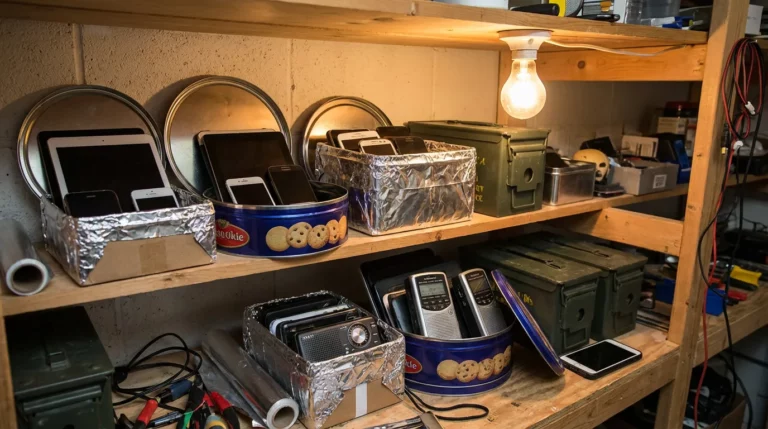
An EMP event is one of the few preparedness scenarios that could simultaneously knock out power, vehicles, communications, and medical equipment across an entire region — permanently. Unlike a storm or a power outage, an EMP doesn’t reset in a few days. Depending on the severity, recovery could take months or years. That’s the case for doing something about it. But there’s also a case for calibrating your preparation to what’s realistic — not every device fails, not every EMP is catastrophic, and modest protection is achievable for most families without building a bunker.
This guide separates the myths from what’s actually documented, tells you specifically what to protect and how to protect it, and gives your family of 4 a practical EMP prep plan.
What an EMP Actually Does to Your Devices
An electromagnetic pulse works by inducing a rapidly changing electrical current in conductive materials — which includes the wiring and circuits inside your electronics. This sudden surge can:
- Burn out microprocessors and transistors — the foundational components of any computerized device
- Destroy circuit boards by creating voltage spikes far beyond rated tolerances
- Damage or destroy data storage — hard drives, SSDs, memory chips
- Affect the power grid itself — by damaging transformers and switching equipment, causing a long-term blackout independent of individual device damage
What it does NOT do: an EMP does not kill people directly, does not affect mechanical equipment without electronics, and does not damage devices that are completely disconnected from any antenna or electrical connection (including ground).
The Two EMP Scenarios You’re Actually Preparing For
Coronal Mass Ejection (CME) — The Realistic Threat
A solar CME sends a massive cloud of charged particles toward Earth. When it hits, it induces currents in long electrical conductors — primarily the power grid’s transmission lines. The 1989 Quebec blackout was caused by a CME that lasted 9 hours and left 6 million people without power. A Carrington-level event (1859) would be 10× larger.
What a major CME damages: The power grid (primarily large transformers, which take months to years to replace), devices plugged into grid power at the time of the event, and some unplugged devices with long antenna-like components.
What survives most CME events: Unplugged devices in shielded containers, vehicle electronics in most cases (short conductors), battery-powered devices not connected to power lines.
High-Altitude Nuclear EMP (HEMP) — The Low-Probability Threat
A nuclear device detonated 30–400 km above Earth generates three distinct EMP pulses. The first (E1) is extremely fast and intense — it would damage solid-state electronics regardless of whether they’re plugged in. The second (E2) resembles a lightning strike. The third (E3) resembles a CME and affects the grid.
A HEMP would be significantly more damaging than a CME to individual devices, including unplugged electronics. Genuine protection requires a properly constructed Faraday cage. The probability of this scenario is genuinely low; most prep analysts treat it as a reason to build good Faraday protection rather than as an imminent threat.
Priority: Which Devices to Protect First
You can’t protect everything — and you don’t need to. Protect in this order of priority:
| Priority | Device Category | Why |
|---|---|---|
| 1 | Communication: NOAA radio, walkie-talkies, satellite communicator | Information is survival — you need to know what happened and what’s coming |
| 2 | Medical: CPAP, insulin pump, cardiac device chargers, hearing aids | Medical device failure is immediately life-threatening for dependent family members |
| 3 | Power generation: Solar charge controllers, small inverters | Needed to recharge everything else; grid will likely be down |
| 4 | Navigation: GPS unit, handheld compass, phone (backup) | Maps and navigation become critical when infrastructure fails |
| 5 | Utility: Flashlights (LED, not incandescent), headlamps | Spare LED drivers are cheap to protect; replacements unavailable post-event |
| 6 | Backup phones and tablets with offline data | Offline survival guides, maps, medical references, family documents |
Faraday Cages: How They Work and What Actually Protects Devices
A Faraday cage works by redistributing external electromagnetic energy around the exterior of a conductive enclosure without allowing it to penetrate inside. The key word is “conductive” — the cage material must conduct electricity, forming a complete skin around the protected items.
What Makes an Effective Faraday Cage
- Complete metal enclosure: No gaps — every seam must be electrically connected (grounded to the same surface)
- Items not touching the walls: The device inside must be insulated from the cage’s conductive surface (use cardboard, foam, or plastic)
- No cables penetrating the cage: Any cable in or out acts as an antenna and channels EMP energy inside
DIY Faraday Options by Budget
| Option | Cost | Effectiveness | Best For |
|---|---|---|---|
| Nested aluminum foil | $2 | Low–Moderate (for E3/CME; not E1) | Quick, temporary protection for individual small devices |
| Galvanized steel trash can (tight-fitting lid, taped seams) | $25–$40 | Moderate–Good | Storing a collection of devices; practical for most families |
| Ammo can (steel, gasketed lid) | $20–$40 | Good–Excellent | Compact devices — walkie-talkies, radios, phones, hard drives |
| Commercial EMP bag (Mission Darkness, TitanRF) | $20–$60 each | Good–Excellent (rated/tested) | Individual device protection; flexible, stackable |
| Metal file cabinet (all-metal, seams lined with conductive tape) | $50–$150 | Good | Large item collection; more organized than trash cans |
The Galvanized Steel Trash Can Method (Most Practical)
For a family of 4, a 32-gallon galvanized steel trash can ($35) with a tight metal lid is the most practical DIY Faraday solution:
- Purchase a galvanized steel can with a metal lid that fits snugly
- Line the interior with cardboard or foam — nothing inside touches the metal walls
- Wrap items in additional plastic bags or plastic containers before placing inside
- Tape the lid seam with conductive copper tape ($8 for a roll) to improve the seal
- Keep the can away from walls and on a rubber or wooden surface (insulated from ground)
- 1 × galvanized steel 32-gallon can + lid ($35) + copper tape ($8) = Main storage cage
- 2 × ammo cans ($30 each) = Compact device storage
- 4 × Mission Darkness faraday bags ($25 each) = Individual device bags for daily-use backup phones
- Total: ~$200 for comprehensive protection
What to Actually Put Inside Your Faraday Cage
Recommended contents for a family of 4’s protected cache, in priority order:
- Communication: RunningSnail hand-crank NOAA radio, 2 pairs of Midland walkie-talkies, backup handheld GPS unit
- Power: Small solar charge controller (separate from your main system), 4 USB power banks (fully charged), spare solar panel (if small enough)
- Navigation: Offline-loaded smartphone with maps, survival guides, and medical references saved locally; printed paper maps as ultimate backup
- Medical: Spare charging cables for any medical devices; spare batteries for any battery-operated medical equipment
- Data: Encrypted USB drive with copies of all family documents (IDs, insurance, medical records, deeds)
- Utility: 4 spare LED headlamps and a bag of batteries; spare LED driver/flashlight
- Spare vehicle electronics: If you have an older vehicle’s spare parts (ignition module, etc.) — only relevant for certain vehicle years
Vehicle EMP Protection
Vehicles are a frequent topic of EMP concern. The reality is nuanced:
- Vehicles built before 1980 with minimal electronics (no computer-controlled fuel injection, no electronic ignition) are largely immune to EMP
- Modern vehicles have short antenna lengths in their wiring and have passed some degree of transient voltage testing — most would survive a CME event and many E3 scenarios
- An E1 pulse from a HEMP would likely damage modern vehicle ECUs (engine control units) — but this is the most uncertain variable
Practical action: If you have an older carbureted vehicle (pre-1980) that runs, maintain it as a backup. If not, consider keeping a spare ignition module in an ammo-can Faraday cage — a $30–$80 part that, if protected, lets you restore your vehicle after an event.
Surge Protection for Everyday Use (CME Early Warning)
For solar storm events, NOAA’s Space Weather Prediction Center (swpc.noaa.gov) typically provides 1–3 days of warning before a major CME reaches Earth. This window allows you to:
- Unplug all devices from wall power
- Move daily-use devices into your Faraday cage
- Disconnect your home from the grid (main breaker off) if a Carrington-level event is forecast
Sign up for NOAA space weather alerts (free at swpc.noaa.gov/products/notifications-timeline). A “G4” or “G5” geomagnetic storm warning is your signal to act. Lower-level storms (G1–G3) are common and generally don’t require action beyond surge protection on connected devices.
Common Mistakes in EMP Preparation
1. Using cardboard boxes as Faraday cages
Cardboard is not conductive. Wrapping devices in aluminum foil inside a cardboard box creates a partial cage — better than nothing, but not reliable. You need a continuous conductive metal enclosure.
2. Leaving gaps or cable penetrations in the cage
A Faraday cage with a USB cable running through a gap is like a waterproof bag with a hole in it. Every penetration is an antenna. Nothing goes in or out while the cage is active. All seams must be electrically connected.
3. Storing devices while they’re touching the cage walls
The device must be insulated from the cage itself. If it touches the metal, the cage can conduct energy into the device rather than around it. Use cardboard, plastic containers, or foam as internal insulation.
4. Protecting devices but not having a plan for non-electronic survival
Your protected radio is worthless if you have no food and water. EMP prep makes you communications-capable in a grid-down world. It doesn’t replace food storage, water, and the other fundamentals. Build EMP protection on top of a solid preparedness base — not instead of it.
5. Not having a non-electronic backup for every critical function
For every critical function that relies on electronics (navigation, time-keeping, communication, cooking), have a zero-electronics backup: paper maps, mechanical watch, written contact list, wood stove. Electronics that survive are a bonus; non-electronic capability is your floor.
FAQ
Does a microwave oven work as a Faraday cage?
Partially. Microwave ovens are designed to keep microwave frequencies inside, not to block EMP frequencies from outside. They provide some protection but are not rated or tested for EMP resistance. Their door seals are designed for microwave-frequency containment and typically have gaps at the EMP-relevant lower frequencies. Better than nothing; not a reliable substitute for a purpose-built cage.
Will my car start after an EMP?
Probably, for a CME event. Modern vehicles have been somewhat hardened against transient voltage events and their short antenna lengths (wiring) limit induced current. Many vehicles would survive a CME with no action required. For a HEMP E1 pulse, the answer is genuinely uncertain and depends on the vehicle, the pulse intensity, and proximity to the detonation. Older (pre-1980) carbureted vehicles are the most certain to work regardless.
How do I test if my Faraday cage is working?
Simple test: place an active cell phone inside your cage (leave it powered on and receiving calls). Seal the cage completely. Call the phone from another phone. If it rings, the cage is not working. If it goes directly to voicemail (no signal), the cage is blocking RF and provides baseline protection. Note that this tests RF shielding, not EMP protection specifically — but a cage that blocks RF is likely functional for basic EMP protection.
Do I need to ground my Faraday cage?
For EMP protection specifically, grounding is debated. Some experts say grounding helps dissipate induced energy; others say it can channel additional energy into the cage. The consensus for personal Faraday cages is to keep them ungrounded (insulated from earth ground) and focused on maintaining a complete conductive enclosure. The NOAA and military guidance for equipment-protection differs from consumer guidance — for home prep purposes, ungrounded complete enclosures are the practical standard.
Bottom Line
EMP protection is one of the most misunderstood areas in preparedness — both over-feared and under-addressed. The practical approach: build two or three Faraday containers ($150–$200 total), fill them with your critical communication and backup power gear, sign up for NOAA space weather alerts, and maintain a non-electronic backup for every critical function. That covers you for the realistic threats without consuming your prep budget on exotic scenarios.
The galvanized steel trash can method takes one afternoon to set up. The space weather alerts take two minutes. Do both this week.

Dan Lockland is a preparedness instructor and survival skills educator with over 15 years of hands-on experience. He shares practical, no-nonsense guidance on emergency preparedness, self-reliance, and sustainable living at PreparingWithDan.com.