
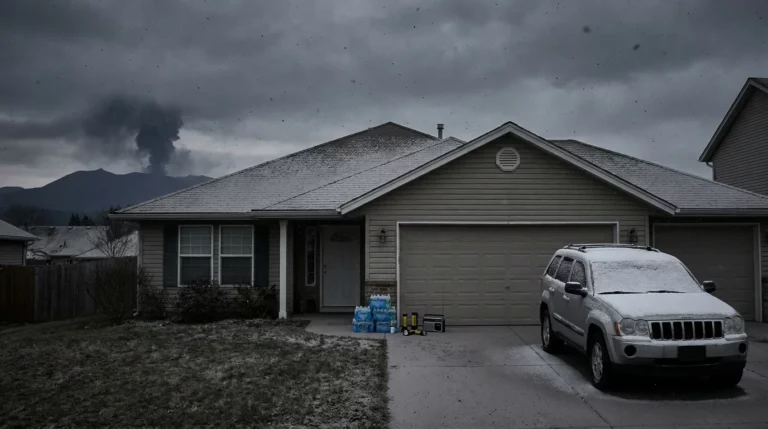
Most people fear lava when they think about volcanoes. Lava kills almost no one — it moves at 5 mph and you can walk away from it. The real killers are pyroclastic flows (700°C gas clouds moving at 450 mph), volcanic ash (which collapses roofs and destroys engines), toxic gas emissions, and lahars (volcanic mudflows that bury entire communities). Understanding what actually threatens your family changes everything about how you prepare.
If you live within 100 miles of an active or potentially active volcano in the U.S. — that includes Mount Rainier, Mount St. Helens, Kilauea, Mount Shasta, Mount Hood, and 160+ others catalogued by the USGS — this guide gives you a practical framework for your family of 4.
The 5 Real Volcanic Hazards (Ranked by Lethality)
| Hazard | Speed/Reach | Warning Time | Survival Action |
|---|---|---|---|
| Pyroclastic flows | Up to 450 mph / 30+ miles | Minutes | Evacuate before eruption — no other option |
| Lahars (mudflows) | 20–40 mph / up to 50+ miles | Minutes to hours | Move to high ground immediately, know your lahar zone |
| Volcanic gases (SO2, CO2) | Wind-dependent | Variable | Stay indoors, seal gaps, N95 minimum — P100 preferred |
| Ashfall | Wind-carried, 100s of miles | Hours to days | Shelter in place, protect respiratory system, clear roofs |
| Lava flows | 2–10 mph typical | Hours to days | Evacuate in designated direction — easily survivable |
Your preparation priorities should follow this ranking. If you’re in a pyroclastic or lahar zone, evacuation planning is everything. If you’re primarily in an ashfall zone (most people in the Pacific Northwest), shelter-in-place preparation becomes equally important.
Step 1: Know Your Actual Risk Level
The USGS Volcano Hazards Program maintains hazard maps for every monitored volcano in the U.S. These maps define specific hazard zones — and they’re not vague. They tell you whether your property sits in a lava flow path, lahar inundation zone, or ashfall area.
How to Find Your Risk Zone
- Go to volcanoes.usgs.gov and search for the volcano nearest your home
- Download the volcanic hazard zone map for that volcano
- Locate your address on the map — identify which hazard zones you’re in
- Check your local emergency management website for county-specific evacuation zones
U.S. Volcano Alert Levels (USGS)
| Alert Level | What It Means | Your Action |
|---|---|---|
| Normal | Background activity, volcano stable | Stay informed, maintain your plan |
| Advisory | Elevated unrest, not yet erupting | Review evacuation routes, top off fuel, check kit |
| Watch | Eruption possible within days/weeks | Be ready to leave on short notice, pre-position family |
| Warning | Eruption imminent or ongoing | Evacuate if ordered — do not wait for lava to appear |
Step 2: Build Your Volcanic Eruption Emergency Kit
A standard 72-hour emergency kit needs specific modifications for volcanic events. Here’s what a family of 4 needs beyond the basics:
Volcanic-Specific Additions
| Item | Why It Matters for Volcanoes | Cost (Family of 4) |
|---|---|---|
| N95 respirators (20+) | Volcanic ash particles damage lungs — they’re sharp, not soft like regular dust | $25–$40 |
| P100 half-face respirator (x4) | Superior protection for extended ash exposure or volcanic gas | $80–$120 |
| Safety goggles (x4) | Ash is abrasive and causes corneal damage without eye protection | $20–$40 |
| Dust tape + plastic sheeting | Seal windows and doors against ashfall intrusion | $20–$30 |
| Extra air filters for HVAC | Ash destroys HVAC systems — seal or replace during ashfall | $30–$50 |
| Car engine air filter (spare) | Ash destroys engines within minutes of exposure | $20–$40 |
| Battery-powered NOAA radio | Power may be out; ash disrupts cell networks | $30–$60 |
| Portable air purifier (HEPA) | Maintains indoor air quality during multi-day ashfall shelter | $80–$150 |
Standard Emergency Kit Items (Volcanic Context)
- Water: 1 gallon/person/day minimum — ash contaminates open water sources; municipal supply may fail
- Food: 7-day supply, not just 72 hours — volcanic events often disrupt supply chains for weeks
- First aid kit: Include antihistamines (ash causes severe respiratory irritation), extra asthma inhalers if applicable
- Documents: Waterproof copies of IDs, insurance policies, prescriptions
- Cash: $200–$300 — ATMs and card systems often fail in disasters
- Medications: 30-day supply if possible — pharmacy access may be disrupted
Step 3: Create a Volcanic Evacuation Plan
For volcanic hazards, your evacuation plan needs to be more specific than a standard emergency plan. Volcanic hazards are directional — the danger zones extend in specific directions from the volcano based on terrain and prevailing winds.
Map Two Escape Routes
Download your county’s volcanic hazard evacuation map. Identify two routes that move you away from the volcano and away from river valleys (lahars follow drainage channels). At least one route should be passable without highways — during evacuations, highways become parking lots.
Drive both routes with your family at least once before you need them. Time each route. Know where the gas stations are along the way — and note that in a volcanic event, you may not be able to fuel up, so keep your tank above half at all times when alert levels are elevated.
Designate Your Destination
- Primary: A family member or friend’s home at least 50 miles from the volcano in the safe direction
- Secondary: A specific hotel or motel (have the name and address written down, not just saved in your phone)
- Tertiary: Official county evacuation shelter location (check your emergency management website)
Communication Plan for a Family of 4
Agree on these four things before any eruption occurs:
- Out-of-area contact: A family member in another state who everyone checks in with — local lines are often jammed during evacuations
- Meeting point #1: Near your home (if you can’t return but kids came home from school)
- Meeting point #2: Outside your neighborhood (if you can’t reach #1)
- Departure trigger: Define in advance what event causes you to leave without waiting for an order — for volcanic events, I recommend leaving at Watch level, not waiting for Warning
Step 4: Protect Your Home During an Eruption
If you’re outside the immediate danger zone but within ashfall range, shelter-in-place is often the right call — especially if the eruption occurs without enough warning to evacuate safely. Here’s how to protect your home:
Sealing Against Ashfall
- Close all windows and doors immediately
- Seal gaps with duct tape and plastic sheeting (pre-cut and labeled by room for speed)
- Turn off HVAC systems and seal vents — ash destroys air conditioning units and contaminates ductwork
- Place wet towels at door thresholds as a secondary seal
- Bring pets indoors immediately — ash exposure is as dangerous for animals as for people
Roof Load Management
Volcanic ash is heavier than it looks — especially when wet. Dry ash weighs 40–80 lbs per cubic foot. A 2-inch deposit of wet ash on a 1,500 sq ft roof adds 4–8 tons of weight. Older homes and flat roofs are especially vulnerable. If ashfall is significant (over 2 inches), carefully remove ash from your roof using a brush or soft shovel — never use water (it creates heavy, concrete-like slurry). Wear full respiratory and eye protection.
Water and Vehicle Protection
- Fill bathtubs and large containers with water before ashfall begins — ash contaminates municipal water systems
- Cover vehicles or move them into garages — even light ashfall destroys paint and, critically, can destroy engine air filters in minutes of driving
- If you must drive in ash, change your engine air filter every 30–50 miles
Step 5: Health Protection During and After Eruptions
Ash Inhalation — The Primary Health Threat
Volcanic ash is not soft. It’s pulverized rock with sharp, glassy edges. Inhaling volcanic ash causes silicosis, a serious and irreversible lung disease. Short-term exposure causes respiratory irritation, bronchitis, and exacerbates asthma severely.
Protection protocol:
- Indoors during ashfall: N95 minimum if ash is entering; P100 if levels are significant
- Outdoors during ashfall: P100 half-face respirator — N95 is inadequate for heavy ash
- After ashfall: Continue masking during any cleanup activities; ash re-suspension is dangerous for weeks
- Children and elderly: Keep indoors entirely during ashfall events
Volcanic Gas (Vog) Protection
Sulfur dioxide (SO2) from volcanic activity creates volcanic smog (“vog”) that travels hundreds of miles from eruptions. It causes respiratory distress, headaches, and eye irritation. People with asthma are especially vulnerable. During elevated vog events:
- Stay indoors with windows sealed
- Run air purifiers with activated carbon filters (HEPA alone doesn’t capture SO2)
- Have rescue inhalers available for all family members with respiratory conditions
Post-Eruption Cleanup Safety
- Wear P100 respirator, safety goggles, and full-coverage clothing during all ash cleanup
- Use a vacuum with a HEPA filter — never blow ash with compressed air or leaf blowers
- Wash skin thoroughly after any ash contact
- Do not let children play in or near ash deposits
- Check water sources before use — ash contaminates wells and surface water
Conducting Family Volcanic Preparedness Drills
A plan you’ve never practiced is a plan that fails when it matters. Run two drills per year for volcanic preparedness:
Drill 1: 20-Minute Evacuation Drill
The scenario: “Advisory just upgraded to Watch. We have 20 minutes to load the car and leave.” Time yourselves. What gets forgotten? Where are the grab bags? Can everyone find their shoes, phone charger, medications, and pet carrier in under 5 minutes? Most families discover at least 3–4 critical gaps in their first drill.
Drill 2: Shelter-in-Place Drill
The scenario: “Ashfall is starting. Seal the house.” Practice sealing windows and doors with pre-cut plastic sheeting and duct tape. Time how long it takes. Put on respirators and goggles. Practice with your kids so it’s familiar, not frightening.
Common Mistakes in Volcanic Eruption Preparedness
1. Waiting for the evacuation order before deciding to leave
Official evacuation orders are issued based on what’s already happening, not what’s about to happen. In fast-moving events, the order and the danger can arrive at the same time. Decide in advance what triggers your family’s departure — and leave before the order if needed.
2. Underestimating ashfall range
The 1980 Mount St. Helens eruption deposited measurable ash across 11 states and 2 Canadian provinces. Families 500 miles from the volcano needed ash protection. If you’re in a downwind state from any active volcano, have N95 masks for your family regardless of your distance.
3. Driving through heavy ashfall
Ash destroys engines — even a thin coating can clog air filters and overheat a car within miles. If you’re caught in heavy ashfall while driving, stop, turn off your engine, and shelter in the vehicle with the HVAC off until it’s safe to change your air filter or find shelter.
4. Using regular dust masks instead of respirators
Paper surgical masks and painter’s masks do not filter volcanic ash particles effectively. The particles are too small and too abrasive. NIOSH-approved N95 is the minimum; P100 is strongly preferred for meaningful exposure.
5. Ignoring the mental health component
Volcanic evacuations — especially when the eruption is prolonged or property is destroyed — cause significant psychological stress. Plan for extended displacement. Identify in advance how your family will manage 1–4 weeks away from home, how kids will continue schooling, and what support network you’ll lean on.
FAQ
How do I know if I’m in a real volcanic risk zone?
Go to volcanoes.usgs.gov and search for your nearest active volcano. Download the volcanic hazard zone map and locate your address. Your county emergency management website will have zone maps specific to local evacuation planning. If you’re in any colored zone on those maps, you’re in a real risk area that warrants preparation.
What’s the difference between a volcanic Watch and a Warning?
Watch means eruption is likely within days or weeks — elevated seismic activity, ground deformation, or gas emissions suggest an eruption is building. You should be ready to evacuate on short notice. Warning means eruption is imminent or actively occurring. Follow evacuation orders immediately — do not wait to assess the situation yourself.
We’re 200 miles from the nearest active volcano. Do we really need to prepare?
Yes, for ashfall. The 1980 Mount St. Helens eruption deposited ash as far as 1,000 miles away. N95 masks, an air purifier, and a plan to shelter in place if ashfall reaches your area takes one afternoon and costs under $100. For pyroclastic flows and lahars, 200 miles is likely outside the immediate danger zone — but know your downwind position relative to the volcano.
How long do volcanic ash events typically last?
A single explosive eruption deposits acute ashfall over hours. But volcanic eruptions often involve multiple events over days, weeks, or months. The 2010 Eyjafjallajökull eruption in Iceland lasted 39 days. The ongoing Kilauea eruptions in Hawaii have deposited ash intermittently for years. Prepare for weeks, not hours.
Can we stay in our home during a volcanic eruption if we’re not in the immediate hazard zone?
For ashfall only: yes, with proper sealing and respiratory protection. For pyroclastic flows, lahars, or significant gas emissions: absolutely not — no home provides adequate protection against these hazards. Know which hazard zone you’re in before making any shelter-in-place decisions.
Bottom Line
Volcanic eruptions are among the few natural disasters where advance preparation can be the difference between life and death — not just comfort and inconvenience. Pyroclastic flows and lahars give you minutes. Ashfall gives you days. The families who survive are the ones who already know their risk zone, already have their evacuation route memorized, and already have a departure trigger defined that doesn’t require waiting for official certainty.
Spend two hours this month: check your USGS volcano zone, register for alerts, and stock N95 masks for all four family members. That’s the minimum. The full kit and plan are what make your family genuinely ready.

Dan Lockland is a preparedness instructor and survival skills educator with over 15 years of hands-on experience. He shares practical, no-nonsense guidance on emergency preparedness, self-reliance, and sustainable living at PreparingWithDan.com.