
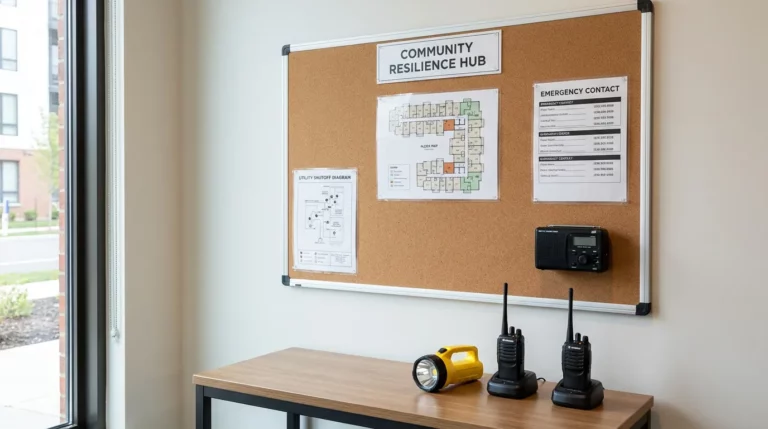
The research on disaster survival is unambiguous: neighbors who know each other recover faster, lose fewer people, and coordinate more effectively than isolated households — regardless of how much gear either side has. During Hurricane Katrina, the neighborhoods with established social networks had dramatically better outcomes than equally poor or equally well-equipped neighborhoods without them. Community beats gear, almost every time.
If you live in an apartment building, this is both your biggest vulnerability and your biggest opportunity. You’re surrounded by potential allies you’ve never met. This guide shows you exactly how to turn a building full of strangers into a functioning emergency network — in 30 days or less.
Step 1: Map Your Building’s People and Resources
Before recruiting anyone, spend 20 minutes mapping what you already know about your building. You’re looking for two things: skills and resources that already exist, and vulnerable residents who will need extra support in an emergency.
Skills Worth Identifying
- Medical/health: Nurses, doctors, EMTs, paramedics, first aid certified residents
- Mechanical/technical: Electricians, plumbers, HVAC techs — critical for utility emergencies
- Physical capability: Strong individuals for moving injured people or heavy equipment
- Language skills: Non-English speakers who can translate for neighbors in their community
- Mental health: Counselors, social workers — invaluable for extended emergencies
- Logistics/organization: People who stay calm and can coordinate under stress
Vulnerable Residents to Know in Advance
- Elderly residents living alone
- Residents with mobility limitations or disabilities
- Families with infants or very young children
- Residents with medical equipment that requires power (oxygen concentrators, dialysis, etc.)
- Non-English speaking residents who may miss emergency communications
Create a simple building map (hand-drawn is fine) showing unit numbers, residents you know, and any notes on skills or needs. This becomes your network planning document.
Step 2: Recruit Your Core Group
You need 4–6 committed households to start. More is better, but 4 motivated people accomplish more than 20 passive ones.
How to Approach Neighbors
Door-to-door works best — it’s personal and shows you’re serious. Knock on 15–20 doors. Your pitch doesn’t need to mention “prepping” if that word creates hesitation. Try this framing:
“Hi, I’m Dan from unit 4B. I’m trying to put together a small group of neighbors who’d be willing to look out for each other in emergencies — power outages, building issues, that kind of thing. It’s really just having each other’s contact info and knowing who’s around. Would you be interested?”
That framing works for almost everyone. It’s truthful and non-threatening. About 25–35% of people will say yes.
Your First Group Meeting
Keep it to 45 minutes maximum. Cover three things:
- Why you’re doing this (real local example if possible — a recent power outage, fire, or weather event)
- What you’re NOT asking people to do (no survivalist bunker, no major time commitment)
- One immediate practical action everyone agrees to take (sharing phone numbers in a group chat)
End with a clear next step and a date. Groups that don’t have a next meeting scheduled at the end of their first meeting rarely have a second meeting.
Step 3: Define Roles (Keep It Simple)
Four roles cover what a building emergency network actually needs. One person can hold multiple roles in a smaller group.
| Role | Responsibilities | Time Required |
|---|---|---|
| Network Coordinator | Runs meetings, main point of contact, coordinates with building management | 2–3 hrs/month |
| Communications Lead | Manages group chat, sends alerts, maintains contact list | 1–2 hrs/month |
| Supplies Coordinator | Maintains shared resource inventory, tracks what’s available | 1 hr/month |
| Vulnerable Resident Liaison | Regular check-ins with elderly/disabled residents, ensures they’re in the loop | 1–2 hrs/month |
Step 4: Set Up Communication Systems
Your network is only as good as its ability to communicate under stress. Set up three communication layers — because single points of failure kill response networks.
Layer 1: Normal Conditions — Smartphone Group Chat
A WhatsApp, Signal, or Telegram group with all network members. Use this for routine updates, meeting reminders, and non-urgent coordination. Keep it active with occasional low-stakes messages (“Heads up, maintenance is doing work on floor 3 today”) so people stay engaged and the channel stays warm.
Layer 2: Power/Cell Outage — Physical Notification Plan
Designate a physical meeting point (lobby, courtyard, common room) and a standard time (e.g., “meet at the lobby at 9am if we have no power for 4+ hours”). Post this on a laminated card inside your door and distribute to all network members. No batteries required.
Layer 3: Evacuation — Out-of-Area Contact
Designate one person outside your city — a family member or friend — as the network’s external contact. Everyone knows their number. In chaotic evacuations where local communication fails, you call the external contact, leave your status and location, and others do the same. They coordinate across the network.
Building Management Integration
Introduce your network to building management or your super. Share your contact list. Request to be notified first about building emergencies. Most building managers are relieved to have an organized resident group — they’ll often give you access to storage space or help publicize your network to other residents.
Step 5: Create a Shared Resource Inventory
You don’t need everyone to stock everything. What you need is to know who has what so you can coordinate during an emergency.
| Resource Category | Items to Inventory | Who Has It |
|---|---|---|
| Medical | First aid kits, AED, prescription medications, medical training | Map by unit |
| Power | Generators, power banks, solar panels, battery lanterns | Map by unit |
| Water | Stored water, filtration systems, large containers | Map by unit |
| Food | Extended supply of non-perishables (for sharing if needed) | Voluntary disclosure |
| Tools | Bolt cutters, crowbar, rope, fire extinguishers, gas shutoff wrench | Map by unit |
| Transportation | Vehicles, fuel, ability to transport non-drivers | Map by unit |
A simple shared spreadsheet (Google Sheets works; a paper binder also works) keeps this organized. Update quarterly. The goal is that anyone in the network can look up this document in an emergency and immediately know who to call for what.
Step 6: Develop the Building Emergency Plan
Your building-level plan needs to address six specific scenarios that apartment buildings face:
Scenario 1: Extended Power Outage (48+ Hours)
- Who checks on elderly/disabled residents first? Assign specific units to specific neighbors
- Where do residents with refrigerated medication store it? (Network can pool ice, power banks, or generator access)
- What’s the lighting plan for common areas and stairwells?
Scenario 2: Building Fire Evacuation
- Who sweeps which floors to alert residents?
- Who assists mobility-impaired residents to Areas of Rescue Assistance?
- Where is the off-site rally point so you can account for everyone?
Scenario 3: Water System Failure
- Who has stored water?
- Where is the nearest alternative water source (retail, community center)?
- What’s the coordination plan for sharing?
Scenario 4: Medical Emergency
- Who in the building has medical training?
- Where is the building AED (if applicable)?
- Who calls 911 while who renders first aid?
Scenario 5: Mandatory Building Evacuation
- What’s the carpool plan for non-drivers?
- Where is the first rally point outside the building?
- Where is the second rally point (further away)?
Scenario 6: Shelter-in-Place Order
- Who has space to host a neighbor in need?
- How does the network communicate when confined to apartments?
- What’s the protocol for checking in daily?
Step 7: Run Your First Drill
A plan that’s never been practiced doesn’t work under pressure. Your first drill doesn’t need to be elaborate — it just needs to happen.
First Drill: 20-Minute Walkthrough
Walk the building together. Identify: all stairwells and fire exits, the Areas of Rescue Assistance, the utility shutoff locations (water main, gas), the AED location, and the lobby assembly area. Walk the primary and secondary evacuation routes from the building to the rally point. The physical act of walking the route — with your network members — makes it real in a way that reading a plan never does.
Second Drill (90 Days Later): Simulated Power Outage
On a Saturday, simulate a 4-hour power outage. Network members check in with their assigned vulnerable residents. The communications lead tests all three communication layers. The supplies coordinator verifies the resource inventory is current. Debrief as a group: what worked? What didn’t?
Connecting with Local Emergency Services
Register your network with your local emergency management office. Many cities have formal Community Emergency Response Team (CERT) programs — free training, some equipment grants, and official coordination with fire and police during disasters. A CERT-trained building network is significantly more capable than an untrained one.
Also connect with your local fire department’s community outreach division. Most fire departments will do a free building walkthrough and identify hazards you’d never notice — and the relationship matters when you’re calling 911 during an actual emergency.
Common Mistakes in Building Emergency Networks
1. Building the network, then going silent
A network that only activates during emergencies doesn’t activate effectively during emergencies. Send a message once a month — a safety tip, a local alert, a weather heads-up. Keep the channel warm. Groups that go weeks without contact lose cohesion fast.
2. Focusing only on gear instead of people
“We need a shared generator” is less useful than “we know Mrs. Chen in 6C needs evacuation assistance and the Johnson family in 3A has medical training.” People and skills are your most critical resources — inventory them first.
3. Not accounting for the hardest hours — midnight to 6am
Most plans assume daytime emergencies. Fires start at 3am. Gas leaks happen at midnight. Make sure your communication plan works when people are asleep and phones are on silent. A dedicated emergency alert protocol (specific ring pattern, specific message header) ensures people wake up when it actually matters.
4. Excluding non-English speakers
In many urban apartment buildings, a significant portion of residents don’t speak English fluently. An emergency network that communicates only in English effectively leaves those residents unprotected. If your building has Spanish, Chinese, French, or other language speakers, recruit a bilingual liaison for those communities specifically.
5. Waiting for a crisis to find out the plan has gaps
The only way to find gaps is to run drills. Every drill reveals something. The neighbor who doesn’t remember the rally point, the stairwell door that’s always locked, the unit whose residents have moved out but whose name is still on the contact list. Find these in a drill, not in an emergency.
FAQ
What if my neighbors aren’t interested in emergency preparedness?
Frame it as mutual assistance rather than disaster prep. “I’m putting together a way for us to look out for each other” resonates far more broadly than “I’m building a prepper network.” You only need 4–6 committed households. If your direct neighbors aren’t interested, look two or three floors away. The right people are in your building — you just have to find them.
How do I handle a neighbor who wants to control everything or create conflict?
This happens. Keep the group focused on practical tasks rather than theoretical debates. If one person is dominating or creating friction that’s driving others away, have a direct private conversation. The network serves everyone — if one person consistently undermines it, the group has the right to ask them to step back from active participation.
Should I involve building management?
Yes, almost always. Building management controls access to common spaces, has contact information for all residents, and needs to know who to call in a building emergency. Present your network as a resource for them, not a demand on their time. Most managers welcome organized residents — they’re an asset, not a headache.
How much time does maintaining this network actually take?
After the initial setup (4–6 hours over 2–4 weeks), ongoing maintenance is 1–2 hours per month for the coordinator, less for everyone else. One group message per month, one meeting per quarter, one drill per year. That’s a realistic commitment that most people will sustain.
What happens when people move out and new residents come in?
Turnover is the main challenge for building networks. Assign the communications lead to update the contact list every 6 months. When new neighbors move in, the coordinator knocks on their door within the first month and gives them the one-pager. High-turnover buildings require more active recruitment — which is a good reason to keep the commitment bar low enough that new people can join easily.
Bottom Line
A building emergency network doesn’t require a bunker, a generator, or a survival budget. It requires knowing your neighbors’ names, having their phone numbers, and having agreed in advance who does what when things go wrong. That’s it. Start this weekend: knock on three doors, introduce yourself, and ask if they’d be willing to share contact information. The rest follows naturally from that first conversation.
Your building full of strangers is already a resource — it just needs to be organized.

Dan Lockland is a preparedness instructor and survival skills educator with over 15 years of hands-on experience. He shares practical, no-nonsense guidance on emergency preparedness, self-reliance, and sustainable living at PreparingWithDan.com.