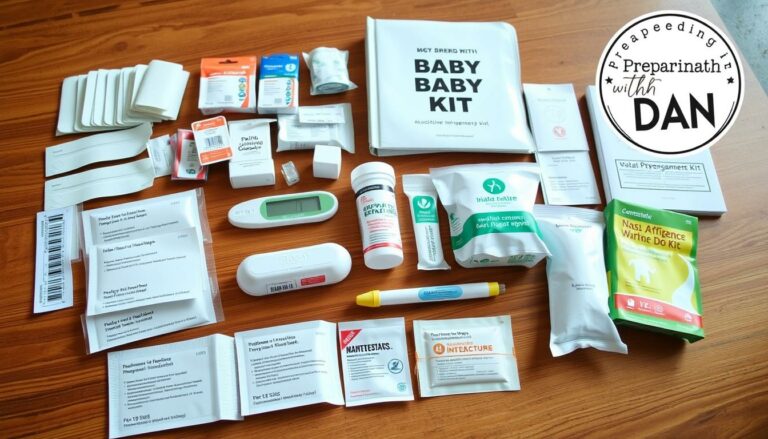
An emergency kit for a baby is the standard family kit plus one rule most parents get wrong: Ready.gov says use ready-to-feed formula, not powder, because mixing powder needs clean water you may not have. Add three days of diapers counted from what you actually use, the medicines a pharmacy would have to fill, and one comfort object — and the kit is done. A toddler’s kit is the same list with shoes.
Everything in the general emergency checklist still applies; this article is only the part that changes when someone in the household is under three. The quantities and rules come from Ready.gov’s kit, food and water guidance, and the sources are listed at the end.
Feeding: the formula decision
Ready.gov’s food-safety guidance for emergencies is one line, and it is the most important line on this page: “Use ready-to-feed formula. If you must mix infant formula use bottled water or boiled water as a last resort.”
The reason is that a disaster that takes the power usually compromises the water too — a boil-water notice, a broken main, a well pump with no electricity. Powdered formula needs clean water at every feed; ready-to-feed formula needs none. It costs more per ounce, which is why the kit version should be a three-day supply of ready-to-feed, rotated into normal use before it expires, while the everyday supply stays powder.
- Bottles and nipples: a spare set, plus disposable bottle liners or single-use bottles so nothing needs washing in water you cannot trust.
- If you are breastfeeding: you are the kit. Ready.gov notes that nursing mothers need more water than the one-gallon baseline — add at least an extra half-gallon per day for yourself, and keep a small supply of ready-to-feed formula anyway, because stress and dehydration affect supply and a shelter is not where you want to discover that.
- For toddlers: shelf-stable pasteurised milk (on Ready.gov’s list), pouches of fruit and vegetable purée, dry cereal, crackers, and the one snack your child never refuses. Three days of food a toddler will actually eat beats a week of food they will not.
Water: more than the standard figure
The Ready.gov baseline is one gallon per person per day, and it says explicitly that children, nursing mothers and sick people may need more, and that in very hot weather needs can double. For a household with a baby, count the baby as a full person for water (formula, washing, wiping) and add the extra for a nursing mother. Bottled water in the kit, not tap water in old containers, so it is drinkable without treatment on day one. Our water purification tablets review covers the backup for day four onwards — but note that treated water is for older children and adults; for formula, Ready.gov’s order is bottled first, boiled as a last resort.
Diapers, wipes and the arithmetic
Ready.gov’s kit list names diapers, wipes and diaper rash cream. The quantity is the part guides get wrong, because it changes every month of a baby’s life. Do not guess: count what you use in a normal day, multiply by three, and add a third. Write the number and the size on the outside of the kit with the date, because the size will be wrong in three months. Add:
- A pack of wipes beyond the diaper count — they are also the family’s hand-washing when the taps stop.
- Diaper rash cream and a small tube of petroleum jelly.
- Scented disposal bags; three days of diapers in a closed room is a real problem.
- Two changes of clothes per child in the current size, one warmer than the season.
- For toddlers who are potty-training: pull-ups in the kit regardless. An emergency is not the week to hold the line.
Medicine and health
Ready.gov’s general kit already asks for prescription medications and a first aid kit. For an infant or toddler, the additions are the things a pharmacy would have to fill and cannot in a disaster:
- Infant or children’s fever reducer with the dosing syringe, and the dose for your child’s current weight written on the box.
- Any prescription your child takes, with a two-week supply if your provider will authorise it, and the written prescription in the document pouch.
- Oral rehydration solution sachets: diarrhoea from unfamiliar water or food dehydrates a baby faster than an adult, and this is what a doctor would reach for.
- A digital thermometer, nasal aspirator, saline drops, and children’s electrolyte drinks.
- A copy of the immunisation record and the paediatrician’s number in the document pouch — shelters and clinics will ask.
This is a preparedness list, not medical advice: confirm doses and any medication with your paediatrician before the season, not during the emergency. The American Academy of Pediatrics keeps a disaster-preparedness resource for parents (linked below).
Warmth, carrying and sleep
- A baby carrier or sling in the kit, even if you use a stroller daily. Evacuation routes, shelters and stairs in a blackout are not stroller places, and a carrier leaves your hands free.
- A sleeping bag or warm blanket for each person is on Ready.gov’s list; for an infant, a wearable sleep sack is safer than loose blankets in an unfamiliar place.
- A hat for the baby in any season — heat loss through the head is proportionally larger.
- Something for the child to sleep in that is not your arms for three days: a folding travel bassinet or a pack-and-play stays in the car if you evacuate by car.
The comfort object, and the parent’s list
Ready.gov’s list includes “books, games, puzzles or other activities for children” and it is not filler. A toddler who has a familiar toy, a book and a snack in a shelter is a toddler who sleeps, and a toddler who sleeps means parents who can think. Put one small comfort object and one new, never-seen toy in the kit. Ready Kids (linked below) has age-appropriate material for explaining an emergency to a small child — our guide on teaching kids about preparedness covers the conversation for older children.
Two things for the parent that are easy to forget: a photo of the child on your phone and printed, with height, weight and a description on the back, in case you are separated; and a list of the child’s needs (allergies, formula brand, medication, sleep routine) that another adult could follow if you are injured. Both go in the waterproof document pouch that the general kit already has.
What this adds to the family kit’s cost
We priced the eight items that carry the cost of a family 72-hour kit in what a 72-hour kit actually costs; the baby layer adds mostly consumables you already buy (diapers, wipes, formula) shifted three days ahead, plus a carrier if you do not own one. It is one of the cheapest additions to a kit, and one of the few that a shelter cannot improvise for you.
Every three months
A baby kit expires faster than any other: sizes, doses, formula stage and the child’s tastes all change. Put a recurring reminder at each season change to swap diaper sizes, clothes and the formula stock, and to re-write the dose on the fever-reducer box. The kit that fits a six-month-old is useless for an eighteen-month-old, and most families find that out in the shelter.
Official sources & further reading
The quantities and rules in this article come from official emergency-preparedness guidance. Consult it directly for the authoritative version, and confirm anything medical with your paediatrician:

Dan Lockland is a preparedness instructor and survival skills educator with over 15 years of hands-on experience. He shares practical, no-nonsense guidance on emergency preparedness, self-reliance, and sustainable living at PreparingWithDan.com.