Solo prepping will only get you so far. You can’t stay awake for 72 hours straight to watch the perimeter. You can’t be the medic and the mechanic at the same time. At some point, the family that has trusted neighbors, a few vetted friends with real skills, and a communication plan will outlast the lone wolf with a bigger Costco run every time.
Building a prepper community doesn’t mean recruiting a survivalist army or advertising your food storage on social media. It means identifying 5–15 people you trust, making sure the group covers the skills your family lacks, and setting up simple systems so everyone can function when things go sideways.
Here’s how to do that without blowing your OPSEC or burning bridges.
Why Solo Prepping Has Real Limits
A family of 4 can store food, filter water, and own a generator — but there are hard limits to what two adults can manage alone in a prolonged crisis.
- Sleep: Security watch requires rotating shifts. Two adults can’t sustain 24/7 vigilance for more than 3–4 days.
- Medical: A serious injury (broken leg, infected wound, appendicitis) is a life-threatening emergency without medical skill in the group.
- Specialization: You probably aren’t a mechanic, a nurse, a licensed ham operator, and a master gardener simultaneously.
- Morale: Extended isolation destroys mental health, especially for kids. Children need peer contact to stay stable under stress.
- Load distribution: Hauling water, securing a perimeter, cooking, and managing kids simultaneously overwhelms two people fast.
Who to Build Your Prepper Network With
Start With Family and Close Friends
Your inner circle (3–5 people beyond your household) should be people you already trust with your life — literally. Family members, childhood friends, military or work buddies you’ve known for years. These are the people who get the full picture of your preps.
Don’t try to convince skeptics in this group. If your brother-in-law thinks you’re paranoid, don’t share details — he’s not in your inner circle. Look for the ones who are already quietly concerned and just haven’t formalized anything.
Expanding to Neighbors and the Wider Circle
Your outer circle (5–10 additional people) can include neighbors and community members you’ve gotten to know over time. You don’t need to disclose your full preps to these people — you just need mutual aid agreements: “If the grid goes down for more than 48 hours, we check on each other.”
How to find them without sounding unhinged:
- Talk about recent local weather events and ask how they handled them
- Mention your backup power setup casually — “Got a generator after the last outage”
- Use terms like “resilience” and “self-sufficiency” instead of “SHTF” or “collapse”
- Ask about their background naturally — a retired EMT or a veteran neighbor is worth knowing
Skills to Recruit For
Your goal is to build a group that collectively covers the critical skill gaps no single household can fill. When you’re evaluating potential members, think skills-first — not stockpiles. Supplies can be acquired. Skills take years to build.
| Skill Category | Why It Matters | Who Might Have It |
|---|---|---|
| Medical / First Aid | Trauma care, wound management, medication — hospitals may be overwhelmed or inaccessible | Nurse, EMT, combat vet, paramedic |
| Mechanical / Electrical | Generator repair, vehicle maintenance, solar troubleshooting | Mechanic, electrician, farmer |
| Communications / Ham Radio | Long-range comms when cell towers fail — GMRS has 20–30 mile rated range, ham much more | Licensed ham operator, IT/telecom professional |
| Security / Tactical | Perimeter assessment, threat evaluation, physical security setup | Law enforcement, military vet, security professional |
| Food Production | Growing, preserving, hunting, fishing — extends your runway indefinitely if needed | Gardener, farmer, hunter, forager |
| Construction / Repair | Shelter hardening, structural repairs, fortification | Contractor, carpenter, handyman |
| Childcare / Education | Frees up adults for critical tasks; kids need structure to stay calm during extended stress | Teacher, stay-at-home parent, childcare worker |
Building Group Communication Infrastructure
When the cell network goes down — and in major disasters it often does within hours — your group needs a communication plan that doesn’t depend on it. Set this up before you need it.
Tier 1: Digital (When It Works)
- Signal app (free): Encrypted group messaging. Set up a group now while everything is normal. This is your primary digital channel.
- WhatsApp or Telegram as a backup if members won’t use Signal
- Group email chain for non-urgent coordination
Tier 2: Radio (When Cell Fails)
- Midland GXT1000VP4 GMRS radios (~$55/pair): 36-mile rated range (realistic: 1–5 miles in suburbs, more in open terrain). GMRS license required for full power: $35 for 10 years, covers your whole household.
- Baofeng UV-5R (~$25 each): Budget ham/GMRS radio. Requires Technician license to transmit on ham bands. Good redundant option.
- Meshtastic LoRa nodes (T-Beam ~$35–40 each): Off-grid mesh text network. Each node extends the range. Four nodes across a neighborhood gives you 1–2 mile messaging with zero cell or internet infrastructure.
Tier 3: Physical (Last Resort)
Designate a physical rally point everyone can reach without any communication — a specific member’s house, a church parking lot, a park. Set a rule: “If no contact by 6 PM Day 2, meet at [location].”
Pooling Resources Without Losing OPSEC
Resource pooling is one of the biggest advantages of a group — but it requires trust and clear agreements. You don’t need to show everyone your basement. You need to know what the group collectively has.
The Skills and Resources Inventory
Have each member fill out a simple private inventory shared only within the group:
- Skills and certifications
- Tools and equipment (generator, hand tools, medical supplies)
- Specialty items (water filtration capacity, food storage in weeks)
- Special needs (medications, mobility limitations)
The Barter Framework
High-value trade items within a community group during an extended crisis:
- Skills on demand — medical care, mechanical repair, security watch shifts
- Fuel — propane, gasoline stabilized with PRI-G (~$20 for a quart, treats 256 gallons)
- Medications — OTC pain relievers, antibiotics if available, antihistamines
- Batteries and light sources
- Comfort items — coffee, salt, sugar, alcohol (also useful for wound cleaning)
Group Drills and Tabletop Exercises
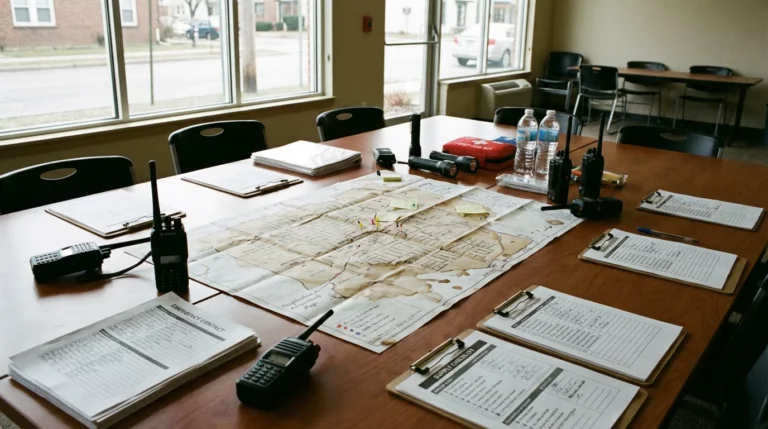
The difference between a group that functions in a crisis and one that collapses is practice. You don’t need elaborate live exercises — a 90-minute tabletop drill twice a year exposes critical gaps that theory never will.
Tabletop Exercise Format
Present a scenario: “It’s Day 3 of a grid-down event. Cell service is out. A group member has a serious laceration. Another member reports strangers casing the neighborhood.”
Walk through: Who does what? Who has what? Where does everyone go? What’s the communication plan? What decisions require group consensus vs. individual action?
These conversations reveal planning gaps you’d never spot in theory.
Live Practice: Monthly Radio Check-Ins
5 minutes on a weekend morning. Everyone keys up, confirms their radio works, confirms their channel programming. This single habit catches equipment failures before you need the equipment.
Community Food Security
A group of 10–15 people sharing a coordinated food strategy is far more resilient than 5 individual households each trying to store everything independently.
Community Garden
Even 4 raised beds (128 sq ft total) split across two or three member households can supplement the group’s fresh produce significantly. Coordinate who grows what: one household focuses on high-calorie crops (potatoes, beans, winter squash), another on vitamins and fresh eating (tomatoes, greens, herbs).
Coordinated Stockpile Strategy
Each household goes deep on 2–3 staples rather than every household buying a little of everything:
| Household | Stockpile Focus | Why |
|---|---|---|
| Household A | Grains (rice, oats, flour in mylar bags) | Calorie base, long shelf life (25+ years stored properly) |
| Household B | Proteins (canned fish, freeze-dried meat, dried beans) | Protein variety; complements grains nutritionally |
| Household C | Medical / first aid supplies | Best centralized with whoever has the medical skills |
| Household D | Fuel (propane, gasoline, firewood) | Centralized energy supply for cooking and heat |
This approach lets each household stock 3–4 months of their specialty at a reasonable cost rather than every household attempting 3 months of everything at once.
Common Mistakes
- Recruiting based on friendship instead of skills. Your best friend who brings no useful skills and dismisses preparedness is a drain on the group, not an asset. Skills and attitude matter more than how close you are.
- Skipping the OPSEC conversation. Every new member needs to understand the rule: what the group discusses stays within the group. One person posting about the group’s supplies on social media ends your security advantage overnight.
- Building the group but never practicing. A group that has never run a tabletop or radio test will revert to chaos under stress. Practice reveals gaps that theory always hides.
- Making it too formal too fast. Weekly meetings with agendas and bylaws scare off practical people. Start with casual monthly check-ins and build formality as trust develops.
- Forgetting about the kids. Children’s mental health during extended crisis scenarios depends heavily on peer contact and routine. Plan explicitly for childcare so adults can handle critical tasks without kids underfoot.
- No clear decision-making structure. Who decides when to evacuate? Who has final say on security responses? Ambiguity in a crisis leads to paralysis or conflict. Agree on this in advance, in writing.
FAQ
How many people should be in a prepper community group?
5–15 people covering 3–5 households is the practical sweet spot for most suburban or urban preppers. Small enough to maintain trust and OPSEC, large enough to cover critical skills and rotate watch duties. Groups larger than 20 become difficult to coordinate and trust becomes harder to maintain across the whole network.
How do I find preppers near me without advertising my own situation?
CERT training courses, ham radio clubs, homesteading meetups, and local emergency preparedness community groups are all ways to meet like-minded people in a low-disclosure context. Many cities have CERT programs through the fire department — free training, practical skills, and you’re meeting neighbors who already take emergencies seriously.
Do I need a ham radio license?
For GMRS, a license costs $35 for 10 years and covers your whole household — no test required. For ham radio, a Technician license gives you access to more frequencies and much longer range. Study materials are free at HamStudy.org; the exam runs ~$15 at a local club. Most people pass with 2–4 weeks of casual study.
What if I live in an apartment and can’t do a community garden?
Focus on the non-food elements: communication infrastructure (radios, Signal group), skill sharing (get to know the nurse or mechanic in your building), and mutual aid agreements with 2–3 trusted neighbors. Container gardening on a balcony or a plot in a community garden can supplement, but food production isn’t the only value a community network provides.
How do I handle group disagreements about security or decision-making during an actual crisis?
Agree on a decision structure before the crisis. A simple rule works: routine decisions (supply runs, garden tasks) are individual. Group-affecting decisions require a majority vote. Emergency security decisions fall to whoever has the relevant expertise — the security-trained member calls the shots on defense. Write it down and get consensus before it’s ever needed.
Bottom Line: The best prep you can make this year isn’t another case of freeze-dried food — it’s building a trusted network of 5–10 people who cover the skill gaps your family has. Start with 3 people you already trust completely. Identify the skills you’re missing and recruit specifically for those gaps. Get everyone on the same GMRS channel and set up a Signal group. Run one tabletop exercise. That foundation is worth more than any amount of solo stockpiling, and it costs you almost nothing except time and intentionality.

Dan Lockland is a preparedness instructor and survival skills educator with over 15 years of hands-on experience. He shares practical, no-nonsense guidance on emergency preparedness, self-reliance, and sustainable living at PreparingWithDan.com.