
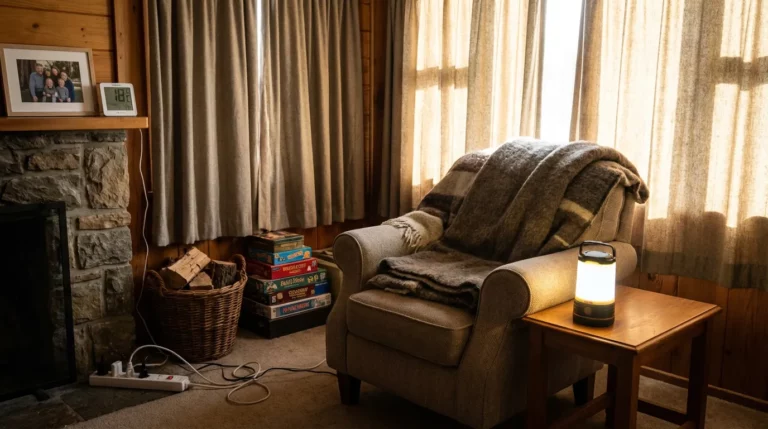
The average American family of 4 spends $2,200–$2,800 per year on electricity. A realistic set of energy habits — the kind you can turn into family games — trims that by $400–$700 annually. That’s a year’s worth of emergency prep supplies, a car payment, or a family vacation. Here are 10 specific challenges that actually work, with the savings math to back them up.
How to Run a Family Energy Challenge
Before picking challenges, set up a simple scorekeeping system that makes the savings visible:
- Baseline reading: Check your electric meter on Day 1 (or pull last month’s bill for the kWh number)
- Weekly check-ins: Compare usage on the same day each week — most smart meters and utility apps show this in real time
- Prize pool: Take 25% of monthly savings and put it toward a family reward chosen at the start of the challenge. If you save $80 in electricity this month, $20 goes to pizza night or the family movie fund.
- Team vs. individual: Assign each kid one energy area to “own” (lighting, TV, charging). Individual scores keep tweens and teens more engaged than group-only challenges.
The 10 Challenges — With Real Savings Numbers
Challenge #1: The Phantom Slayer (Standby Power Hunt)
What it is: Every device plugged in but not actively used draws “phantom” or “standby” power. TVs, game consoles, cable boxes, phone chargers, microwaves with displays — all of them. The U.S. Department of Energy estimates standby power accounts for 5–10% of a typical home’s electricity bill.
The game: Give each kid a list of rooms to audit. They go room by room with a notebook and list every plugged-in device that’s not actively being used. Whoever finds the most phantom loads wins a point. Then the whole family unplugs or power-strips everything on the list.
Savings estimate: A family of 4 with a typical load of electronics saves $8–$18/month from eliminating standby draws. Over a year: $100–$220.
| Device | Standby watts | Annual cost (at $0.15/kWh) |
|---|---|---|
| Cable/satellite box | 15–30W | $20–$40/year |
| Game console (Xbox/PlayStation) | 10–15W | $13–$20/year |
| Desktop computer + monitor | 10–20W | $13–$26/year |
| Microwave (clock display) | 2–5W | $3–$7/year |
| Phone chargers (4 family) | 0.5W each × 4 | $3–$5/year |
Challenge #2: The 30-Day Thermostat Degree Challenge
What it is: Every degree you raise your AC setpoint in summer (or lower your heat setpoint in winter) saves approximately 3% on your heating/cooling bill. For a family spending $1,200/year on HVAC, each degree shift = ~$36/year.
The game: Start at your current thermostat setting. Each week, shift by one degree in the conservation direction. At the end of 4 weeks, see how many degrees you’ve shifted — and how comfortable the family actually is at the new setpoint. Most families find they adapt quickly and don’t miss the original setting.
Savings estimate: A 4-degree shift (very achievable) = 12% HVAC savings = $144/year on a $1,200 HVAC bill. Pair with ceiling fans to make it comfortable — ceiling fan use allows raising AC setpoint by 4°F at the same perceived comfort level.
Challenge #3: Lights Out Week
What it is: For one week, the family relies on natural light during the day and turns off every light when leaving a room. The kid who catches a parent leaving a light on wins a point. The parent who catches a kid wins one too.
The game mechanics: Post a scoreboard on the fridge. “Light Crimes” are logged by name. Loser buys the Friday night pizza. (Or contributes to the family prize fund.)
Savings estimate: If your family has 20 light bulbs averaging 10W (LED) and currently leaves 8 on for 4 extra hours per day, eliminating that habit saves ~0.32 kWh/day = ~$17/year. If you’re still on incandescent bulbs (60W each), this number multiplies by 6 and the first upgrade to LEDs pays back in under a year.
LED upgrade math: Replacing one 60W incandescent with a 10W LED that runs 3 hours/day saves $8.75/year per bulb. Twenty bulbs = $175/year in perpetual savings after a one-time $40 investment in LED replacements.
Challenge #4: Cold Water Laundry Month
What it is: 90% of the energy used by a washing machine goes to heating the water. Cold water wash performs just as well for most household laundry (modern detergents are formulated for cold water). The only exception: heavily soiled items and sanitizing loads.
The game: For one month, every load goes in cold. Track the number of loads. At the end of the month, compare your electric bill to the same month last year.
Savings estimate: A family of 4 runs approximately 8–10 loads per week. Switching from hot to cold saves about 0.5 kWh per load. 10 loads/week × 0.5 kWh × $0.15/kWh × 52 weeks = $39/year. Small but zero-cost and permanent once the habit is established.
Challenge #5: The 5-Minute Shower Sprint
What it is: A typical shower uses 2 gallons per minute. A 10-minute shower = 20 gallons of hot water. Cut to 5 minutes = 10 gallons, halving the hot water energy cost per shower.
The game: Put a waterproof timer in each bathroom. The rule: shower ends when the timer goes off. Whoever comes in under 5 minutes most consistently over the month wins. Post results on the bathroom mirror.
Savings estimate: A family of 4 each showering 5 minutes shorter saves 4 people × 10 gallons × 365 days × ~$0.015/gallon heated water = $220/year in water heating costs, plus reduced water bill. This is consistently one of the highest-ROI changes a family can make.
Challenge #6: The Full Load Rule
What it is: Running a dishwasher or washing machine half-full uses the same energy as running it full. The challenge: no appliance runs unless it’s full.
The game: Assign each kid to check the dishwasher and washer before anyone starts a load. If it’s less than 75% full, they have veto power. The family votes on whether the load runs. Kids love having veto power over parents.
Savings estimate: If a family currently runs 5 half-full dishwasher loads per week and consolidates to 3 full loads, that’s 2 fewer cycles per week × 1.2 kWh/cycle = 2.4 kWh/week = $18.72/year. Combined washer savings: similar. Not huge individually, but adds up alongside other habits.
Challenge #7: The Unplug-Before-Bed Race
What it is: Before bed each night, one family member does a 3-minute circuit of the house unplugging everything non-essential: TV power strips, game console strips, unused phone chargers, desktop computers.
The game: It’s a race. Whoever finishes their assigned rooms first and reports back wins a point. Use a shared tally on the fridge. Friday’s winner picks the weekend movie.
Savings estimate: Combining nightly unplug habit with smart power strips ($25 for a 6-outlet strip that cuts standby to your TV setup) can save $15–$40/month depending on your equipment load. Smart strips that automatically cut power when a primary device (TV) goes off are the lazy version of this challenge.
Challenge #8: The Air Dry November
What it is: The electric dryer is one of the biggest single energy users in a home — 4,000–5,000 watts per cycle, typically 45–60 minutes. Air drying on a rack or clothesline eliminates this entirely.
The game: For the month of November (or any month with reasonable indoor air-drying conditions), all laundry air-dries. Track the kWh change on your bill versus October.
Savings estimate: 8 loads/week × 5 kWh/load × $0.15/kWh = $6/week = $312/year if you eliminate drying entirely. Even air-drying half your loads saves $156/year. This is consistently the highest single-appliance saving a family can make.
Challenge #9: The 72-Hour Power-Down Drill
What it is: For one weekend, the family simulates a power outage — voluntarily. No TV, no gaming, no unnecessary lights. Meals are cooked on a camp stove or grill. Phones are used minimally. This is the challenge that doubles as emergency preparedness practice.
The game: It’s not a competition — it’s an adventure. Plan it like a camping trip indoors. Pull out the emergency lanterns, the camp stove, the board games. Cook something that doesn’t require the oven. See how the family functions.
What you learn: What you actually need vs. what you just habitually use. Which devices you can’t live without (CPAP, medical equipment) vs. which ones you reach for out of boredom. This knowledge directly informs your emergency prep priorities.
Savings estimate: A full weekend power-down for a family of 4 saves approximately 20–30 kWh ($3–$4.50 at current rates). The financial savings are minor; the preparedness insight is major.
Challenge #10: The Annual Energy Audit Challenge
What it is: Once per year, the whole family does a structured energy audit of the house. Assign each person a category: windows and doors (drafts), appliance settings, lighting inventory, thermostat schedule, water heater temperature. Each person presents their findings and proposed fix.
The game: Score each finding by estimated annual savings. The person who finds the highest-value improvement wins a prize. This is the annual reset that prevents backsliding on the other 9 challenges.
What the audit typically finds:
- Water heater set to 140°F instead of 120°F (save 10–15% on water heating)
- Refrigerator coils dusty and working 20% harder than needed (vacuum the coils, 5 minutes, free)
- HVAC filter last changed 6+ months ago (replace $10–$20 filter, restore airflow efficiency)
- Air gaps around windows and doors (weatherstripping fix: $15 materials, saves $50–$150/year)
- Old incandescent bulbs still in basement, garage, or closets (replace with LEDs)
Combined Savings Tracker
Running all 10 challenges consistently throughout the year:
| Challenge | Annual savings estimate |
|---|---|
| Phantom power elimination | $100–$220 |
| Thermostat 4-degree shift | $100–$180 |
| Lights off habit + LED upgrade | $100–$200 |
| Cold water laundry | $35–$50 |
| 5-minute shower habit | $180–$260 |
| Full load rule (washer + dishwasher) | $30–$50 |
| Nightly unplug routine | $100–$200 |
| Air-dry 50% of laundry | $130–$180 |
| Annual energy audit fixes | $80–$200 |
| Total estimated annual savings | $855–$1,540/year |
These numbers assume a family currently spending $2,400/year on electricity and utilities. The range is wide because home size, climate, current habits, and utility rates vary considerably. Even the conservative estimate of $855/year is meaningful — that’s $71/month redirected to whatever matters most to your family.
Making the Challenges Stick: Game Mechanics That Work
The reason most energy-saving efforts fail isn’t motivation — it’s that the feedback loop is too slow. Your utility bill arrives monthly, and it’s hard to connect a specific habit to a specific line on the bill. Here’s how to close that loop:
- Real-time monitoring: A smart plug ($15–$20 on Amazon) shows exact watt-draw from any single device. Give kids access to the Kasa or TP-Link app and let them see what the TV actually costs per hour. The numbers are surprisingly motivating.
- Monthly bill comparison: Screenshot your utility app’s monthly kWh on the same day each month. Post it on the fridge with the prior month’s number. Making the trend visible is the simplest possible feedback loop.
- Prize structure that scales: Don’t promise a fixed reward. Promise 25% of the verified monthly savings. If the family saves $60 this month, $15 goes to the prize fund. Now everyone has a financial stake in the outcome.
- Age-appropriate ownership: Kids 6–10 own one specific habit (the light switch rule). Tweens 11–14 own an audit category. Teens own a full zone (their bedroom + bathroom energy use). Graduated responsibility keeps older kids engaged rather than dismissive.
Common Mistakes When Running Family Energy Challenges
- Too many challenges at once. Starting all 10 simultaneously creates overwhelm and rapid backsliding. Pick 2–3 challenges per month. Build habits sequentially rather than all at once. Month 1: phantom slayer + lights out. Month 2: add thermostat challenge. Month 3: add shower sprint.
- No visible scoreboard. Out of sight means out of mind. A physical whiteboard or paper tally on the fridge outperforms any app for family engagement because it’s unavoidable. Digital-only tracking gets forgotten within a week.
- Not connecting savings to something real. “We’ll save money” isn’t motivating to a 9-year-old. “We’re saving up for the waterpark trip in July” or “$50 goes to your gaming fund” creates direct motivation. Name the reward before the challenge starts.
- Letting one person opt out. Energy challenges require household buy-in. One family member who ignores the thermostat rule undermines the whole effort. Discuss expectations before the challenge begins, not after someone breaks the rules.
- Focusing on low-ROI changes first. Phone chargers and turning off lights get all the attention, but air-drying laundry and shower length have 5–10× the financial impact. Start with high-savings habits even if they require more behavior change.
Frequently Asked Questions
What’s the single highest-impact energy habit for a family of 4?
Shortening showers by 5 minutes per person and air-drying laundry are neck-and-neck for highest dollar savings, typically $150–$300/year combined with no upfront cost. The thermostat degree shift comes third and is the easiest habit to maintain since it’s mostly automatic after the initial setting change. Start with these three before any other changes.
How do I get my kids actually engaged in energy challenges?
Three things work: visible scoreboard (paper on the fridge, updated daily), named reward tied directly to savings, and individual ownership of a specific area rather than vague group goals. Kids 8+ respond well to being the designated auditor of a room or appliance type. Giving them veto power over a parent (“you can’t run the half-empty dishwasher”) is surprisingly effective leverage.
Are smart home devices worth buying for energy savings?
Smart plugs ($15–$20 each) and a smart thermostat ($130–$200) are the two devices with clear payback periods under 2 years for most families. Full smart home systems (lighting automation, smart switches throughout) have longer paybacks and add complexity. A single Sense Energy Monitor in your breaker panel often generates the most insight per dollar — it shows your actual load by device and identifies problems like an aging HVAC running 25% harder than it should.
How much can a family realistically save in year one?
Starting from average habits with no smart equipment, a family of 4 implementing 5–6 of these challenges consistently can expect $400–$700 in year-one savings. The first year includes one-time wins (LED upgrades, weatherstripping, thermostat replacement) that don’t repeat but provide permanent ongoing savings. Year two and beyond, the recurring behavioral habits generate $300–$500/year without additional investment.
Do these habits help with emergency preparedness?
Yes — directly. A family that has practiced living without a dryer knows how to hand-wash and air-dry during a prolonged outage. A family that’s done a 72-hour power-down drill knows their critical needs vs. their comfort loads. Families that understand phantom power know how to triage an off-grid battery system during an emergency. Energy frugality and emergency resilience are the same skill set expressed in different contexts.
Bottom Line
A family of 4 that runs these challenges seriously and consistently over 12 months realistically saves $600–$1,000 on their utility bills — with no major purchases required beyond LEDs and possibly a smart thermostat. The game structure keeps it from being a chore, the visible scoreboard makes progress real, and the prize fund gives everyone a stake in the outcome. The bonus: you’re also building the energy awareness habits that matter most when the grid goes down and you’re running on batteries. For a deeper look at reducing home energy dependence, see our DIY solar power guide and our breakdown of surviving a long-term blackout.

Dan Lockland is a preparedness instructor and survival skills educator with over 15 years of hands-on experience. He shares practical, no-nonsense guidance on emergency preparedness, self-reliance, and sustainable living at PreparingWithDan.com.