
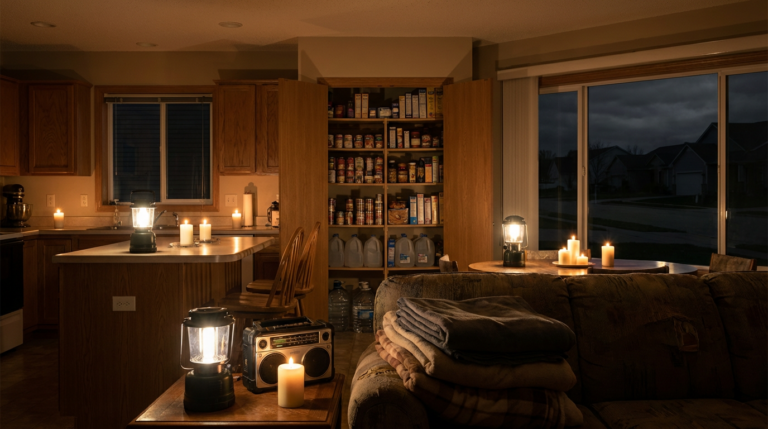
A 3-day blackout is inconvenient. A 7-day blackout with kids at home is a genuine emergency if you’re not ready for it. The difference between families who manage fine and families who end up in a shelter on day 4 isn’t luck — it’s having thought through the right things before the lights go out. Here’s the complete playbook for a family of 4.
Table of Contents
- The First Hour: What to Do Immediately
- Water: The Number That Surprises Everyone
- Food for 7+ Days Without Refrigeration
- Power and Lighting
- Staying Warm When the Heat Goes Off
- Communication When Phones Die
- Home Security During a Blackout
- Managing Kids and Mental Health
- 7-Day Blackout Prep Checklist
- Common Mistakes
- FAQ
The First Hour: What to Do Immediately
Most families waste the first hour of a blackout waiting to see if the power comes back. Don’t. The actions you take in the first 60 minutes determine how the next 7 days go.
- Fill your bathtubs immediately. If the outage is related to a major event (storm, earthquake), water service may be disrupted within hours. A standard bathtub holds 80–100 gallons. Fill every one you have, right now.
- Check the refrigerator and freezer. Stop opening them. A full freezer stays frozen for 48 hours if left closed. A full fridge stays safe for 4 hours. Consolidate both to maximize fullness if needed.
- Locate all flashlights, lanterns, and batteries. Don’t wait until dark.
- Charge every device immediately on any remaining power — laptops, power banks, phones. You have minutes, not hours.
- Turn your fridge and freezer thermostats to maximum cold. If power is intermittent, this buys time.
- Check in with elderly neighbors. They’re the most vulnerable and least likely to self-report.
Water: The Number That Surprises Everyone
Most families dramatically underestimate how much water they use. The FEMA minimum of 1 gallon per person per day covers drinking and basic hygiene only — no cooking, no dishwashing, no toilet flushing if the water system fails.
Realistic daily water needs for a family of 4:
| Use | Gallons/Day (family of 4) | Notes |
|---|---|---|
| Drinking | 4 gallons | 1 gal/person minimum |
| Cooking + food prep | 2–3 gallons | Boiling, reconstituting food |
| Basic hygiene (sponge baths) | 4–8 gallons | Not showering — just washcloths |
| Toilet flushing (manual) | 6–12 gallons | Bucket method: 1.5 gal/flush |
| Realistic daily total | 16–27 gallons | For a family of 4, conservative use |
For a 7-day blackout, plan for 112–189 gallons of water. Your bathtubs alone (if filled immediately) give you 160–200 gallons. That’s why filling them in hour 1 matters so much.
Food for 7+ Days Without Refrigeration
Your refrigerator is an asset for the first 4 hours and a liability after that. Here’s how to manage food over a multi-day blackout:
Hours 0–4: Refrigerated food is still safe. Eat the most perishable items first — dairy, cooked leftovers, meat. Keep the fridge door closed as much as possible.
Hours 4–48: Freezer food stays frozen if the door stays closed. Refrigerated food in the “danger zone” (40°F–140°F) for more than 2 hours should be discarded. When in doubt, throw it out.
Day 2+: You’re living from your pantry. What should be in it for a family of 4 for 7 days:
| Category | 7-Day Target (family of 4) | Examples |
|---|---|---|
| Calories/day | 7,000–8,000 cal total | 1,750–2,000 cal/person |
| Grains/carbs | 14–20 lbs | Rice, pasta, oats, crackers |
| Protein | 28+ cans | Canned beans, tuna, chicken, peanut butter |
| Fats | 2–3 bottles | Olive oil, coconut oil (shelf stable) |
| Fruits/vegetables | 20–28 cans | Canned tomatoes, corn, fruit in juice |
| Comfort foods | Enough to matter | Coffee, chocolate, hard candy for kids |
Cooking without power: a single-burner propane camp stove with two 1-lb canisters ($15–$25 total) handles all cooking needs for a 7-day blackout. Use it outdoors or with windows open.
Power and Lighting
Minimum lighting setup for a family of 4 during a multi-day blackout: one high-output lantern (500–1,000 lumens) for the main living area, one dimmable lantern per bedroom, and a small lantern for the bathroom. That’s 4–5 lanterns total, not one.
For power beyond lighting, your options:
- Solar power station (e.g., EcoFlow Delta Pro, ~$2,500): Runs fridge, charges phones and laptops, powers CPAP — silently, indoors, no fuel. Best for 1–5 day outages in urban areas.
- Gas or dual-fuel generator (e.g., Champion 3500W, ~$550): Higher output for well pumps, AC, or whole-home critical loads. Must run outdoors, 20+ feet from windows.
- Hybrid (solar station + gas): The best setup for extended outages — solar handles days 1–3, gas extends coverage to 14+ days at 75% less fuel than running gas alone.
Staying Warm When the Heat Goes Off
In a winter blackout, a house with no heat loses approximately 1°F per hour in cold weather. After 12 hours, a 70°F house is at 58°F. After 24 hours, it may be at 46°F — cold enough to be dangerous for infants and elderly. Here’s how to manage:
- Pick one room and heat only that room. Trying to heat a whole house with emergency heat is impossible. One interior room with no exterior walls, minimal windows, and a door is your base camp. Stuff towels under the door.
- Layer clothing, not just blankets. Thermal base layers, wool socks, and hats worn indoors are 3x more effective than adding blankets.
- Propane heaters (Mr. Heater Big Buddy): Safe for indoor use with proper ventilation — one window cracked 1 inch is sufficient. The 4,000 BTU setting heats a 100 sq ft room in minutes. One 1-lb canister lasts 5–6 hours on low.
- Wood stove or fireplace: Best long-term heat source if you have one. Have 3 days’ worth of seasoned wood stored before winter every year.
Communication When Phones Die
Cell towers have backup power for 4–8 hours. After that, service becomes unreliable. Plan for it:
- Hand-crank NOAA weather radio: The single most important communication device in a blackout. Picks up emergency broadcasts when everything else fails. A good one runs $30–$50.
- Out-of-state contact: Designate a family member outside your region as a central check-in point. Local calls overload in regional disasters; out-of-state calls often go through.
- Walkie-talkies: For coordination within 1–2 miles. Useful if family members are at different locations during an evacuation.
- Written contact list: Print the 10 most important phone numbers and keep a copy in every emergency bag. Most people can’t recall numbers stored in their phone.
Home Security During a Blackout
Extended blackouts increase property crime — not dramatically, but measurably. Dark houses are targets. Simple steps:
- Keep exterior lights on battery-powered motion sensors (these are independent of the grid)
- Lock all entry points every night — doors and windows
- Avoid posting on social media that your power is out and you’re relying on backup systems
- A battery-powered doorbell camera (Ring has battery models) still functions during blackouts
- Connect with immediate neighbors — mutual awareness reduces vulnerability for everyone
Managing Kids and Mental Health
Kids pick up on parental stress faster than parents realize. The households that manage multi-day blackouts best are the ones that treat it as a controlled adventure, not a crisis — even when it’s difficult.
- Keep a routine. Wake, meals, and bedtime at normal times. Structure reduces anxiety for kids and adults equally.
- Pre-load a tablet with offline content — downloaded movies, audiobooks, games — before the next outage. A fully charged tablet is 8–10 hours of kid entertainment.
- Physical activity matters more in confinement. Blanket forts, indoor obstacle courses, flashlight tag — kids need to burn energy even when it’s dark outside.
- Be honest, age-appropriately. Kids handle “we’re having a power adventure” better than sensing you’re anxious but won’t explain why.
7-Day Blackout Prep Checklist for a Family of 4
| Category | What to Have | Minimum Quantity |
|---|---|---|
| Water | Stored water + WaterBOB bladders | 112+ gallons (16 gal/day) |
| Food | Non-perishable pantry + cooking fuel | 7-day calorie supply + 2 propane canisters |
| Lighting | Lanterns + spare batteries | 4–5 lanterns, 6-month battery supply |
| Power | Power bank or solar station | 100Wh minimum; 2,000Wh for fridge |
| Heat | Propane heater + fuel | Mr. Heater Big Buddy + 6 x 1lb canisters |
| Communication | Hand-crank NOAA radio | 1 radio with fresh batteries |
| First aid | Trauma kit + 30-day medication supply | Per family member |
| Cash | Small bills | $200+ (ATMs and card readers fail) |
Common Mistakes in Long-Term Blackout Prep
- Underestimating water needs. Families plan for 4 gallons/day (1 per person) and discover they actually need 16–27. The math is in the table above — do it for your family before you need it.
- Not filling the bathtubs immediately. Most families wait to see if the outage is serious. By the time they decide it is, the water pressure may already be dropping. Fill them in the first 10 minutes.
- One lantern for the whole house. It won’t cover everyone’s needs simultaneously. You need 4–5 distributed across the home.
- No cash. Card readers don’t work during blackouts. ATMs run out or go offline. Keep $100–$200 in small bills in your emergency kit.
- Waiting for the next big storm to prepare. The 48 hours before a major storm is the worst time to buy water, batteries, and fuel — shelves are empty and prices spike. Build your kit on a calm Tuesday in September.
FAQ
How long can a family of 4 survive a blackout without any prep?
About 24–48 hours comfortably. After that, refrigerated food becomes unsafe, phone batteries die, and water supply becomes uncertain if the outage is tied to a larger infrastructure event. With basic prep — 7 days of food and water, a few lanterns, a hand-crank radio — the same family manages 7–14 days without leaving home.
How much food do I need for a 7-day blackout for a family of 4?
Plan for 1,750–2,000 calories per person per day, which equals 49,000–56,000 calories for 4 people over 7 days. In practical terms: 14–20 lbs of rice/pasta/grains, 28 cans of protein, 20 cans of vegetables and fruit, plus cooking oil and comfort foods. All shelf-stable, all rotatable into your regular pantry.
Is it safe to use a propane heater indoors during a blackout?
Yes, with ventilation. A Mr. Heater Big Buddy is rated for indoor use — crack one window an inch in the room you’re heating. Install a CO detector nearby and test it first. Never use a grill, charcoal, or gas oven for heat indoors — those are not designed for enclosed spaces and produce lethal CO levels.
How long does food stay safe in the fridge and freezer during a blackout?
A refrigerator keeps food safe for 4 hours if the door stays closed. A full freezer stays frozen for 48 hours; a half-full freezer for 24 hours. Use an appliance thermometer to check — food is safe below 40°F. Above 40°F for more than 2 hours: discard it. When in doubt, throw it out.
What’s the single most important thing to buy for blackout preparedness?
Water storage. Everything else — food, light, heat — you can improvise around. Running out of water with a family of 4 on day 3 of a blackout is a genuine emergency. A WaterBOB bathtub bladder ($30) and 5 gallons of stored water are the highest-ROI preparedness purchases you can make today.
Your Next Step
The best blackout kit is the one you build before you need it. Start with water storage and a hand-crank radio this week — then work through the checklist above. For power generation, see our full breakdown of Solar vs Gas Generator for Preppers, and for the right lighting setup, see Best Emergency LED Lanterns for Blackouts.
Last Updated: April 2026
