
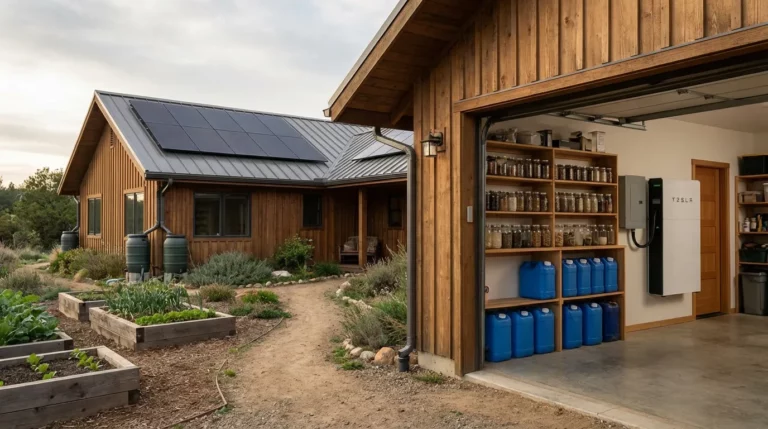
Most preppers think in terms of 72 hours. FEMA recommends 72 hours. That’s a weekend camping trip. The disruptions that actually strain families — extended power outages, supply chain breakdowns, severe weather events, job loss combined with a local emergency — last 2–4 weeks. Thirty days is the benchmark that separates a household that weathers real disruptions from one that scrambles after day three.
This guide gives your family of 4 a concrete, pillar-by-pillar roadmap to 30-day home autonomy. Not a theoretical framework — specific quantities, specific products, specific costs.
The 6 Pillars of 30-Day Home Autonomy
| Pillar | Goal for 30 Days (Family of 4) | Budget Range | Difficulty |
|---|---|---|---|
| Food | 2,000 cal/person/day × 30 days = 240,000 calories total | $400–$800 | Medium |
| Water | 2 gal/person/day × 30 days = 240 gallons stored or sourced | $100–$400 | Medium |
| Energy | Essential loads only: lights, comms, small appliances | $300–$2,000+ | Hard |
| Cooking | 3 hot meals/day without grid power for 30 days | $100–$300 | Easy |
| Sanitation | Waste management + hygiene without running water | $50–$200 | Easy |
| Communication | Stay informed + contact with family without internet | $50–$150 | Easy |
Pillar 1: Food — 240,000 Calories for a Family of 4
Feeding four people for 30 days requires more planning than most families realize — not because it’s difficult, but because the quantity is large enough that improvisation doesn’t work. You need a system.
Calorie Reality Check
At 2,000 calories per person per day (light activity — you’ll use more in a stressful physical situation), your family needs 240,000 total calories across 30 days. That’s not a number you can casually buy at Costco without a plan. Here’s what that looks like in practical terms:
| Food Item | Quantity for 4 People / 30 Days | Calories | Approx. Cost |
|---|---|---|---|
| White rice (50 lb bag) | 2 bags (100 lbs) | ~72,000 cal | $60 |
| Dried beans (mixed, 25 lb) | 2 bags (50 lbs) | ~76,000 cal | $40 |
| Cooking oil (128 oz) | 3 jugs | ~28,000 cal | $30 |
| Oats (50 lb bag) | 1 bag | ~27,000 cal | $35 |
| Canned goods (variety) | 120 cans | ~30,000 cal | $120 |
| Pasta (5 lb boxes) | 10 boxes | ~16,000 cal | $25 |
| Peanut butter (40 oz jar) | 6 jars | ~28,000 cal | $50 |
| Total | ~277,000 cal | ~$360 |
That base covers your calorie needs at roughly $360. Add $100–$200 in supplements — spices, condiments, coffee, comfort foods, and vitamins — and you have a functional 30-day food supply for under $600.
Storage Requirements
100 lbs of rice + 50 lbs of beans + canned goods requires approximately 10–12 cubic feet of storage space (roughly two 5-gallon bucket stacks plus a shelving unit). Store in a cool, dark area. Use food-grade 5-gallon buckets with Gamma-Seal lids and oxygen absorbers for rice, beans, and oats. Properly stored, this food keeps for 10–25 years.
Nutritional Balance
Rice and beans alone is survivable but miserable. Make sure you also have:
- Fat: Cooking oil, peanut butter, ghee — fat is calorie-dense and essential for hormone function
- Protein: Canned fish, canned meat, dried lentils, beans
- Vitamins: Multivitamins (90-day supply), canned and freeze-dried vegetables
- Morale foods: Coffee, tea, chocolate, spices — these matter more than people expect during sustained stress
Pillar 2: Water — 240 Gallons for a Family of 4
Water is the hardest pillar to fully achieve from stored supply alone. At 2 gallons per person per day (drinking + cooking + basic hygiene), your family of 4 needs 240 gallons for 30 days. That’s a lot of storage. The realistic approach combines modest stored water with reliable collection and filtration capability.
Stored Water: First 7–10 Days
Store at minimum 56 gallons (1-week buffer) using food-grade containers:
- 7-gallon WaterBrick containers ($20 each, stack flat) — 8 containers = 56 gallons
- 55-gallon blue water barrels ($50–$80 each) — 2 barrels = 110 gallons, strong 2-week buffer
- Bathtub WaterBOB emergency bladder ($30) — fills a bathtub with 100 gallons in minutes when you have warning
Collection: Days 10–30
Two rain barrels (55 gallons each) attached to your downspouts collect approximately 0.6 gallons per 1 sq ft of roof per inch of rain. Most homes collect 50–100 gallons per average rainstorm. This extends your supply from 2 weeks toward 30 days in most climates.
Filtration: Your Safety Net
Any collected water needs filtration before drinking. Your home should have:
- Sawyer Squeeze filter ($35) — filters up to 100,000 gallons, portable
- Berkey countertop filter ($250–$350 for Big Berkey) — filters 2.75 gallons/hour, ideal for family use
- Aquatabs ($10 for 50 tablets) — chemical backup when other methods fail
Pillar 3: Energy — Essential Power Without the Grid
Full home energy independence for 30 days requires either a large generator with significant fuel supply, a whole-home solar+battery system, or a deliberate reduction of what you actually need powered. The third option is the most practical for most families.
Define “Essential” Loads
Make a list of what you actually need electricity for during an emergency. For most families, the list is shorter than they think:
| Load | Daily Consumption | Can It Be Eliminated? |
|---|---|---|
| LED lighting (8 bulbs, 4 hours) | ~0.3 kWh | Partially (use headlamps) |
| Phone charging (4 phones) | ~0.1 kWh | No |
| NOAA radio | ~0.01 kWh | No |
| Small fan (summer) | ~0.2 kWh | Yes (in cooler weather) |
| CPAP (if applicable) | ~0.1–0.3 kWh | No |
| Refrigerator (running) | ~1.5 kWh | Yes (switch to cooler + ice) |
| Minimal total | ~0.5–0.7 kWh/day |
Realistic Power Solutions by Budget
Budget: $300–$600 — Portable Power Station
A 500–1000Wh power station (EcoFlow RIVER 2 Pro at $400, or Goal Zero Yeti 500X at $500) paired with a 100W solar panel ($80–$120) covers essential loads — lights, phone charging, radio, CPAP — for 30 days with daily solar recharging. This is my recommended starting point for most families.
Budget: $1,500–$4,000 — Extended Power System
A 3–5 kWh portable power station (EcoFlow DELTA Pro, Bluetti AC300) with 2–4 solar panels powers a wider range of essential loads including a chest freezer or sump pump during emergencies. This system covers 30 days easily for a family of 4.
Budget: $5,000–$15,000+ — Whole-Home Backup
A propane or natural gas standby generator (Generac, Kohler) or a whole-home battery backup (Tesla Powerwall, Enphase) provides near-seamless backup power. High upfront cost but zero management during an emergency.
Pillar 4: Cooking Without Grid Power
This is the most underrated pillar — and the easiest to solve. Most families own exactly zero off-grid cooking capability. That means their $600 food supply becomes inedible the moment the stove stops working.
Primary: Camp Stove with Propane
A two-burner camp stove (Coleman Classic, ~$50) running on 1-lb propane canisters is your primary off-grid cooking solution. One 1-lb canister lasts approximately 1 hour of cooking time at medium heat. For 3 meals/day over 30 days at 30–45 minutes of active cooking per day, you need roughly 20–25 canisters (~$60 for 24 canisters).
Alternatively, a single-burner stove connected to a 20-lb propane tank ($50 for the tank, $15–$25 to fill) provides approximately 20–25 hours of cooking time — roughly 30 days of cooking on one tank.
Secondary: Rocket Stove or Wood Burning
A wood-burning rocket stove (EcoZoom Versa, ~$100) is your backup when propane runs out. It uses small diameter wood — twigs, scrap lumber, branches — and burns extremely efficiently. In a wooded or suburban area, fuel is free. This is your 30+ day cooking solution when all other options are exhausted.
Fuel Storage Safety
- Store propane canisters outdoors or in a well-ventilated structure — never inside
- Keep propane away from any ignition sources and direct sunlight
- Check canister expiration dates (typically 12 years, but seals degrade over time)
- Never cook indoors with propane or charcoal — carbon monoxide kills silently
Pillar 5: Sanitation Without Running Water
This is the pillar people plan last and need first. Sanitation failure in an extended emergency leads to disease, which kills more people in disasters than the initial event. Take this seriously.
Toilet Functionality
If your home is on municipal water, your toilet will flush normally as long as your tank is full — approximately 1.6 gallons per flush. After that, you need to pour water directly into the bowl to flush (“bucket flush”). This uses 1–2 gallons per flush. For a family of 4, sanitation water alone is 6–8 gallons per day if flushing every use.
Alternatives for extended water-out scenarios:
- Camp toilet bucket kit ($30–$50): 5-gallon bucket with toilet seat lid and compostable waste bags. Waste bags seal for disposal. Simple, effective, and sanitary.
- Composting toilet ($500–$1,500): More expensive, but a permanent solution. Works without water and creates usable compost.
Hygiene Basics (Non-Water-Intensive)
- Hand sanitizer: 4 large bottles (24 oz each) for 30 days of regular use; stock 6–8 for emergencies
- Wet wipes: Substitute for showering when water is scarce — 3–5 packs of 80 ct for the family
- Dry shampoo: Surprisingly important for morale; stock 2–3 cans
- Dish cleaning: Minimal water method — wipe plates with paper towels first, wash in 1 quart of water with a few drops of dish soap
Waste Disposal
If trash collection stops, you need a plan. Compost all food waste (accelerates with a tumbler). Keep a burn barrel or designated burn area for combustible materials (where legal). Store non-compostable, non-combustible waste in sealed heavy-duty bags in a secure outdoor area.
Pillar 6: Communication and Information
Extended emergencies mean internet and cell networks degrade or fail. You need information (what’s happening, what’s coming, when it’s safe) and contact with family outside your home.
NOAA Weather Radio
A hand-crank or battery-powered NOAA weather radio ($30–$60) receives emergency broadcasts from FEMA and NWS without internet or cell service. This is your primary information source when everything else is dark. Every home should have one — it’s the single best $40 preparedness purchase you can make.
FRS/GMRS Walkie-Talkies
A pair of Midland T71VP3 or similar walkie-talkies ($50–$80/pair) lets your family communicate within 1–5 miles without any infrastructure. Critical if family members are at different locations during an event.
Out-of-State Contact Protocol
Designate one out-of-state family member as your family’s communication hub. Everyone knows to call that one number. When local lines are jammed, long-distance calls often go through when local ones don’t. Write this number on a card inside every family member’s phone case.
What 30-Day Autonomy Actually Costs
| Pillar | Essential Setup Cost | Full Setup Cost |
|---|---|---|
| Food (30-day supply) | $400 | $600 |
| Water (storage + filtration) | $150 | $400 |
| Energy (power station + panel) | $400 | $2,000+ |
| Cooking (stove + fuel) | $120 | $250 |
| Sanitation | $80 | $200 |
| Communication | $70 | $150 |
| Total | ~$1,220 | ~$3,600+ |
The essential setup — not perfect, but functional for 30 days — costs roughly $1,200–$1,500 for a family of 4. That’s less than a used car, and it functions as a household insurance policy with an indefinite term.
Building in Phases (If Budget Is Limited)
You don’t need to do all of this at once. A phased approach over 6 months:
- Month 1: Food supply ($400) + NOAA radio ($40) + water storage start ($80) = $520
- Month 2: Complete water storage + filtration ($200) + camp stove + fuel ($120) = $320
- Month 3: Power station + solar panel ($500) + sanitation kit ($80) = $580
- Month 4–6: Top off gaps, add redundancy, improve storage organization = $200
Total phased cost: ~$1,620 over 6 months — under $270/month.
Common Mistakes in 30-Day Home Autonomy Planning
1. Prioritizing gear over consumables
Families spend $400 on a tactical flashlight collection and $60 on food. Gear is the exciting part — but food and water are what actually sustain life. Fund the consumables first, gear second.
2. Forgetting infant or medical needs
If anyone in your household takes daily medication, a CPAP, or an insulin-dependent device — or if you have an infant with formula needs — those specific requirements need to be solved first, not last. A diabetic family member with 3 days of insulin and a 30-day food supply still has a 72-hour plan.
3. Storing food with no cooking method
Dried beans require 60–90 minutes of boiling. Rice requires 20 minutes. If your stove doesn’t work and you have no camp stove, your long-term food storage is inedible. Food and cooking method must be planned together.
4. Not accounting for fuel storage decay
Gasoline degrades in 3–6 months without stabilizer. Propane canisters’ seals weaken. Batteries discharge slowly even unused. Any stored fuel or power source needs a rotation and testing schedule, or it won’t work when you need it.
5. Treating 30-day autonomy as a one-time project
Your first expiration date hit turns your 30-day supply into a 15-day supply. Set calendar reminders every 6 months to rotate food, check water freshness, test power equipment, and top off fuel supplies. Autonomy is maintained, not achieved once.
FAQ
Can I achieve 30-day home autonomy in an apartment?
Yes, with adjustments. Food storage scales directly — you just need interior space for buckets and shelving. Water is the main challenge: without outdoor space for rain barrels, you rely more on stored water and emergency bladders (bathtub WaterBOB). Cooking must be done on a camp stove outdoors or at a window with ventilation. Energy follows the same portable power station approach. Sanitation can use the camp toilet bucket method. Apartments are harder than houses but absolutely achievable.
How do I store 240 gallons of water in a regular home?
You don’t need to store all 240 gallons — that’s the full theoretical requirement. A realistic approach: store 55–110 gallons (1–2 barrels), fill the bathtub WaterBOB at first warning (adds 100 gallons), and have rain collection capability for the rest. The combination covers 30 days in most scenarios without needing dedicated warehouse space.
What’s the most common gap in family 30-day prep?
Cooking method. Almost universally, families have food stored but no off-grid cooking capability. The second most common gap is water filtration — families store some water but have no way to process collected rainwater or stream water safely. These two gaps are also the cheapest and easiest to close ($50–$150 each).
Do I need a generator for 30-day autonomy?
No. A generator is convenient and powerful, but it’s expensive to run ($5–$10/day in fuel for a mid-size generator) and requires significant fuel storage. For 30-day essential-loads-only operation, a 500–1000Wh portable power station with a solar panel is quieter, cheaper to run, lower maintenance, and sufficient for lights, phone charging, radio, and medical devices. Generators are better for short-term heavy-load backup than long-duration minimal-load scenarios.
Bottom Line
Thirty-day home autonomy for a family of 4 is achievable for roughly $1,200–$1,500 in total investment, spread over a few months. It’s not about building a bunker or going off-grid permanently — it’s about having the six pillars in place so that whatever happens in the next year, your family’s baseline needs are met without depending on a functioning supply chain, grid, or municipal water system.
Start with food. One Costco run puts you 60% there. The rest follows.

Dan Lockland is a preparedness instructor and survival skills educator with over 15 years of hands-on experience. He shares practical, no-nonsense guidance on emergency preparedness, self-reliance, and sustainable living at PreparingWithDan.com.