
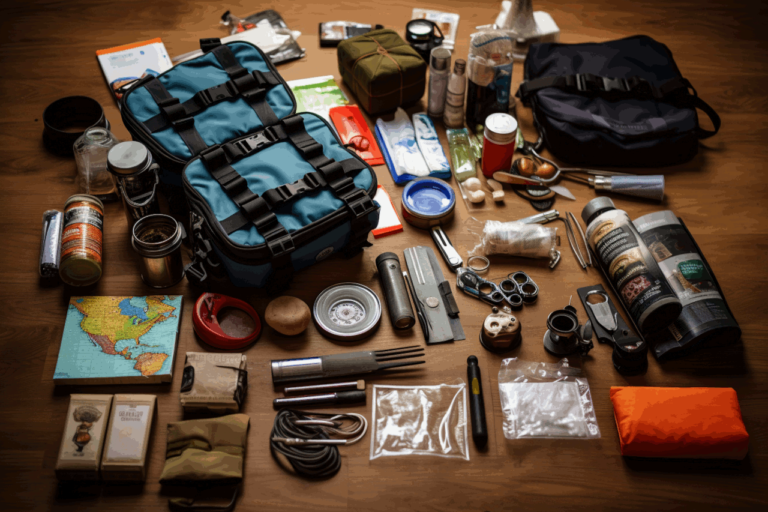
Half of American adults believe they are prepared for a disaster and a third have signed up for emergency alerts, according to FEMA’s National Household Survey as reported in the 2024 National Preparedness Report. In 2024 the average US electricity customer went 11 hours without power, weather killed 1,084 people (529 of them from heat), and 27 disasters each cost more than a billion dollars. This page collects the official numbers on preparedness in one place, each with its source and date, for anyone who needs to cite them. It is updated when the sources are.
Last updated 15 September 2026. Every figure below links to the government or official publication it comes from; where a figure is ours, it says so. Journalists, teachers and bloggers are welcome to reuse any of it with a link to this page or to the original source — see “How to cite” at the end.
How prepared American households say they are
Source: FEMA’s National Household Survey (NHS), as reported in FEMA’s 2024 National Preparedness Report (PDF, GovInfo).
- 51% of adults believed they were prepared for a disaster (2023 NHS) — up from 42% in 2017, but down from a high of 59% in 2019.
- 77% of respondents, urban and rural alike, believed they would likely be affected by a disaster in the coming year.
- 48% had assembled or updated emergency supplies in the past year; 32% had “saved for a rainy day”; 30% had documented or insured their property.
- 36% had signed up for alerts and warnings — while 98% expect to receive real-time alerts from several sources.
- Fewer than 40% reported having savings set aside for disasters, and about 1 in 4 said they would rely on public transport to evacuate.
- 14% had got involved with their community on preparedness.
- 89% had encountered preparedness information, and those who had were five times more likely to take at least three preparedness actions.
- 63% were “very” or “extremely” concerned about energy availability during an emergency.
What the weather actually did in 2024
Source: National Weather Service, Summary of Natural Hazard Statistics for 2024 (PDF).
- 1,084 weather-related deaths and 1,482 injuries in the United States in 2024; $18.4 billion in property and crop damage.
- Heat killed 529 people — nearly half of all weather deaths, and more than ten times the 46 deaths from cold.
- Flash floods killed 119, river floods 30; tropical storms and hurricanes 78; rip currents 74; tornadoes 52; lightning 14; winter storms 22.
- Hurricanes and tropical storms caused the most damage: $9.3 billion, followed by flash floods at $3.2 billion and tornadoes at $1.7 billion.
Billion-dollar disasters
Source: NOAA National Centers for Environmental Information, U.S. Billion-Dollar Weather and Climate Disasters (dataset archived after 2024).
- 27 disasters each costing more than $1 billion struck the US in 2024 — the second-highest count on record — for a total of $182.7 billion and 568 deaths: 17 severe storms, 5 tropical cyclones, 2 winter storms, 1 flood, 1 drought, 1 wildfire.
- From 1980 to 2024, 403 such events cost more than $2.915 trillion (CPI-adjusted to 2024) and caused 16,941 deaths — an average of about 9 events and 376 deaths a year.
Power outages
Source: U.S. Energy Information Administration, Today in Energy, December 2025, from the Electric Power Annual 2024.
- The average US electricity customer experienced 11 hours of interruptions in 2024 — nearly twice the annual average of the previous decade.
- Hurricanes Beryl, Helene and Milton accounted for 80% of the hours without power in 2024; major-event interruptions averaged nearly nine hours, against about four in 2014-2023.
Home fires and carbon monoxide
Sources: U.S. Fire Administration, Fire Statistics and Residential Fire Estimates; CDC, Carbon Monoxide Poisoning Basics.
- An estimated 343,000 residential building fires in 2024. Cooking caused 46.7% of them; unintentional or careless actions 10%; heating 7.9%; electrical malfunction 7.7%; intentional fires 4.7%.
- Over 2014-2023, residential fires fell 6% but residential fire deaths rose 5% and inflation-adjusted dollar loss rose 25%; deaths ran between roughly 2,600 and 2,800 a year.
- Fires are only 3.7% of what US fire departments respond to; EMS and rescue calls are 65.1%.
- Portable heaters caused only about 3% of residential heating fires (2017-2019), but the USFA notes their consequences were substantial relative to that share.
- More than 400 Americans die each year from unintentional carbon monoxide poisoning not linked to fires; more than 100,000 visit an emergency department and more than 14,000 are hospitalised.
Financial resilience
Source: Federal Reserve Board, Economic Well-Being of U.S. Households in 2024 (May 2025).
- 63% of adults would cover an unexpected $400 expense entirely with cash or its equivalent — unchanged from 2022 and 2023, down from 68% in 2021. The remaining 37% would borrow, sell something, or could not cover it.
- 35% of non-retirees thought their retirement savings plan was on track, down from 40% in 2021.
Our own figures (original data, free to cite with a link)
- A FEMA-compliant 72-hour kit for a family of four costs about $200 — $50 per person, $16.67 per person per day — priced item by item at the cheapest verified US retail listings in July 2026. Water and food are $111 of it. From our 72-hour kit cost study.
- The standard 3,600-calorie emergency ration bar provides 1,200 calories a day over three days, against a commonly cited need of 1,600-2,500 — a deficit of 400 to 1,300 calories per person per day. Same study.
- The best-selling one-person 72-hour kit on Amazon ships with six 4.25 oz water pouches — about 25 ounces for three days — against Ready.gov’s one gallon per person per day. From our 72-hour kit review, verified on the listing in September 2026.
What the official guidance asks for (the baseline the numbers are measured against)
- Ready.gov: one gallon of water per person per day, for several days, for drinking and sanitation; non-bottled stored water replaced every six months.
- Ready.gov: a several-day supply of non-perishable food, a battery or hand-crank radio, flashlight, first aid kit, extra batteries, whistle, dust mask, sanitation supplies, wrench for utilities, can opener, maps, phone chargers and a backup battery.
- USFA: smoke alarms inside and outside every sleeping area and on every level, both ionization and photoelectric sensing, replaced 10 years from the manufacture date.
- Ready.gov: generators, camp stoves and grills outdoors and at least 20 feet from windows; carbon monoxide detectors with battery backup.
How to cite
Each figure above belongs to the organisation named beside it; cite them directly. For our own figures, or for this compilation: “Emergency Preparedness Statistics (2026), Preparing with Dan, preparingwithdan.com/basics/emergency-preparedness-statistics/”. If you use a number from this page in an article or a lesson, a link back is appreciated and is how we know what to keep updated. Corrections: if a source has been revised, tell us and we will change the figure and date it. The free supply calculator turns the Ready.gov baselines into quantities for a specific household.
Official sources & further reading
The guidance in this article comes from official sources. Consult them directly for the authoritative version:
- FEMA — 2024 National Preparedness Report (National Household Survey findings)
- National Weather Service — Summary of Natural Hazard Statistics for 2024
- NOAA NCEI — U.S. Billion-Dollar Weather and Climate Disasters
- U.S. Energy Information Administration — Hurricanes in 2024 led to the most hours without power
- U.S. Fire Administration — Fire Statistics
- CDC — Carbon Monoxide Poisoning Basics
- Federal Reserve — Economic Well-Being of U.S. Households in 2024

Dan Lockland is a preparedness instructor and survival skills educator with over 15 years of hands-on experience. He shares practical, no-nonsense guidance on emergency preparedness, self-reliance, and sustainable living at PreparingWithDan.com.