
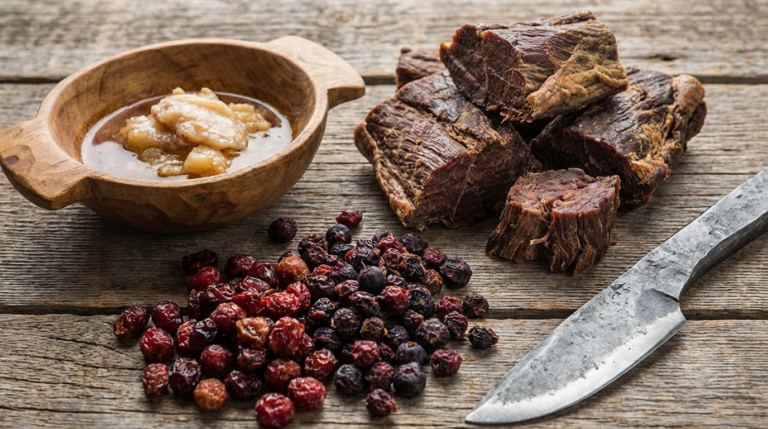
Pemmican is a concentrated, high-calorie survival food made from three ingredients: dried lean meat, rendered fat (tallow), and optionally dried berries. It was the primary travel and winter food of Native American plains tribes and later adopted by European fur traders and Arctic explorers because it solves a critical problem: packing maximum calories into minimum weight and space, with a shelf life measured in years rather than days.
What’s in Pemmican
Traditional pemmican uses just two mandatory ingredients and one optional:
- Dried meat (jerky ground to powder): Traditionally bison, elk, or deer. Modern recipes use lean beef, venison, or even lean turkey. The meat is dried until brittle (0% moisture), then ground or pounded into a powder or fine shred. This provides protein and some minerals.
- Rendered fat (tallow): Beef tallow is the standard. The fat is rendered (melted and strained) to remove impurities, producing a pure fat that’s shelf-stable at room temperature for years. Fat provides 9 calories per gram — more than double the caloric density of protein or carbohydrates. This is what makes pemmican an energy powerhouse.
- Dried berries (optional): Traditionally dried saskatoon berries, chokecherries, or blueberries. These add flavor, some vitamins (particularly vitamin C), and natural sugars. Not required for the basic recipe but recommended for palatability and nutrition.
The standard ratio is roughly 1:1 by weight — equal parts dried meat powder and melted tallow, with berries mixed in at about 10-20% of total weight.
Nutritional Profile
Pemmican is one of the most calorie-dense foods you can make. A typical 100g serving provides approximately:
- Calories: 550-600 (compared to ~350 for beef jerky, ~130 for canned tuna)
- Protein: 25-30g
- Fat: 45-50g
- Carbohydrates: 2-5g (higher with berries)
This macronutrient profile — high fat, high protein, very low carb — is ideal for sustained energy output during physical activity. Fat provides slow-burning energy, while protein supports muscle maintenance. Fur traders and Arctic explorers survived on pemmican as their primary food source for months at a time, often consuming 1-2 lbs per day (2,500-5,000 calories).
How to Make Pemmican
Step 1: Dry the Meat
Start with 2-3 lbs of very lean meat (beef round, venison, bison). Remove ALL visible fat — fat in the meat will go rancid, while rendered tallow won’t. Slice the meat as thin as possible (1/8 inch or less) against the grain. Dry it in a dehydrator at 155°F for 8-12 hours, or in an oven at the lowest setting (170°F) with the door cracked for 6-10 hours. The meat is done when it snaps cleanly — it should be brittle, not bendy.
Step 2: Grind the Dried Meat
Break the dried meat into small pieces and grind it in a food processor, blender, or mortar and pestle until it’s a fine powder or shredded consistency. The finer the grind, the better the tallow will bind. You should end up with roughly 1 lb of meat powder from 2-3 lbs of fresh meat.
Step 3: Render the Tallow
Cut 2 lbs of beef suet (the hard fat around the kidneys — ask your butcher) into small cubes. Heat in a pot on low (200-250°F) for 2-4 hours, stirring occasionally, until the fat melts and the solid bits (cracklings) turn brown and float. Strain through cheesecloth into a heat-safe container. The clear liquid is tallow. It solidifies at room temperature into a white, waxy fat. You need roughly equal weight of tallow to dried meat powder.
Step 4: Mix and Form
While the tallow is still warm and liquid (not hot — let it cool to about 120°F), pour it over the meat powder in a large bowl. If adding dried berries, mix them in now. Stir thoroughly until everything is coated and the mixture has a wet, dense consistency. Press the mixture into a baking pan, muffin tins, or form into bars by hand. Let it cool and solidify completely at room temperature. Cut or pop out into individual portions.
Step 5: Store
Wrap individual portions in wax paper, parchment paper, or vacuum-seal them. Store in a cool, dark place. Properly made pemmican (with all moisture removed from the meat and properly rendered tallow) will last 1-5 years at room temperature and significantly longer if stored below 60°F. In cool root-cellar conditions, some historical accounts report pemmican lasting 10-20 years.
Why Pemmican Matters for Preppers
Pemmican fills a specific gap in emergency food planning: it’s a complete food (protein + fat) that’s shelf-stable, calorie-dense, needs no cooking, and weighs very little relative to its energy content. One pound of pemmican provides roughly 2,500-3,000 calories — a full day’s nutrition in a package smaller than a paperback book. For a bug-out bag where weight and space are critical constraints, pemmican is one of the most efficient foods you can carry.
It’s also one of the few emergency foods you can make entirely from scratch with basic equipment. No freeze-dryer, no dehydrator (sun-drying or oven-drying works), no specialized packaging. This makes it relevant for long-term self-sufficiency scenarios where commercial food production isn’t available.
Bottom Line
Pemmican is dried lean meat powder mixed with equal weight rendered tallow, optionally with dried berries. It delivers 550+ calories per 100g, lasts years at room temperature, needs no cooking, and weighs almost nothing relative to its calorie count. It’s not a gourmet meal — it’s a survival food designed to keep you alive and functional when nothing else is available. For more on building your emergency food supply, see our prepper pantry guide and our pantry recipes.

Dan Lockland is a preparedness instructor and survival skills educator with over 15 years of hands-on experience. He shares practical, no-nonsense guidance on emergency preparedness, self-reliance, and sustainable living at PreparingWithDan.com.