
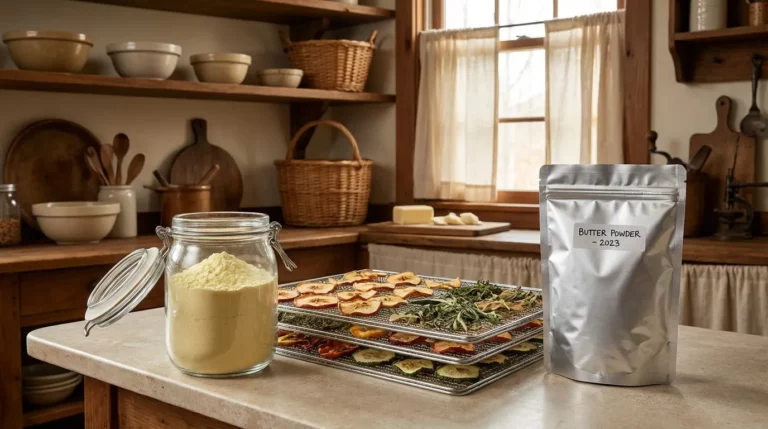
Dehydrating butter is the process of removing all moisture from butter to create a shelf-stable powder that can be stored for years and reconstituted with water when needed. It’s a legitimate preservation method, but it comes with important caveats — butter is 80% fat, and fat doesn’t dehydrate the way water-rich foods do. Understanding the process and its limitations will help you decide whether powdered butter belongs in your prepper pantry.
How Butter Powder Is Actually Made
Commercial butter powder (the kind you buy from Augason Farms, Hoosier Hill Farm, or emergency food companies) is made through spray-drying: butter is mixed with food starch and milk solids, then sprayed as a fine mist into a heated chamber where the moisture evaporates almost instantly. The result is a free-flowing powder that contains butter fat bound to a starch carrier.
This is important: you cannot fully replicate commercial butter powder at home with a standard food dehydrator. Home dehydrators work by evaporating water at 125-160°F with airflow. Butter is 80% fat, 15-17% water, and 3-5% milk solids. A dehydrator will remove the water portion, but you’re left with a greasy, semi-solid mass — not a powder. The fat doesn’t evaporate; it just sits there.
What You Can Do at Home
Method 1: Clarified Butter (Ghee)
The most practical home approach is making ghee — clarified butter with all water and milk solids removed. Ghee stores at room temperature for 9-12 months without refrigeration (3+ months longer than regular butter) and doesn’t require dehydration equipment.
Process: Melt unsalted butter in a heavy pot over medium-low heat. As it melts, three layers form: foam (milk proteins) on top, clear golden fat in the middle, milk solids settling to the bottom. Skim the foam, then carefully pour or ladle the clear fat through a cheesecloth-lined strainer into a glass jar, leaving the milk solids behind. The result is pure butterfat — ghee — that’s shelf-stable in a sealed jar at room temperature for up to a year, or 2+ years in a cool pantry.
Ghee functions exactly like butter for cooking: sautéing, frying, baking, and as a spread. It has a slightly nutty flavor from the toasted milk solids during the clarification process. For preppers, ghee is the most practical way to store butter fat long-term without refrigeration or commercial processing.
Method 2: Dehydrator Method (Partial)
If you want to attempt home dehydration, the most successful approach uses this process:
- Melt butter and mix with an equal weight of nonfat dry milk powder. The dry milk acts as a carrier to absorb the fat (mimicking what commercial spray-drying does with starch).
- Spread the mixture very thinly (1/8 inch) on dehydrator trays lined with parchment paper or silicone mats.
- Dehydrate at 130-140°F for 12-18 hours until the mixture is dry and crumbly.
- Break into pieces and grind in a food processor to a coarse powder.
- Store in airtight containers with oxygen absorbers.
This produces a usable product, but it’s not the same as commercial butter powder. The texture is grainier, the fat content means it can still go rancid (shelf life is 6-12 months vs. 3-5 years for commercial), and it doesn’t reconstitute as smoothly. It works for baking and cooking but isn’t great as a table spread.
The Practical Answer: Buy Commercial Butter Powder
For most preppers, buying commercially produced butter powder is more cost-effective and reliable than trying to make it at home. A #10 can of Augason Farms butter powder costs $15-25, stores for 10+ years unopened, and reconstitutes with water into a spreadable butter that works for cooking, baking, and table use. Making an equivalent amount at home requires butter ($5-8/lb), dry milk ($8-12), dehydrator time (12-18 hours of electricity), and yields an inferior product with a shorter shelf life.
Where home ghee-making wins: if you have access to cheap or free butter (dairy farm, bulk sales, homestead), ghee is an excellent way to preserve it without any special equipment beyond a pot and cheesecloth.
Storage: What to Expect
- Commercial butter powder (sealed): 10-15 years
- Commercial butter powder (opened): 6-12 months
- Homemade ghee (sealed jar, cool pantry): 9-24 months
- Homemade dehydrated butter (with O2 absorbers): 6-12 months
- Canned butter (commercially or home-canned): 2-3 years (note: USDA does not recommend home-canning butter due to density and heat penetration concerns)
Bottom Line
If you want shelf-stable butter for your prepper pantry, either buy commercial butter powder (#10 cans from emergency food suppliers) or make ghee at home. Skip the home dehydrator method unless you enjoy the process — it produces an inferior product at higher cost. Ghee is the practical winner for homesteaders with butter access, and commercial powder is the practical winner for everyone else. Either way, fat is a critical macronutrient that most prepper pantries under-stock — at 9 calories per gram, it’s the most calorie-dense macronutrient and essential for energy, brain function, and making bland emergency food taste acceptable.

Dan Lockland is a preparedness instructor and survival skills educator with over 15 years of hands-on experience. He shares practical, no-nonsense guidance on emergency preparedness, self-reliance, and sustainable living at PreparingWithDan.com.