
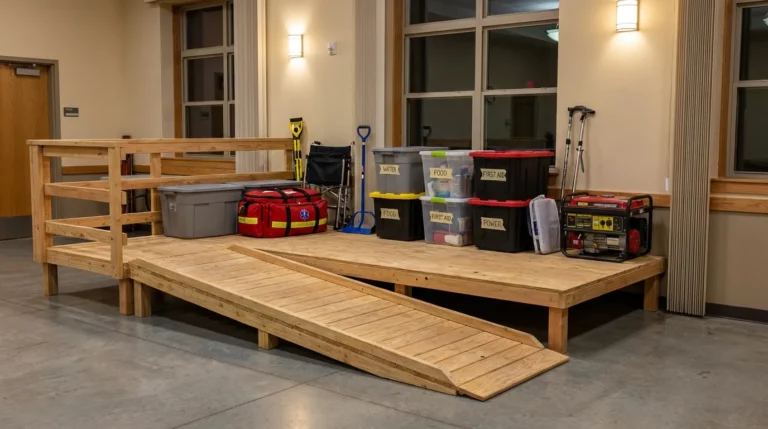
If someone in your household has a disability, a standard emergency plan will not cut it—and waiting until disaster strikes to figure that out is the most dangerous mistake a prepper family can make. The 61 million Americans living with disabilities face risks that multiply fast when the power goes out, roads flood, or shelters fill up. This guide gives your family the specific, practical steps to build a plan that actually works.
Know Your Needs Before the Disaster Hits
Visible vs. Invisible Disabilities
Not every disability is obvious. Wheelchair users and those with vision or hearing loss have equipment needs you can see and plan around. But people with epilepsy, diabetes, heart conditions, PTSD, or cognitive disabilities face equally serious emergency risks that planners often miss. A person with spinal cord injury cannot regulate body temperature—extreme heat becomes a medical emergency fast. Someone with Alzheimer’s may not be able to communicate distress. Your plan has to account for every condition in your household, visible or not.
Build a One-Page Needs Profile
First responders need your family member’s medical information in the first 60 seconds. Don’t make them dig for it. Create a one-page profile that covers everything a stranger would need to help them.
💡 Tip: What to include on your Needs Profile card
- Full name and date of birth
- Disability type and key medical diagnoses
- All medications with dosages and schedules
- Medical equipment and power requirements
- Communication needs (speech impairment, AAC device, sign language)
- Mobility limitations and equipment
- Behavioral triggers or calming techniques (for cognitive disabilities)
- Emergency contacts with phone numbers
- Blood type and known allergies
Laminate it. Put one in the go-bag, give copies to your support network, and tape one inside the front door where first responders will see it.
Build Your Personal Support Network
FEMA recommends identifying at least three people who can help at each location you regularly visit—home, work, school. For families with a disabled member, this is not optional. People with disabilities are two to four times more likely to need outside help during a disaster. Most do not have a support network in place.
How to Structure Your Network
- Resource coordinator: Tracks supplies, makes phone calls, manages logistics
- Evacuation assistant: Provides physical help with mobility and transport
- Communication relay: Updates family members and authorities on status
- Backup caregiver: Knows the full care routine if the primary caregiver is unavailable
✅ Action: Build your network this week
Call three people today and ask if they will be part of your emergency support network. Give each of them a copy of your one-page Needs Profile. If appropriate, give them a spare key. Confirm their participation every year—people move, schedules change.
Register with Official Programs
- Sign up on your city or county’s Special Needs Registry (search “[your county] emergency special needs registry”)
- Contact your utility company to be placed on their Medical Baseline or Priority Restoration list—this is free and can mean hours earlier power restoration
- Contact your local transit authority about emergency evacuation assistance for accessible transit users
- Update all registrations every 12 months or when your needs change
Your Disability-Specific Emergency Kit
A standard 72-hour kit is a starting point. For most families with a disabled member, you need 7 to 14 days of supplies minimum. Power grids take 7–10 days to restore after a major storm. Pharmacies run out during mass-casualty events. Plan for reality, not best-case scenarios.
Medical Supplies to Stock Now
- 30 to 60-day medication supply: Most insurance refills every 25–30 days—request early fills before hurricane season each year
- Consumables: Nebulizer masks (~$3 each at any pharmacy, replace every 5 years), feeding tube supplies, catheters, ostomy supplies
- Waterproof medication list with drug names, dosages, prescribing doctor, and pharmacy contact
- Copies of all prescriptions in a waterproof envelope
⚠️ Warning: The medication gap kills people
Only 22% of households dependent on medical equipment have adequate backup supplies. If you run out of a critical medication three days into a two-week evacuation, you cannot simply walk into any pharmacy and get it. Many controlled substances and specialty drugs require prior authorization. Start building your surplus now, not when a storm is 48 hours out.
Backup Power for Medical Equipment
72% of people who rely on powered medical devices have no backup power source. For a CPAP user, that means no sleep and worsening health by night three. For an oxygen concentrator user, it can mean a 911 call.
| Device | Typical Power Draw | Recommended Backup | Est. Price |
|---|---|---|---|
| CPAP machine | 30–60W | Jackery Explorer 300 | ~$250 |
| Home oxygen concentrator | 150–300W | Goal Zero Yeti 500X | ~$500 |
| Power wheelchair charger | 100–200W | EcoFlow River 2 | ~$300 |
| Nebulizer | 50–100W | Jackery Explorer 300 | ~$250 |
| Hearing aid charger | 5–10W | Any USB power bank | ~$30 |
| Infusion pump | Varies | Consult manufacturer | — |
⚠️ Warning: Register with your utility company today
Most power companies have a Medical Baseline program that puts you on a priority restoration list after outages. It costs nothing. Call the number on your bill today and ask about it. This single phone call can mean 6–12 hours earlier power restoration after a storm.
Adaptive Equipment to Include
- Extra power wheelchair batteries or a lightweight manual backup chair
- Hearing aid batteries (stock 30-day supply—know your battery size)
- Extra eyeglasses and a copy of the prescription
- Walking aids: backup cane, crutches, or rollator (Medline rollator ~$80 at Amazon)
- Extra AAC device batteries or a laminated printed communication board
- Comfort and sensory items for cognitive disabilities (familiar toy, weighted blanket, noise-canceling headphones)
Transportation and Evacuation Planning
Evacuation planning for a family with disabilities requires specific routes, not generic ones. A standard “head north on Route 1” instruction means nothing if there are no curb cuts, ramps are flooded, or your mobility device does not fit on the transit bus being used.
Plan Your Routes Now, Not During a Storm
- Identify two accessible evacuation routes minimum—drive or travel both now
- Map ramp locations, curb cuts, and accessible rest stops along each route
- Note which hotels along the route are ADA-accessible and pet-friendly
- Practice loading your mobility equipment into your vehicle
Accessible Transit Options
| Service | Provider | How to Access |
|---|---|---|
| ADA Paratransit | Local transit authority | Pre-registration required; call your local transit authority |
| Paratransit (door-to-door) | Local government | Wheelchair accessible, advance scheduling required |
| Special Needs Registry transport | County emergency management | Register with county before a disaster occurs |
| Private adaptive transport | Medical transport companies | Pre-arrange contract for emergency use |
💡 Tip: Do a timed evacuation drill twice a year
75% of people with disabilities have never practiced their evacuation plan. A power wheelchair user evacuating a two-story home via a stair chair takes 8–12 minutes—that is training time, not emergency time. Practice with your actual equipment, your actual support network, and your actual go-bag. Time it. You will find the gaps.
Medical Preparedness
Emergency Medical Information—Ready in 30 Seconds
A first responder who finds your family member needs critical medical information immediately. Do not rely on them to search through bags or phones. Create a laminated Medical ID card and attach it to the outside of your go-bag or wear it as a bracelet or necklace.
The card should include: full name, diagnoses, all medications with dosages, allergies, emergency contacts (two numbers), blood type, and insurance information. Keep the same information on a USB drive, in your phone’s Medical ID app, and as a printed sheet inside the go-bag.
Know Your Backup Medical Facilities
If your regular doctor or pharmacy is unavailable, where do you go? Map this out now.
- Nearest urgent care with hours and distance
- Nearest ER with trauma capability
- For dialysis patients: register with your dialysis center for their emergency protocols—they have disaster plans and network centers
- Nearest specialty hospital if you have specific ongoing needs (cardiac, oncology, rehabilitation)
Communication Plans for Every Disability Type
Match Your Tools to the Disability
For hearing impairments:
- Visual doorbell alerts and smoke detectors with strobe lights
- Register for your county’s text-based emergency alerts (not just the siren system)
- Motorola T465 two-way radios (~$30/pair) have a vibrating alert mode
- Captioned telephone (CapTel) for phone communication
For speech impairments:
- Laminated communication board in the go-bag at all times
- AAC device fully charged (add charging to your emergency kit checklist)
- Pre-programmed emergency messages on the device
- Backup: written message pad and pen, always in the bag
For vision impairments:
- Talking smoke detectors and carbon monoxide alarms
- Screen reader on phone with emergency contacts labeled for voice activation
- Braille emergency instructions if applicable
- All support network members trained in sighted guide technique
💡 Tip: The go-bag communication card
Create a laminated index card and attach it to the OUTSIDE of your go-bag. It should say: the person’s name, disability type, what they need from first responders (“I use a communication device—give me time to respond”), and the primary emergency contact. Anyone who finds that bag can help immediately.
Service Animals and Pets in Your Emergency Plan
Service animals are legally allowed in American Red Cross shelters and virtually all public emergency shelters under the ADA. Regular pets are not. Know the difference and plan accordingly.
Service Animal Emergency Kit
- 3-day food supply in a sealed container
- Water and a portable collapsible bowl
- Current medications (heartworm, flea prevention)
- Laminated vaccination records
- ID tags with your name and cell number
- A recent photo of you and your animal together (proof of working relationship)
- Familiar comfort item or toy to reduce stress
Emergency Options for Non-Service Pets
- Research pet-friendly hotels along both of your evacuation routes before you need them
- Contact your local boarding facility about their emergency protocols
- Connect with your county animal shelter for disaster shelter options
- ASPCA Mobile App stores pet info and connects to emergency resources
💡 Tip: June is Pet Preparedness Month
Use it every year as a trigger to update your pet emergency plan, renew vaccinations, and photograph your animals with their current ID tags.
Legal and Financial Preparedness
Documents to Keep in Your Go-Bag
Store everything in a waterproof, portable container inside your go-bag:
- Government-issued ID and passport
- Social Security card
- Guardianship papers, power of attorney, or conservatorship documents
- Medical records and prescription copies
- Insurance cards (health, homeowner or renter, auto)
- ABLE account information
- Special Needs Trust documentation
- Direct deposit information for benefits
Protect Your Benefits During a Disaster
| Financial Tool | Benefit | Key Limit to Know |
|---|---|---|
| ABLE Account | Save up to $17,000/year tax-free without affecting SSI | Keep balance under $100,000 to maintain Medicaid |
| Special Needs Trust | Protects larger sums without affecting federal benefits | Requires legal documentation and trustee management |
| Direct Deposit | SSI and benefit payments continue even when mail stops | Requires active bank account—ensure it stays open |
| Regular bank account | Flexible access to funds | Over $2,000 can affect SSI eligibility—use ABLE instead |
⚠️ Warning: The $2,000 SSI asset limit is a real trap during disasters
If you receive SSI and a FEMA disaster payment or insurance check pushes your bank account over $2,000, you can lose eligibility. An ABLE account is the solution—money deposited there does not count against the SSI resource limit. Talk to a benefits counselor before disaster season, not after.
For Caregivers: Plan for Your Own Limits
Caregiver burnout is real before a disaster. During one, it becomes critical. Parents of children with significant disabilities already report chronic stress levels comparable to combat veterans. During an evacuation with no sleep, limited food, and an unfamiliar environment, that baseline gets worse fast.
Build Redundancy into the Care Plan
If you are the primary caregiver and you get injured, sick, or separated from the family, who takes over? That person needs to know the full routine right now, not during the emergency.
- Identify a backup caregiver who knows the complete daily care routine
- Write down all care tasks in a simple checklist format
- Keep a care instruction sheet in the go-bag
- Brief your support network on behavioral triggers, communication cues, and calming techniques
✅ Action: Write the care instructions document this week
Write down your complete daily care routine and give a copy to your backup caregiver today. Include: medication schedule, mobility assistance steps, communication cues, dietary restrictions, and behavioral triggers. This is the most important document you will create for emergency preparedness.
Common Mistakes in Disability Emergency Planning
1. Registering once and forgetting it. Local special needs registries require annual updates. If you move, your needs change, or your contact information changes and you do not update your registration, you will not receive priority assistance when it matters.
2. A one-person support network. People get sick, travel, and become unavailable. You need at least two backup contacts per location who know the full care routine. One person is a single point of failure.
3. No backup power for medical devices. 72% of people using powered medical equipment have no backup source. A CPAP machine without power on night three of an extended outage is a health emergency waiting to happen. A portable power station is a one-time purchase that protects for years.
4. Waiting until the storm warning to refill medications. Pharmacies run out during mass-casualty events. Controlled substances and specialty medications require prior authorizations. Maintain a 30-day surplus at all times by requesting early refills before hurricane season or winter storm season each year.
5. Generic evacuation routes. A standard “exit via Route 1 North” plan is meaningless if there are no curb cuts on that route, ramps are flooded, or your wheelchair does not fit the transit vehicle being used. Plan your specific accessible route and walk or drive it before you need it.
6. Drilling without the actual equipment. Most families practice a fire drill without the wheelchair, without the communication device, without the medication bag. If you do not practice with everything, the drill is fiction. Time your actual evacuation with your actual gear at least twice a year.
FAQ
How much water should I store for a family member who needs extra hygiene care?
The standard 1 gallon per person per day covers drinking and basic sanitation. If your family member requires sponge bathing, wound care, or catheter maintenance, budget 2 gallons per day for them. For a family of four with one member needing extra care, plan for 5 gallons per day minimum, with a 14-day supply stored.
My family member uses a power wheelchair. What if the battery dies during evacuation?
Charge it fully as soon as you hear a storm or emergency is possible—do not wait for the evacuation order. Keep a portable power station like the EcoFlow River 2 (~$300) in your vehicle to recharge on the road. Third, contact your wheelchair supplier about a lightweight manual backup chair. Most suppliers can arrange a loaner or rental for emergencies.
Can my service dog come with us to an emergency shelter?
Under the ADA, a legitimate service animal—one trained to perform a specific disability-related task—must be accommodated in Red Cross shelters and virtually all public emergency shelters. Staff may ask what task the animal is trained to perform, but cannot require documentation. Emotional support animals do not have the same legal protections in shelters. If yours is an ESA, pre-arrange pet-friendly hotels along your evacuation routes.
How do we prepare for a family member with a cognitive disability like dementia or autism?
Maintain routines as closely as possible during and after the emergency—disruption and unfamiliar environments dramatically worsen symptoms. Prepare a sensory comfort kit with familiar items, preferred snacks, noise-canceling headphones, and a familiar blanket. Brief your entire support network on behavioral triggers and calming techniques. For children with autism, pre-exposing them to emergency sounds and walking through drills in a calm, low-stakes setting reduces panic during actual events. Consider a medical ID bracelet with an emergency contact number.
What is the single most important document to have in the go-bag?
The one-page Needs Profile: disability type, all medications with dosages, equipment dependencies, power requirements, communication notes, and two emergency contacts. A first responder who finds your family member unconscious needs this information in 30 seconds. Laminate it. Put it on top of everything else in the bag, and attach a copy to the outside of the bag where anyone can see it.
The families who make it through disasters intact are the ones who identified their exact needs before the event, built a real support network with redundancy, maintained a 30-day medication surplus, and practiced with their actual equipment. Do those four things and your family is better prepared than 90% of households in your area—disabled or not. Start with the one-page Needs Profile this week.
Official sources & further reading
The guidance in this article aligns with official emergency-preparedness resources. Consult them for the authoritative version:

Dan Lockland is a preparedness instructor and survival skills educator with over 15 years of hands-on experience. He shares practical, no-nonsense guidance on emergency preparedness, self-reliance, and sustainable living at PreparingWithDan.com.