
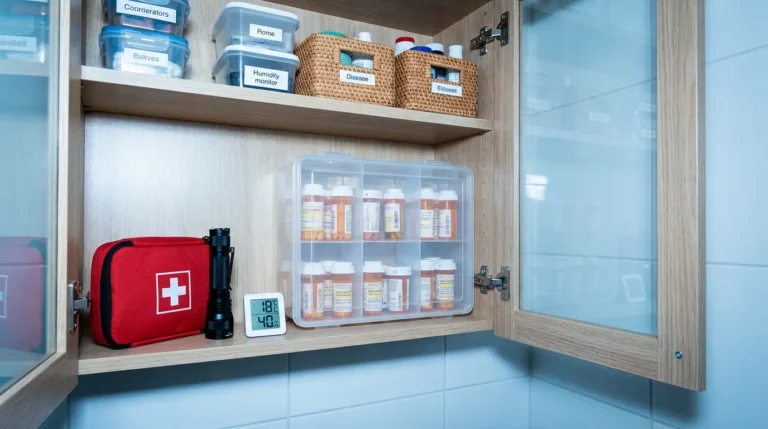
In 2005, Hurricane Katrina displaced over a million people — and cut off hundreds of thousands from their regular pharmacies for weeks. People with diabetes, heart conditions, epilepsy, and mental health conditions found themselves without medication in a matter of days. The pharmacies were closed, the insurance systems were down, and the medications they had been taking for years were sitting in flooded homes or abandoned evacuation bags. This is not a fringe scenario. It is what happens when a family has not built any buffer into their medication supply — and it can happen with a hurricane, a blizzard, a supply chain disruption, or a job loss that interrupts insurance.
This guide covers exactly what a family of 4 needs to know: how to legally build a reserve, how to store different drug types correctly, and what to do when you need medications and the normal system is not working.
The Legal Framework: What You Can and Cannot Store
Before anything else, understand what is legal. The rules are not complicated, but they vary by drug class:
| Drug Type | Examples | Can You Build a Reserve? | How |
|---|---|---|---|
| Non-controlled prescriptions | Blood pressure meds, statins, thyroid meds, antidepressants, inhalers | Yes — straightforwardly | Early refills, vacation overrides, 90-day supplies |
| Controlled substances (Schedule III–V) | Testosterone, some sleep aids, low-dose codeine products | Yes, with more paperwork | Prescription from your doctor, filled at one pharmacy |
| Controlled substances (Schedule II) | Adderall, Ritalin, OxyContin, Vicodin, Fentanyl patches | Limited — 30-day fills only in most states | Some states allow 90-day fills; emergency supplies require physician documentation |
| Insulin and biologics | Insulin, EpiPen, some injectables | Yes, but storage is critical | Requires refrigeration; build reserve carefully with cold storage plan |
The short version: for most maintenance medications — the ones you take every day for a chronic condition — building a 30–90 day reserve is completely legal and achievable with your doctor’s cooperation. The restrictions mostly apply to Schedule II controlled substances.
How to Build a Legal Medication Reserve
1. Talk to Your Doctor Directly
The most important step is also the one most people skip: just ask your doctor. Say something like: I am trying to be better prepared for emergencies — can you write my prescription for a 90-day supply, and is there any way I can get an early refill to build a small buffer? Most physicians — especially those who have practiced through natural disasters or pandemics — will understand immediately and help you.
Specifically ask about:
- 90-day supply fills: Many insurance plans cover 90-day fills through mail-order pharmacies. This means you are always at least 90 days out, not 30. The cost is usually the same or lower than three 30-day fills.
- Vacation override or emergency supply: Most insurers allow a one-time vacation override — an early refill before your normal refill date. This gives you an overlapping supply. Your doctor or pharmacist can initiate this.
- Documentation for Schedule II: If you take a Schedule II medication and need an emergency supply (documented hardship, evacuation order, natural disaster), your doctor can write a letter to support an emergency dispensing request at the pharmacy level.
2. Use the Fill Early, Use from Front Method
For non-controlled medications with refills available:
- Fill your prescription 7–10 days before you run out (most insurance allows refill at 75–80% usage)
- Store the new fill; continue using the previous supply first
- Each cycle, you build a slightly larger buffer
- After 3–4 fill cycles, you will have a meaningful reserve
This is slow but completely above-board. The key is consistency — it only works if you actually refill early every time.
3. Mail-Order Pharmacy for 90-Day Supplies
If your insurance plan includes mail-order pharmacy benefits (most do — check your plan documents), you can often get a 90-day supply for the same copay as a 30-day retail fill. This alone puts you 3 months ahead. Services like Express Scripts, CVS Caremark, and OptumRx are common mail-order partners for major insurers.
Storage Conditions by Medication Type
Most medications have the same enemy: heat, humidity, and light. The standard “store at room temperature” label means 68–77°F (20–25°C). Your bathroom medicine cabinet — where most families keep their medications — is one of the worst possible locations. Steam from showers raises humidity; temperature fluctuates significantly. Here is what each drug type actually needs:
| Medication Type | Temperature | Humidity | Light | Notes |
|---|---|---|---|---|
| Oral tablets/capsules | 68–77°F ideal; most stable to 86°F | <50% RH | Avoid direct sunlight | Store in original container with desiccant packet |
| Liquid medications | Per label; many need refrigeration | Any | Amber bottles block light | Shorter shelf life; rotate frequently |
| Insulin (opened) | Room temp up to 28 days (most types) | Any | Avoid direct light | Unopened: refrigerate 36–46°F; never freeze |
| EpiPen / epinephrine | 59–77°F | Any | Keep in carrier tube | Check monthly — discoloration = degraded, replace |
| Nitroglycerin | 59–77°F | Low — very sensitive | Keep in original dark glass bottle | Loses potency quickly; 6-month rotation required |
| Inhalers (bronchodilators) | 59–77°F | Any | Avoid heat | Do not store in car glove box — heat degrades propellant |
| Antibiotics (prescription) | 68–77°F (most) | <50% RH | Avoid sunlight | Amoxicillin liquid requires refrigeration; doxycycline degrades faster in heat |
Best Storage Location at Home
The ideal medication storage location in a typical home:
- A bedroom dresser drawer or bedroom closet shelf — stable temperature, low humidity, away from light
- A dedicated small container or bin — keeps medications organized and grouped by family member or condition
- Not the bathroom — humidity and temperature fluctuations degrade medications faster
- Not the kitchen — cooking heat and steam create the same problems
- Not a car — interior car temperatures regularly exceed 130°F in summer, which degrades almost all medications rapidly
For refrigerated medications (insulin, some biologics), a small dedicated medical refrigerator ($60–$120 on Amazon) maintains more stable temperatures than a household refrigerator that is frequently opened. If you are on insulin, this is worth considering.
Organizing Your Family Medication Reserve
The System That Actually Works
For a family of 4, medication management gets complicated fast — different people, different conditions, different schedules. A simple physical system prevents errors:
- One container per person: A labeled bin or medication organizer (like a Stack-On or Plano tackle box, $10–$20) for each family member. Color-code by person.
- Include a printed medication card: For each family member, a card listing: medication name, dosage, frequency, prescribing doctor’s name and phone, pharmacy, and what the medication treats. Keep a copy in your go-bag and in your car.
- First in, first out: New fills go behind older stock. You always use the oldest supply first, keeping the newer fill as reserve.
- Expiration tracking: On a sticky note or label inside the bin lid, write the earliest expiration date in the container. Check quarterly.
Childproofing the Reserve
A medication reserve creates a real safety risk for households with children. Every year, medication poisonings send over 50,000 children to emergency rooms. Your storage system needs to address this:
- Store all medications in their original child-resistant containers — do not transfer to non-child-resistant containers for convenience
- Store the medication reserve in a locked box or high cabinet — not just out of sight, but physically inaccessible to children under 6
- A lockable medication case ($15–$40) or a locked storage box prevents access even if a child finds the location
- Never describe medications in terms that sound appealing to children
Medication Reserve for Your Go-Bag
Your home reserve is for sheltering in place. Your go-bag needs its own medication supply sized for 72 hours minimum, ideally 7 days:
- Pack a 7-day supply of each family member’s critical medications in a labeled zip-lock bag inside the go-bag
- Include a printed copy of each person’s medication card (see above)
- Temperature management: If medications require refrigeration (insulin), your go-bag needs a small insulated pouch with reusable ice packs. FRIO insulin cooling wallets ($25–$40) use evaporation to keep insulin cool for 45+ hours without electricity — designed exactly for this situation
- Rotate the go-bag medications every 6 months — pull them out, use them, replace with fresh supply
The rotation discipline is what most families miss. A go-bag that was packed 2 years ago has expired medications. Put a calendar reminder for every April and October: rotate medications in go-bag.
When the Pharmacy Is Closed: Emergency Options
Despite your best preparation, you may find yourself needing a medication you do not have. Know these options before you need them:
- Emergency dispensing at any in-network pharmacy: Most states allow pharmacists to dispense an emergency supply (typically 72 hours to 30 days) of a non-controlled medication if you can demonstrate an established prescription and the prescriber is not available. Ask specifically for an emergency supply.
- Urgent care clinics: Can prescribe most non-controlled maintenance medications if you can show a prescription bottle or medication list
- Telehealth: Services like GoodRx Care, Teladoc, and MDLive can prescribe many maintenance medications after a brief consultation — often within hours, often cheaper than a doctor visit
- GoodRx: If insurance is disrupted, GoodRx coupons at pharmacy chains can reduce out-of-pocket costs significantly — sometimes lower than your insurance copay
- Manufacturer patient assistance programs: For high-cost brand medications (insulin, specialty drugs), manufacturers often have emergency assistance programs. Search for [medication name] patient assistance program.
Common Mistakes in Prescription Medication Preparedness
1. Storing medications in the bathroom
The bathroom cabinet feels logical — it is where you take medications, so you store them there. But the heat and humidity from showers degrade medications significantly faster than cool, dry storage. Move your medications to a bedroom drawer today. This one change extends effective medication life and costs nothing.
2. Assuming expiration dates mean the medication is dangerous after that date
FDA expiration dates indicate when the manufacturer can guarantee full potency — not when the medication becomes toxic. A 2012 FDA study found that 88% of 122 medications tested remained fully effective decades past their expiration date. Potency degrades gradually; most oral tablets remain 80–90%+ effective for years after expiration if stored correctly. Exceptions: liquid antibiotics (degrade faster), nitroglycerin (loses potency quickly), insulin (use-by date should be respected), and eye drops or solutions (contamination risk). For your reserve, expiration dates matter more as a rotation reminder than a safety cutoff.
3. Not telling family members where medications are stored
If you are the one who manages the medication reserve and you are incapacitated or unavailable during an emergency, your family needs to be able to find and administer medications without you. Make sure every adult family member knows: where medications are stored, which medications each person takes, and what to do in case of an adverse reaction.
4. Building a reserve without a rotation system
Storing medications and forgetting about them creates a false sense of security. A medication reserve with no rotation discipline becomes a collection of expired drugs. Set up the rotation system when you build the reserve — not later.
5. Not planning for refrigerated medications during a power outage
Insulin, some biologics, and certain antibiotics require refrigeration. A power outage during an emergency is exactly when you most need these medications — and exactly when the refrigerator is not working. Plan ahead: a FRIO cooling wallet for insulin, ice packs and an insulated case for other refrigerated medications, and a neighbor with a generator as a backup refrigeration option.
FAQ
How do I get my doctor to prescribe a larger supply for emergencies?
Ask directly and be specific. Tell your doctor you are working on emergency preparedness for your family and ask whether they can write your prescription for a 90-day supply and discuss a small buffer for emergencies. Most physicians are supportive of this, especially for chronic condition medications. If your doctor is hesitant, explain your specific concern — an evacuation scenario, natural disaster, or supply chain disruption. If your insurance restricts fill quantities, ask about vacation override provisions or a disaster preparedness fill — many insurers have explicit policies for this. Your pharmacist can also be helpful in navigating insurance restrictions on early refills.
Can I store antibiotics for emergencies without a prescription?
In the US, prescription antibiotics require a prescription for a reason — inappropriate use contributes to antibiotic resistance, and using the wrong antibiotic for the wrong condition can delay proper treatment. That said, fish antibiotics (amoxicillin, doxycycline) sold for aquarium use are chemically identical to human formulations and widely purchased by preppers. This is a legal gray area — technically they are not for human use, but possession is not illegal. If you go this route, understand that self-diagnosis and self-treatment of infections during emergencies carries real risks. A better approach: ask your doctor about a just-in-case antibiotic prescription for travel or emergencies — many will prescribe azithromycin or amoxicillin for documented travelers and preppers.
What happens to insulin during a power outage?
Opened insulin at room temperature is stable for 28–56 days depending on the type (check your specific insulin’s label). So a short-term power outage does not require immediate action if you have enough room-temperature insulin on hand. For extended outages: keep a FRIO insulin cooling wallet in your emergency kit — it uses evaporative cooling to maintain safe temperatures for 45+ hours per activation. Insulin that has been frozen and thawed should be discarded. Contact your insulin manufacturer’s customer service line — most have emergency protocols for natural disaster situations.
How should I dispose of expired medications I am rotating out?
The safest disposal method is DEA-authorized take-back programs — many pharmacies (CVS, Walgreens, Walmart) have drop-off kiosks that accept expired or unwanted medications, no questions asked, year-round. If no take-back is available, the FDA’s recommended household disposal method is to mix medications with coffee grounds, dirt, or kitty litter in a sealed bag and put it in the trash — not flushed down the drain for most medications. A specific list of high-risk medications (opioids, certain sleeping pills) are recommended for flushing because the risk of diversion outweighs environmental concerns.
Bottom Line
The gap between no medication reserve and a 30-day emergency buffer closes in one conversation with your doctor and one habit change: refill 7 days early every time. For most families, that is the entire system. Add a proper storage location (not the bathroom), a printed medication card per family member in your go-bag, and a rotation reminder twice a year. That is what it takes to make sure your family is not standing in an evacuation shelter trying to explain what medication your father takes for his heart condition.
Start with the conversation. Ask your doctor this week.

Dan Lockland is a preparedness instructor and survival skills educator with over 15 years of hands-on experience. He shares practical, no-nonsense guidance on emergency preparedness, self-reliance, and sustainable living at PreparingWithDan.com.