
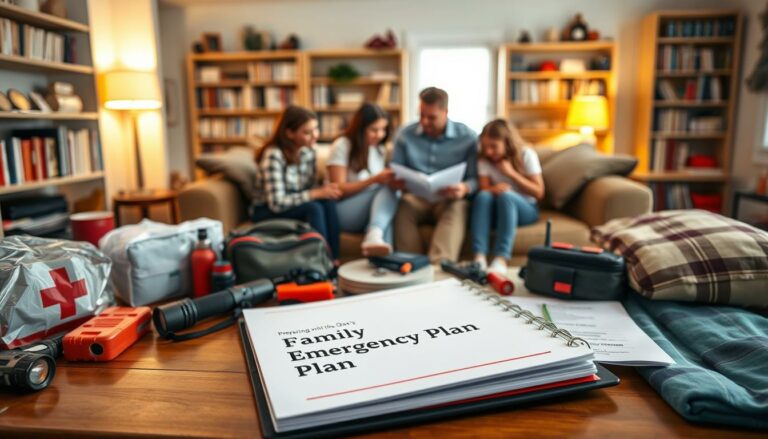
Most families don’t have an emergency plan. Of those that do, most have a generic one that falls apart the moment a real crisis hits — because it wasn’t built around their actual situation. This guide fixes that. You’ll leave with a plan tailored to your family’s size, health needs, local risks, and living situation. Not a template. A real plan.
⚡ What you’ll have after reading this
- A completed family contact card every member carries
- Two confirmed meeting points (near home + out of neighborhood)
- A 72-hour kit checklist tailored to your household
- A communication protocol that works when cell networks are down
- A medical needs inventory for every family member
- A review schedule so the plan stays current
Time to complete: ~2 hours for the full plan. Sections below take 10–20 minutes each.
Step 1 — Map Your Family’s Real Profile
A custom plan starts with an honest inventory of who’s in your household and what they actually need. Don’t skip this — it changes everything downstream.
Fill in this profile for each household member
| Who | Age / mobility | Medical needs | Role in emergency |
|---|---|---|---|
| Person 1 | |||
| Person 2 | |||
| Person 3 | |||
| Pet(s) | Food / meds / carrier | Who handles evacuation |
Questions to answer now:
- Who in the household cannot self-evacuate without assistance? (elderly, toddlers, mobility-impaired)
- Who takes daily medication that cannot be interrupted for more than 24–48 hours?
- Who requires electrical medical devices (CPAP, oxygen concentrator, insulin pump)?
- Who has the most first-aid knowledge? Who drives? Who speaks a second language that might be useful?
- If you have children in school: does each school have an emergency release protocol you’ve verified this year?
⚠️ Critical for families with medical dependencies: Contact your electricity provider now to register as a “medical baseline” or “life support” customer. During planned outages or declared emergencies, they prioritize restoration for registered households. Takes 5 minutes online.
Step 2 — Identify Your Local Risks (Be Specific)
Generic plans prepare for “natural disasters.” Your plan should prepare for the specific threats most likely in your zip code. The difference matters — a hurricane plan and an earthquake plan require completely different actions in the first 60 seconds.
| Threat type | Probability in your area | Warning time | Shelter-in-place or evacuate? |
|---|---|---|---|
| Earthquake | High / Medium / Low | None — seconds | Shelter-in-place (Drop, Cover, Hold) |
| Hurricane / tropical storm | High / Medium / Low | 24–72 hours | Evacuate if Cat 3+ or in flood zone |
| Wildfire | High / Medium / Low | Minutes to hours | Evacuate immediately when ordered |
| Flood / flash flood | High / Medium / Low | Minutes to days | Evacuate — never shelter in flood zone |
| Tornado | High / Medium / Low | 13 min average | Shelter-in-place (interior room, no windows) |
| Extended power outage | High / Medium / Low | Immediate | Shelter-in-place or relocate if medical need |
| Winter storm / blizzard | High / Medium / Low | Hours to days | Shelter-in-place |
| Industrial / chemical incident | High / Medium / Low | Minutes | Shelter-in-place (seal doors/windows) or evacuate |
How to find your actual local risk profile: Go to ready.gov/know-your-risks and enter your address. Your county’s emergency management website will also show the specific hazard maps for your area — look for “Local Hazard Mitigation Plan.”
Once you’ve identified your top 2–3 threats, your plan needs a specific protocol for each. The sections below apply to all scenarios — adapt them accordingly.
Step 3 — Set Your Two Meeting Points
This is the most important logistical decision in your plan. When a crisis hits and phones are down, your family needs pre-agreed locations to converge — no coordination required.
- Meeting Point 1 (near home): A specific spot within 2 blocks — a neighbor’s house, a landmark, the corner of two named streets. Not “the park” — the exact bench at the northeast entrance of the park. Be specific enough that a panicked 10-year-old can find it alone.
- Meeting Point 2 (out of neighborhood): A location at least 2 miles away in a direction that’s not downwind of your home’s main risk (wildfire, industrial area). A family member’s home, a community center, a specific school parking lot.
Write both addresses on the family contact card (see Step 4). Walk to Meeting Point 1 with your children so they physically know the route. Do this once.
Step 4 — Build Your Communication Protocol
Local cell networks collapse in the first hours of a major emergency — too many people trying to reach each other simultaneously. Your plan must work without reliable cell service.
The 3-layer communication system
| Layer | Tool | When to use | Limitation |
|---|---|---|---|
| Layer 1 — Text first | SMS text message | Immediately after any emergency | May be delayed but works when calls fail |
| Layer 2 — Out-of-state contact | One person both sides call | When you can’t reach each other directly | Requires coordination in advance |
| Layer 3 — Radio | Hand crank NOAA weather radio | When cell + internet are both down | Receive only (no two-way communication) |
Designate one out-of-state contact now. This person (a relative, a friend) lives outside your region. Every family member texts or calls them first if separated. They relay messages between family members when direct communication fails. This one step has reunited families in every major disaster of the last 30 years.
📋 Family Contact Card — print and laminate one per person
- My name: _______________
- Home address: _______________
- Meeting Point 1: _______________ (address + landmark)
- Meeting Point 2: _______________ (address + landmark)
- Out-of-state contact: _______________ / _______________
- Parent/guardian cell: _______________
- School emergency contact: _______________
- Doctor / pharmacy: _______________
- Medical alert (if any): _______________
Every person in your household — including children who can read — carries this card in their backpack, wallet, or school bag. Update it whenever a number changes.
Step 5 — Plan Your Evacuation Routes
Every household needs three routes out, not one. Major disasters frequently block primary roads — wildfires close highways, floods submerge underpasses, accidents create gridlock during mass evacuations.
- Primary route: Your normal way out of the neighborhood, heading toward your Meeting Point 2.
- Alternate route: A different direction out — ideally using surface streets, not freeways (freeways gridlock first).
- On-foot route: If you have to abandon the car. Identify a path of 2–5 miles you could walk to Meeting Point 2 or a shelter. Mark it on a paper map (not just GPS).
Keep a paper map of your county in your car and your home kit. GPS fails when cell towers are down or when satellites are overloaded. A $3 AAA county map is a legitimate preparedness item.
Vehicle readiness checklist
- Tank is never below half — refuel when it hits 50%
- Emergency kit stored in trunk (see Step 6)
- Paper maps of county and neighboring counties
- Phone charging cable and car charger
- Cash ($100–$200 in small bills — ATMs go down)
- Spare key known to all adult household members
Step 6 — Build Your Emergency Supply Kit
The kit should cover 72 hours minimum — the window before organized emergency services typically reach most households after a major event. For families with medical dependencies, plan for 7 days.
Core kit checklist (per person, per 72 hours)
| Category | Item | Quantity | Check |
|---|---|---|---|
| Water | Stored water | 1 gallon / person / day = 3 gallons minimum | ☐ |
| Water | Water filter (LifeStraw or Sawyer Squeeze) | 1 per household | ☐ |
| Food | Non-perishable calories (MREs, freeze-dried, canned) | 2,000+ cal / person / day | ☐ |
| Food | Manual can opener | 1 | ☐ |
| Medical | Prescription medications (minimum 7-day supply) | Per person’s needs | ☐ |
| Medical | Basic first aid kit (bandages, antiseptic, gauze, tape) | 1 | ☐ |
| Medical | N95 masks | 2 per person | ☐ |
| Light | Headlamp + extra batteries | 1 per person | ☐ |
| Light | Emergency LED lantern | 1–2 | ☐ |
| Power | Portable power bank (10,000+ mAh) | 1–2 | ☐ |
| Info | Hand crank NOAA weather radio | 1 | ☐ |
| Documents | Copies of IDs, insurance cards, prescriptions | 1 set in waterproof bag | ☐ |
| Documents | Cash in small bills | $200 minimum | ☐ |
| Warmth | Emergency mylar blankets | 1 per person | ☐ |
| Tools | Multi-tool | 1 | ☐ |
| Tools | Whistle (for signaling) | 1 per person | ☐ |
| Sanitation | Hand sanitizer, toilet paper, garbage bags | 3-day supply | ☐ |
Add-ons for specific situations
| Situation | Add to your kit |
|---|---|
| Infants / toddlers | Formula, diapers (5-day supply), baby food, comfort item, changing supplies |
| Pets | 3-day food + water, leash, carrier, vaccination records, any medication |
| CPAP / oxygen user | Battery backup unit or travel CPAP, extra tubing, 12V car adapter |
| Diabetic family member | Extra insulin in insulated case, glucose tablets, ketone strips, glucagon kit |
| Wildfire region | N95 masks (not surgical), goggles, ash-rated air purifier filter |
| Winter storm risk | Extra blankets, hand warmers, waterproof boots, candles + lighter |
🔗 Related guides on Preparing with Dan
Step 7 — Build Your Medical Needs Inventory
This step is skipped by most families and is the most common reason emergency plans break down in real crises. A medical emergency on top of a natural disaster is not a rare scenario — it’s a predictable one.
Complete this for every household member
| Name | Condition | Medication(s) | Dose | Supply in kit | Prescribing doctor + phone |
|---|---|---|---|---|---|
Practical steps for medication preparedness:
- Request an emergency supply: Many pharmacies and insurers allow you to fill a prescription early for “emergency supply” purposes. Call yours and ask — most will provide 7–14 extra days with a note about emergency preparedness.
- Ask about temperature sensitivity: Insulin degrades above 77°F/25°C. If your kit will be stored in a hot car or garage, invest in a FRIO insulin cooling wallet (~$30) — it works without electricity for 45+ hours.
- Keep a physical medication list (name, dose, prescribing doctor, pharmacy, allergies) in your waterproof document bag. Emergency responders will need this if you’re incapacitated.
- Medical alert ID: Anyone with a serious chronic condition (diabetes, epilepsy, severe allergy, heart condition) should wear a medical alert bracelet. This is basic life safety, not an accessory.
Step 8 — Define Your “Go” vs “Stay” Decision
One of the most dangerous moments in an emergency is hesitation about whether to leave. Families who pre-decide their threshold leave faster and more safely than families who debate it in real time.
Write down your triggers now:
- We leave immediately and without debate if: Mandatory evacuation is ordered for our zone / wildfire is within X miles / flooding is within X blocks / [your specific threshold]
- We shelter in place if: Advisory (not mandatory) evacuation / severe weather with no flooding risk / civil unrest without immediate threat to our block
- We check [specific source] before deciding: County emergency management website / local radio station [call sign] / Wireless Emergency Alert on phone
If you live in a designated flood zone, hurricane evacuation zone, or wildfire interface area — your default should be “go” when officials say go. People who stay because they “rode out the last one” account for a disproportionate share of emergency fatalities.
Step 9 — Run One Drill. Just One.
A plan that exists only on paper has never been tested. Plans have a 100% failure rate until someone walks through them in real conditions — meaning with kids who don’t want to cooperate, in low-light conditions, under mild time pressure.
Run this drill within 2 weeks of finishing your plan:
- Announce a surprise “drill” — give 5 minutes’ notice, not 5 days
- Everyone grabs their go-bag and meets at Meeting Point 1
- Time it. Note what was forgotten, who was slow, what was unclear
- Debrief: what would have gone wrong in a real emergency?
- Fix the identified gaps before the next drill
Run a full drill every 6 months. Run a partial drill (grab the bags, meet at Point 1) every 3 months. Make it non-negotiable on the family calendar.
Step 10 — Set Your Maintenance Schedule
| Frequency | What to check / do |
|---|---|
| Monthly | Check water and food expiration dates. Recharge power banks. Test radio. |
| Every 6 months | Full kit audit. Replace expired items. Update contact cards. Run a drill. Review “go/stay” triggers for current season’s risks. |
| Annually | Reassess local risk profile (has anything changed?). Update medication list. Review insurance coverage. Check if children’s school emergency procedures have changed. |
| After any life change | New baby, new home, new medical diagnosis, new family member, child changes school — update the plan within 30 days. |
Tie your reviews to something you already do — changing the clock for daylight saving time is the classic trigger, or a specific birthday, or the first day of hurricane/wildfire season in your area.
Your Plan in One Page — The Summary Card
Family Emergency Plan — Summary
Meeting Points
📍 Point 1 (near home): _____________
📍 Point 2 (out of area): _____________
Out-of-State Contact
📞 Name + number: _____________
Top Local Risks
1. _____________
2. _____________
3. _____________
We Leave Immediately If
___________________________
Kit Location
🎒 Home: _____________
🚗 Car: _____________
Next Drill / Review Date
📅 ___________________________
Print this summary. Post it inside a kitchen cabinet door. Take a photo and set it as a backup lock screen on everyone’s phone.
Frequently Asked Questions
How long does it take to build a family emergency plan?
A complete plan takes roughly 2 hours to build the first time — about 10–20 minutes per step. The most time-consuming parts are the medical needs inventory and identifying your local risk profile. Once built, maintenance takes about 1 hour every 6 months.
What’s the most important part of a family emergency plan?
The two meeting points and the out-of-state contact are the highest-leverage elements. When cell networks are overwhelmed (which happens in every major emergency), having pre-agreed physical locations and a relay contact is what actually keeps families together. Everything else — the kit, the routes — supports those two anchors.
How do I involve children in the family emergency plan?
Children aged 6+ can memorize the out-of-state contact’s number and know Meeting Point 1. Make them walk to Point 1 once so they know the route physically. For younger children, the contact card in their backpack is the critical tool — their job is to show it to a trusted adult. Frame drills as practice for being helpful, not as scary scenarios. Children who’ve practiced stay calmer in real emergencies.
Do I need a different plan for different types of emergencies?
You need one core plan (contacts, meeting points, kit, decision triggers) and scenario-specific adjustments. For example: earthquake = shelter in place immediately, then assess; hurricane = evacuate if Category 3+ or in flood zone; wildfire = grab go-bags and leave when ordered, no debate. The core infrastructure stays the same — only the immediate first actions change based on the threat type.
How much should I spend building a family emergency kit?
A functional 72-hour kit for a family of 4 can be built for $150–$300 if you’re buying individual items deliberately. Pre-built kits range from $80 (very basic) to $400+ (comprehensive). The items with the highest cost-to-value return are: a water filter ($25–$40), a hand crank NOAA radio ($30–$60), a quality headlamp per person ($20–$35 each), and a proper first aid kit ($50–$80). Skip the gimmicky “survival tools” and prioritize water, light, communication, and medical.
