
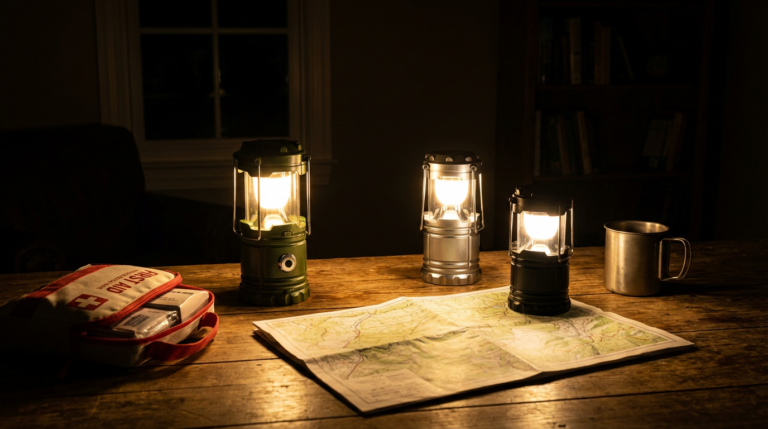
For a 3-day blackout with a family of 4, you need at least 3 lanterns — one per common area, one dedicated to kids’ rooms, and one in the emergency kit for the adults. This guide cuts through 20+ models to give you the actual picks that hold up, the lumen counts that matter by room, and the one mistake that leaves most families in the dark on night 2.
Table of Contents
- How Many Lanterns Does a Family of 4 Actually Need?
- Lumens Guide: How Bright Is Bright Enough?
- Best Emergency LED Lanterns of 2026: Top Picks by Category
- Rechargeable vs. Battery-Powered: Which to Choose
- Blackout-Specific Features to Prioritize
- Maintenance: Keeping Your Lanterns Ready
- Common Mistakes
- FAQ
How Many Lanterns Does a Family of 4 Actually Need?
Most families buy one lantern and discover on night 1 of a blackout that one lantern in the kitchen doesn’t help anyone who needs to use the bathroom at 2 AM. Here’s the minimum setup for a family of 4:
- Kitchen / main living area: 1 high-output lantern (500–1,000 lumens)
- Kids’ bedroom: 1 softer lantern (100–300 lumens) — harsh light makes sleeping harder
- Bathroom: 1 small lantern or plug-in rechargeable nightlight
- Emergency bag / power outages away from home: 1 compact lantern per adult bag
- Spare: 1 backup for the inevitable dead battery
Minimum total: 4–5 lanterns for a family of 4. Not one. If you only have one right now, that’s the first thing to fix.
Lumens Guide: How Bright Is Bright Enough?
Lumens measure light output. Here’s what you actually need by use case:
| Use Case | Lumens Needed | Notes |
|---|---|---|
| Bedside reading | 50–150 | Any more and it disrupts sleep |
| Bathroom / hallway | 150–300 | Enough to move safely, not blinding |
| Kitchen (cooking) | 400–700 | Need task-level lighting to cut and cook safely |
| Living room (family) | 500–1,000 | Main gathering area during a blackout |
| Outdoor / camp use | 800–1,500+ | Needs to project over distance |
| Kids’ bedroom at night | 50–200 | Dimmable is ideal — kids need less than you think |
The most useful feature a lantern can have is adjustable brightness (dimmer). It extends battery life by 2–3x and lets you dial in the right light for each situation.
Best Emergency LED Lanterns of 2026: Top Picks by Category
| Model | Lumens | Power | Runtime | Best For | Price |
|---|---|---|---|---|---|
| Goal Zero Lighthouse 600 | 600 | Rechargeable + hand crank | 150 hrs (low) | Main family lantern — no batteries needed | $60–$80 |
| Coleman 1000L LED Lantern | 1,000 | D-cell batteries (x8) | 75 hrs (low) | Highest output, long runtime on common batteries | $30–$45 |
| Vont 2-Pack LED Lantern | 140 (each) | AA batteries (x3) | 90+ hrs | Kids’ rooms, bathrooms, backup lanterns | $20–$25 |
| BioLite AlpenGlow 500 | 500 | USB rechargeable | 200 hrs (low) | Backpack / bug-out bag — ultra-compact | $50–$65 |
| Luci Outdoor 2.0 | 65 | Solar | 12 hrs | Zero-battery backup, camping, power bank | $15–$20 |
| Streamlight Siege | 540 | D-cell (x3) or USB | 175 hrs (low) | Rugged daily driver, military-grade durability | $40–$55 |
Rechargeable vs. Battery-Powered: Which to Choose
This is the most common debate, and the right answer is: both.
| Rechargeable | Battery-Powered | |
|---|---|---|
| Pros | No batteries to stock, USB charges phone, eco-friendly | Works when power is fully out, batteries universally available |
| Cons | Useless if you can’t charge it during extended outage | Battery cost adds up, dead batteries create waste |
| Best for | Short outages (under 48 hrs), camping with solar backup | Multi-day blackouts, emergencies, areas with frequent outages |
The family-of-4 setup I recommend: 1–2 rechargeable lanterns (charged and ready) + 2–3 battery-powered lanterns with a 6-month supply of spare batteries. The rechargeables handle the first 48 hours. The battery-powered ones take over when the grid is still down on day 3.
Blackout-Specific Features to Prioritize
Camping and blackout use overlap but aren’t identical. For home blackouts specifically, prioritize:
- Red night-vision mode: Preserves night vision, perfect for navigating without waking kids. The Streamlight Siege has this — it’s more useful than it sounds at 3 AM.
- USB charging port: A lantern that can charge phones doubles as a power bank. During a multi-day outage, this matters enormously.
- Dimmable / multi-mode: Full brightness drains batteries fast. Low mode at 50–100 lumens extends runtime by 3–5x for ambient lighting.
- Freestanding base + hanging loop: You need both. Table use for meals, hanging overhead for room lighting.
- No flicker at low settings: Cheap lanterns flicker at low brightness, which gives headaches over hours. Test this before buying.
Maintenance: Keeping Your Lanterns Ready
| Task | Frequency | Why It Matters |
|---|---|---|
| Check battery charge / replace batteries | Every 6 months | Batteries self-discharge; dead battery = dark house |
| Fully charge rechargeable lanterns | Every 3 months | Li-ion batteries degrade faster if stored depleted |
| Test all modes (high/low/red/strobe) | Annually | Mode buttons fail; find out before the blackout |
| Clean lens and housing | Annually | Dust and grime reduce light output by 10–20% |
| Restock spare batteries | Annually | Use the oldest batteries in remotes, restock emergency supply |
Common Mistakes When Buying Emergency Lanterns
- Buying only one. One lantern for a 4-person household is inadequate. You need light in multiple rooms simultaneously. Buy 3–5 before you need them.
- Choosing rechargeable-only for multi-day outages. If the power is out for 4 days and you have no solar charger, a rechargeable lantern is a paperweight by day 2. Keep battery-powered backups.
- Ignoring runtime on low mode. Marketing lumens are always peak output. A 1,000-lumen lantern on high might run 8 hours. The same lantern on low (150 lumens) might run 80 hours. Runtime on low is the number that matters for emergencies.
- Storing lanterns with batteries inside. Batteries left in stored lanterns leak and corrode the contacts. Store batteries separately in a sealed bag inside the lantern case, or use lithium batteries (they don’t leak).
- Forgetting about kids’ rooms. A 1,000-lumen lantern blasting in a 6-year-old’s room at midnight is a problem. Have a dedicated low-output, dimmable option for the kids.
FAQ
How many lumens do I need for a power outage at home?
500–700 lumens for a kitchen or main living area, 150–300 for bathrooms and hallways, and 50–150 for bedrooms. The most important feature isn’t peak lumens — it’s a good dimmer. A dimmable 600-lumen lantern covers every scenario and extends battery life significantly on lower settings.
How long do emergency lanterns last during a blackout?
Runtime varies widely by mode. Most good lanterns run 8–20 hours on high and 50–200 hours on low. For a 72-hour blackout, a lantern with 75+ hours runtime on low is your minimum. Always check the low-mode runtime spec, not the high-mode spec — that’s what you’ll use most.
Should I buy rechargeable or battery-powered lanterns?
Both. Rechargeable lanterns work great for outages under 48 hours and double as phone chargers. Battery-powered lanterns are essential for multi-day blackouts when you can’t recharge. The ideal family setup has at least one of each type, plus a 6-month supply of spare batteries for the battery-powered models.
What’s the best emergency lantern for kids’ rooms?
A dimmable lantern in the 100–300 lumen range with a soft white light and easy controls. The Vont LED Camping Lantern is ideal — it’s inexpensive, runs on AA batteries, collapses flat, and is simple enough for older kids to operate themselves. Keep one dedicated to each child’s room.
Are solar lanterns reliable for emergencies?
Yes, with caveats. Solar lanterns like the Luci Outdoor 2.0 work well as a backup layer — they recharge even through a window on a cloudy day. But they’re not bright enough (65 lumens) to be a primary family lantern. Use solar as supplement, not primary. Reliable for emergencies; insufficient as your only light source.
The Bottom Line
For a family of 4, the right setup is a Goal Zero Lighthouse 600 for the main living area, two Vont 2-Packs for the secondary rooms and backups, and a Luci Solar as a zero-battery emergency backup. Under $130 total and you have reliable lighting for a week-long blackout. For the rest of your blackout prep, see our guide on How to Survive a Long-Term Blackout.
Last Updated: April 2026
