
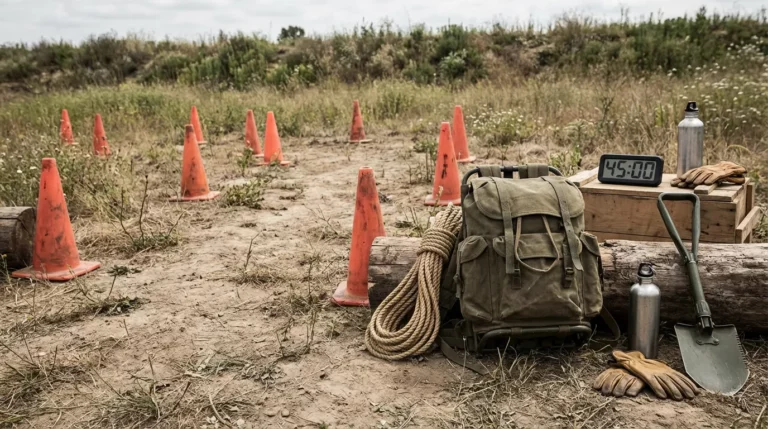
Most preppers invest heavily in gear. Far fewer invest in the physical capability to use it effectively under duress. Your bug-out bag is useless if you can’t carry it three miles. Your evacuation plan fails if you can’t move fast through a damaged building. Your medical training doesn’t help much if you can’t pull a 180-pound person out of a vehicle.
Fitness for preparedness isn’t about aesthetics or athletic performance — it’s about functional capacity for specific emergency tasks. This article covers what those tasks require, how to train for them, and how to honestly assess where you stand.
The Five Physical Demands of a Serious Emergency
| Emergency Scenario | Physical Demand | Fitness Component |
|---|---|---|
| Evacuating with a bug-out bag | Carry 30–50 lbs for several miles on uneven terrain | Cardiorespiratory endurance + leg strength |
| Moving an injured person | Drag or carry 150–200 lbs across ground or debris | Full-body strength, grip |
| Working under stress | Sustained physical effort while cognitively loaded | Aerobic base, stress tolerance |
| Extended shelter/construction work | Sawing, digging, carrying materials for hours | Muscular endurance, grip strength |
| Rapid evacuation | Sprinting, climbing, carrying children | Explosive power, mobility |
These demands don’t require elite fitness. But they require a baseline that most sedentary adults can’t currently meet without preparation. A family of 4 with two adults both capable of the tasks above has dramatically better outcomes than a family where only one can perform them.
The Prepper Fitness Benchmarks
These targets represent functional readiness, not athletic competition:
Cardiovascular Endurance
- Loaded rucksack walk: Carry a 30-pound pack for 5 miles on varied terrain without stopping. Time: under 2 hours. This is the core bug-out benchmark.
- 3-mile run: Complete in under 30 minutes (10-minute mile pace). This is a conservative benchmark for sustained movement.
Strength
- Push-ups: 25 without stopping (men), 15 (women). This represents basic upper body pressing strength for pushing debris, building temporary structures.
- Pull-ups/inverted rows: 5 unassisted pull-ups (men), 3 (women) or 15 inverted rows. Needed for climbing and pulling tasks.
- Deadlift or heavy carry: Ability to lift and carry 75% of your body weight for 50 feet. This covers most injured-person-assist scenarios using proper technique.
- Farmer’s carry: Carry 50 pounds in each hand (grocery bags, water jugs) for 100 yards.
Functional Tasks
- Person drag: Drag a partner (or equivalent weight in a heavy duffel bag) 50 feet across ground. This is a realistic first-responder-style skill.
- Stair carry: Carry a 50-pound pack up two flights of stairs without stopping. Relevant for high-rise evacuation and debris navigation.
The Training Framework
You don’t need a gym membership or a complex program. The following covers the 3 training domains that matter most for preparedness:
Domain 1: Cardiovascular Base (3x per week minimum)
The most important physical adaptation for preparedness is an aerobic base — the ability to sustain moderate-intensity effort for extended periods without accumulating fatigue debt that compromises decision-making.
Where to start: If you can’t walk 30 minutes without stopping, start there. Build to 45–60 minutes of brisk walking before adding anything else. Three days per week minimum.
Progression: Add a loaded rucksack (15 lbs → 25 lbs → 30–35 lbs) once you can walk 45 minutes easily. This is more relevant to emergency scenarios than road running without a pack.
Rucking (loaded walking) protocol:
- Week 1–2: 30-minute walks with 15-lb pack, 3x/week
- Week 3–4: 45-minute walks with 20 lbs
- Week 5–6: 60-minute walks with 25 lbs
- Week 7–8: 90-minute walks with 30 lbs, at least one on varied terrain
Domain 2: Functional Strength (2x per week)
Bodyweight training is sufficient for most preparedness applications. No equipment required.
Starting program (3 sets of each, 2x per week):
- Push-ups: Target 3 sets of 10+ reps. Modify by elevating hands on a table or wall if needed initially.
- Squat or goblet squat: 3 sets of 15. Add weight (backpack, water jug) when bodyweight becomes easy.
- Hip hinge (Romanian deadlift or kettlebell swing with any heavy object): 3 sets of 12. Teaches the posterior chain to engage, critical for lifting safely.
- Inverted row (under a table edge, or with a suspension strap): 3 sets of 8–12. Pulling strength for climbing and person assists.
- Farmer’s carries: Pick up the heaviest objects you can carry in each hand (loaded grocery bags, gallon water jugs, kettlebells) and walk 50–100 feet. 3 sets. Builds grip and loaded carry capacity.
Domain 3: Mobility and Flexibility (daily, 10 minutes)
Mobility determines whether you can move effectively through awkward positions — navigating debris, crawling through spaces, carrying an injured person through tight spaces. Hip mobility is the most critical for preppers who are predominantly sedentary.
Daily minimum (10 minutes):
- Hip flexor stretch: 90 seconds per side
- Deep squat hold: 2 minutes (hold onto something for balance if needed; goal is to get comfortable in a low squat)
- Thoracic rotation: 10 reps per side
- Shoulder circles: 15 reps forward and backward
The Fitness Challenge: Self-Assessment Protocol
Run this assessment quarterly to track actual fitness against preparedness benchmarks:
- 1.5-mile run time (baseline cardio): time how long it takes you to cover 1.5 miles at a consistent pace. Target: under 15 minutes.
- Max push-ups in 2 minutes: no stopping, no resting on the ground. Target: 25+.
- 30-lb loaded carry: 1 mile: carry a loaded pack for one mile, flat terrain. Time it. Target: under 20 minutes.
- Person drag: 50 feet: drag a household member or equivalent weight in a bag. Note whether you can do it without stopping.
- Deep squat: 2 minutes: can you hold a full deep squat for 2 minutes? Yes/no.
Note your results and repeat in 90 days. The trend matters more than the absolute numbers.
Nutrition for Preparedness Fitness
Prepper fitness training has a specific nutritional context: you’re building capacity for calorie-restricted, high-stress scenarios. Some targeted practices:
- Maintain a healthy base weight. Every pound of unnecessary body weight is weight you’re carrying in an evacuation. This isn’t about aesthetics — a 30-pound bug-out bag is much heavier if you’re carrying 40 extra pounds of body fat.
- Practice occasional caloric restriction. Missing a meal and still being able to function is a useful skill. Intermittent fasting (16-hour fasts) builds tolerance for food scarcity without the health risks of extended fasting.
- Stock what you actually need for recovery: Protein (beans, canned fish, freeze-dried meat) matters for maintaining muscle mass during an extended emergency when caloric intake may be reduced.
Common Mistakes
- All gear, no physical capacity. A $500 bug-out bag that you can only carry for 20 minutes is less useful than a $100 pack you can carry all day. Physical capacity multiplies the value of your gear investment.
- Training without testing. Many people follow fitness programs but never test the specific tasks their preps require. Testing the loaded carry, the person drag, and the stair carry with a pack tells you whether your training is actually improving relevant capacity.
- Ignoring mobility. Strength and endurance training without mobility work creates rigid bodies that can’t move through awkward positions. Hip mobility in particular limits evacuation capability more often than raw strength.
- No family fitness strategy. If one adult in the family has good fitness and the other doesn’t, your evacuation capacity is set by the slower person. Both adults need to reach the functional benchmarks. Children should also be involved in age-appropriate fitness activities that build the habits for adult capacity.
- Waiting until it’s needed. Fitness has a long lead time. It takes months of consistent training to meaningfully improve cardiovascular endurance and functional strength. Start now, not when an emergency is imminent.
FAQ
How much fitness is “enough” for preparedness?
The benchmarks in this article — rucking 5 miles with 30 lbs, 25 push-ups, ability to drag a person — represent a realistic functional baseline for most emergency scenarios most preppers will actually face. Beyond that baseline, additional fitness is a bonus, not a requirement. If you’re meeting these benchmarks, your time investment probably provides better returns in other prep areas.
What if I have physical limitations that prevent meeting these benchmarks?
Adapt the benchmarks to your actual situation. If you have a knee injury, the loaded rucksack benchmark may need to be shorter or at a lower weight. The goal is to understand your realistic capacity and plan around it — including knowing which tasks you’ll need other family members or neighbors to cover. Honest self-assessment is more useful than an idealized fitness target you’re not going to reach.
What’s the most important single fitness improvement for a sedentary prepper?
Build a rucking habit. Load a pack with 20–25 lbs and walk for 45–60 minutes, three days per week. After 8–12 weeks, this produces meaningful improvements in cardiovascular endurance, leg strength, and functional carrying capacity simultaneously. It’s the single training activity with the best preparedness return-on-investment for someone starting from a sedentary baseline.
How do I train for person carries without a training partner?
A heavy duffel bag filled with 150 lbs of sand or kitty litter is a reasonable substitute for practicing the drag. Practice the motion — low stance, gripping the bag at the shoulders or arms, short rapid steps — not just the raw strength component. Practice on different surfaces (carpet, grass, pavement) since friction varies significantly. For carries (as opposed to drags), practice with a backpack loaded to a significant percentage of the person’s weight.
Bottom Line: Prepper fitness has five core demands: loaded carry endurance (bug-out rucksack), functional strength (lifting, dragging, carrying), mobility (moving through tight or damaged spaces), stress tolerance (functioning physically while cognitively loaded), and family capacity (both adults able to meet the benchmarks). Build toward the five benchmarks in this article, test quarterly, and address the weakest link. The rucksack walk is the most important single test — do it before you assume you’re ready.

Dan Lockland is a preparedness instructor and survival skills educator with over 15 years of hands-on experience. He shares practical, no-nonsense guidance on emergency preparedness, self-reliance, and sustainable living at PreparingWithDan.com.