
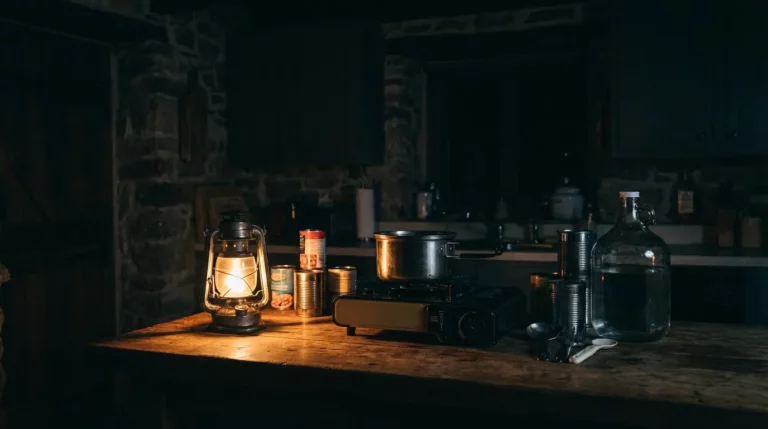
A blackout changes your kitchen in one specific way: you lose the ability to refrigerate and to use electric appliances. Everything else stays the same — you still have running water (usually), your pantry, and 72 hours before most emergency services are typically restored. Here’s exactly what to do with your food supply and how to cook safely during that window.
Table of Contents
- Food Safety: The First 4 Hours Are Critical
- 5 Best Blackout Cooking Methods (Ranked)
- Equipment to Own Before the Power Goes Out
- 72-Hour Meal Plan for a Family of 4
- The Blackout Pantry: What to Keep Stocked
- Carbon Monoxide: The Danger Most Families Miss
- Common Mistakes
- FAQ
Food Safety: The First 4 Hours Are Critical
The food safety decision tree in a blackout is simpler than most people think. The key numbers are 4 hours (fridge) and 48 hours (full freezer).
| Appliance | Safe window (door closed) | Temperature threshold | Action |
|---|---|---|---|
| Refrigerator | 4 hours | 40°F / 4°C | After 4 hours, use perishables immediately or toss. Never taste to check. |
| Full freezer | 48 hours | 0°F / -18°C | After 48 hours, check for ice crystals. Still partially frozen = safe to refreeze or cook immediately. |
| Half-full freezer | 24 hours | 0°F / -18°C | Same rule — less mass means faster temperature rise. |
The rule that saves money and prevents illness: Never taste questionable food to test it. Bacterial growth doesn’t change the taste, smell, or appearance of most foods in the early stages. A piece of chicken that’s been at 55°F for 6 hours looks and smells identical to safe chicken — and will make your family sick. When in doubt, throw it out.
What survives a blackout without refrigeration:
- Hard cheeses (parmesan, cheddar) — up to 6 hours at room temperature, longer if cool
- Butter and margarine — up to 1–2 days at room temperature
- Fruit and vegetables — several days; use up fresh produce first
- Eggs — up to 3–5 weeks at room temperature if never refrigerated; refrigerated eggs should be used within 2 hours of reaching room temp if cooked
- Whole fruits and vegetables with intact skins
Priority use order in a blackout: First, cook and consume fresh refrigerator items (meat, dairy, leftovers). Then move to the freezer before it thaws. Finally, rely on your dry/canned pantry stockpile.
5 Best Blackout Cooking Methods (Ranked)
1. Propane Camping Stove (Best for most families)
A two-burner propane camping stove is the most practical blackout cooking solution for 95% of families. Works identically to a gas range — same pots, same recipes, same cooking times. Safe to use on a porch, in a garage with doors open, or outdoors. One 16.4 oz propane canister gives approximately 1–2 hours of high-heat cooking. For a 3-day blackout with 3 meals per day, stock 4–6 canisters.
Best models: Coleman Classic ($50–$60) for two-burner family cooking; Camp Chef Everest ($130) for higher BTU performance. The Coleman is the right call for most households.
2. Single-Burner Butane Stove (Best for apartments)
A butane stove (like the Iwatani or Gas ONE) is compact, indoor-rated, and inexpensive ($25–$40). Butane canisters produce less CO than propane and can be used in well-ventilated indoor spaces, making this the best option for apartments without outdoor access. One 8 oz butane canister = ~1.5–2 hours of cooking. Stock 10–12 canisters for a 72-hour supply. Note: butane stoves underperform below 40°F — propane is better for cold-weather use.
3. Gas Grill (Best if you already own one)
If you have a gas grill, you have a powerful cooking platform that works during blackouts. Outdoor only — never bring a gas grill inside or into a garage. A standard 20 lb propane tank provides approximately 20–30 hours of cooking time. Keep the tank at least half-full as a policy, not just during emergencies.
4. Charcoal Grill (Good backup; outdoor only)
Charcoal grills work for blackout cooking but produce more CO than propane, require more setup time, and don’t throttle as easily. Outdoors only. A 10 lb bag of briquettes gives approximately 15–20 cooking sessions. Useful as a backup to propane, especially since charcoal stores indefinitely. Not suitable for any indoor or enclosed space, ever.
5. Alcohol or Solid Fuel Stove (Emergency backup; minimal cooking)
Esbit solid fuel tablets or denatured alcohol stoves produce very low heat and are suited for boiling water for oatmeal, instant coffee, or freeze-dried meals — not for family cooking. These are ultralight backup options for bug-out bags, not primary blackout cooking solutions. A family of 4 would burn through Esbit tablets quickly. Best used to supplement other methods, not replace them.
Equipment to Own Before the Power Goes Out
| Item | Purpose | Cost | Notes |
|---|---|---|---|
| Coleman Classic 2-burner propane stove | Primary cooking | ~$55 | Works on all standard pots/pans |
| Propane canisters (16.4 oz) × 6 | Fuel for 3 days | ~$30 | Store in cool, dry location; check for leaks before storing |
| Manual can opener | Access canned goods | $8–$15 | Get two — this is a failure point |
| Cast iron skillet (10″) | All-purpose cooking vessel | ~$25 (Lodge) | Works on propane, charcoal, open flame |
| Dutch oven or large pot with lid | Soups, rice, boiling water | $20–$40 | Wide lid doubles as a pan |
| Appliance thermometers × 2 | Monitor fridge/freezer temp | $8–$12 each | Critical for food safety decision-making |
| Cooler with ice packs | Extend fridge life or transport perishables | $30–$80 | Fill with perishables when power goes out |
| Lighter + waterproof matches | Igniting stove | $5 | Keep 2+ lighters and a box of matches in the kit |
72-Hour Meal Plan for a Family of 4
This plan uses the “refrigerator first, then freezer, then pantry” priority order. All meals can be made on a single-burner propane or butane stove.
| Timing | Meal | Notes |
|---|---|---|
| Hours 0–4 (Fridge items) | Eggs + whatever vegetables are in the fridge; heat leftovers; grill any meat | Use everything that will spoil first |
| Day 1 Dinner | Pasta with canned tomato sauce + canned tuna or sardines | One pot; 15 min; 2,000 cal for 4 |
| Day 2 Breakfast | Oatmeal with nuts and dried fruit | 5-min boil; ~500 cal/person |
| Day 2 Lunch | Peanut butter on crackers + canned fruit | No cooking required |
| Day 2 Dinner | Canned chili or bean soup heated in pot + rice | Two burners or sequential; ~2,200 cal for 4 |
| Day 3 Breakfast | Instant oatmeal or granola bars + coffee/tea (boil water) | 5 min |
| Day 3 Lunch | Crackers + canned chickpeas + olive oil and salt | No cooking |
| Day 3 Dinner | Freeze-dried meal pouches (1 per person) + soup | Just-add-boiling-water; ready in 15 min |
The Blackout Pantry: What to Keep Stocked
A 72-hour pantry for a family of 4 needs approximately 24,000 calories (2,000 cal/person/day × 4 people × 3 days). Here’s what covers that without requiring refrigeration or complex cooking:
| Item | Quantity for 72 hrs (4 people) | Calories |
|---|---|---|
| Oats (quick-cook) | 4 lbs | ~7,000 |
| Peanut butter | 2 large jars (40 oz each) | ~9,000 |
| Crackers (Triscuits, Wasa) | 6 boxes | ~3,600 |
| Canned beans/chili (various) | 12 cans | ~6,000 |
| Canned tuna/salmon | 8 cans | ~2,400 |
| Pasta (dried) | 4 lbs | ~6,400 |
| Canned tomatoes/sauce | 6 cans | ~600 |
| Nuts and dried fruit | 3 lbs mixed | ~6,000 |
| Instant coffee / tea bags | Supply for 3 days | Minimal |
| Shelf-stable milk (UHT) | 6 quarts | ~2,400 |
Rotate this stock every 12–18 months. The easiest rotation system: when you buy a fresh box of crackers or a new jar of peanut butter, move the old one to the front. Use the old, store the new. No waste, always fresh stock.
Carbon Monoxide: The Danger Most Families Miss
Carbon monoxide (CO) kills people every year during power outages — not from lack of food, but from using combustion appliances indoors. CO is colorless, odorless, and lethal at concentrations that take 1–2 hours to build up in an enclosed space.
Never, under any circumstances, use these indoors or in a garage:
- Charcoal grills or briquettes
- Gas grills
- Propane camping stoves (except in very well-ventilated spaces with open windows on multiple sides)
- Wood-burning stoves not designed for indoor use
- Generators
A butane stove in a well-ventilated room (open window, cross-draft) is generally acceptable, but watch for symptoms: headache, dizziness, nausea mean leave immediately and get fresh air. Install a battery-powered CO detector near your cooking area if you ever cook indoors with any combustion device.
Common Mistakes When Cooking During a Blackout
- No manual can opener. You have 24 cans of beans and soup and no way to open them. This happens in a significant percentage of blackout prep failures. Buy two manual can openers and keep one in the kitchen and one in the emergency kit.
- Opening the fridge repeatedly to check on things. Every time you open the door, you’re losing the cold that extends your food’s safe window. Decide what you need, open once, close immediately. The 4-hour safety window assumes the door stays mostly closed.
- Cooking everything that’s about to expire and having nowhere to store it. In a summer blackout, cooking a large batch of chicken and then having no refrigeration to store leftovers just moves the problem. In hot weather, cooked food at room temperature goes bad in 2 hours. Cook what you’ll eat at the next meal, not a 3-day batch.
- No fuel stored in advance. A propane stove is useless without fuel. Most families have the stove from a camping trip but have one canister that’s half-empty. Stock 4–6 full 16.4 oz canisters. At $5–$6 each, this costs $25–$35 and ensures 3 days of family cooking.
- Assuming freeze-dried meals are all you need. Freeze-dried meals are excellent for their purpose — long shelf life, minimal prep — but require boiling water for each serving. For a family of 4 eating 3 meals a day for 3 days, that’s 36 pouches plus fuel to boil 36 servings of water. Cost: $200–$300 in meals alone. A mixed approach (dry pantry + a few freeze-dried for convenience) is more practical and far cheaper.
FAQ
How long does food last in the fridge during a blackout?
A closed refrigerator keeps food safe for about 4 hours. After that, perishables (meat, dairy, eggs, leftovers) enter the danger zone. A full freezer stays safe for 48 hours; a half-full one for about 24. Put appliance thermometers in both now so you know exactly when the threshold is crossed — don’t guess.
Can I use my propane camp stove indoors during a blackout?
Only in a well-ventilated space with multiple open windows providing cross-ventilation. Propane combustion produces carbon monoxide, which is lethal in enclosed spaces. If possible, cook on a porch, deck, or outside entirely. Never use a propane stove in a garage with the door closed, in a basement, or in any space without good airflow.
What’s the best cooking setup for apartment dwellers during a blackout?
A butane stove (Iwatani or Gas ONE, ~$25–$35) with 10–12 butane canisters. Butane produces less CO than propane and is workable in a well-ventilated kitchen with a window open. A butane canister provides about 1.5–2 hours of cooking time. Supplement with no-cook meals (peanut butter and crackers, canned goods eaten cold) to reduce fuel consumption.
How much propane do I need to cook for a family of 4 for 3 days?
Plan for 4–6 standard 16.4 oz propane canisters for 3 days of family cooking (3 meals per day, moderate heat). Each canister provides about 1–2 hours of high-heat cooking. At $5–$6 per canister, stocking a 3-day supply costs $25–$36. Keep canisters stored in a cool, dry location outdoors or in a detached structure — never inside the home.
What foods should I cook first in a blackout?
Cook refrigerator items first (meat, fish, dairy-based dishes), then freezer items as they thaw, then rely on your dry/canned pantry stockpile. Within the refrigerator, prioritize raw meat (highest spoilage risk) first, then dairy and leftovers, then eggs and hard cheese last. Produce and root vegetables can wait longest before needing attention.
Bottom Line
Blackout cooking for a family of 4 is a solved problem: a Coleman Classic propane stove (~$55) + 6 canisters (~$30) + a 72-hour dry pantry stocked with oats, peanut butter, pasta, and canned goods covers everything you need. The critical variable is food safety — keep a thermometer in the fridge, follow the 4-hour rule, and don’t guess. For a complete emergency kit that includes cooking and communication gear, see How to Build a Custom Family Emergency Plan. For your power backup options, see How to Survive a Long-Term Blackout.
Last Updated: April 2026

Dan Lockland is a preparedness instructor and survival skills educator with over 15 years of hands-on experience. He shares practical, no-nonsense guidance on emergency preparedness, self-reliance, and sustainable living at PreparingWithDan.com.