
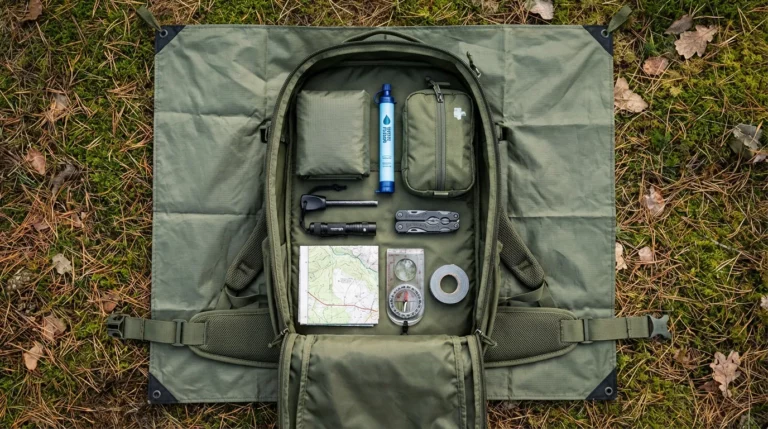
The most common survival kit failure isn’t missing items — it’s a kit that’s too heavy to actually carry. A 40-lb pack that stays in the car because it’s too heavy to move in an emergency is worse than a 15-lb kit that actually gets grabbed. This guide builds a functional 72-hour survival kit under 20 lbs (complete, for one person) and an urban emergency kit under 10 lbs for the specific scenarios most families will actually face.
Table of Contents
- Two Different Kits for Two Different Scenarios
- The Weight Budget: How to Think About Pack Weight
- The Core 10: Non-Negotiable Items
- The Urban Emergency Kit (Under 10 lbs)
- The Wilderness/Bug-Out Kit (Under 20 lbs)
- What to Cut: Gear That Sounds Good but Isn’t
- Adapting for a Family of 4
- Common Mistakes
- FAQ
Two Different Kits for Two Different Scenarios
Before packing anything, define the scenario you’re building for:
| Kit type | Scenario | Duration | Target weight | Stored where |
|---|---|---|---|---|
| Urban emergency kit (EDC/car) | Power outage, evacuation, urban disruption; you stay near civilization | 24–72 hours | Under 10 lbs | Car, office, or near front door |
| 72-hour bug-out kit | Full evacuation; leaving home for 3+ days; may be away from infrastructure | 72 hours (3 days) | Under 20 lbs | Home; grabbed during evacuation |
| Extended wilderness/survival kit | Prolonged off-grid survival; wilderness emergency | 7+ days | 30–35 lbs max | For hikers, remote-area prep only |
Most families need the first two kits, not the third. A 7-day wilderness survival kit is appropriate for people who regularly operate in backcountry environments. For 95% of preparedness scenarios — blackouts, evacuations, urban emergencies — the urban kit and 72-hour bug-out kit cover everything needed.
The Weight Budget: How to Think About Pack Weight
Experienced backpackers target 20% of body weight as the maximum comfortable pack load for a physically fit adult. For a 150-lb adult, that’s 30 lbs. Under stress, with children, or over longer distances, 15–20 lbs is more realistic.
Weight budget by category (72-hour bug-out kit, one adult):
| Category | Target weight | Notes |
|---|---|---|
| Water (plus filter) | 3–4 lbs | 2-liter bottle (4.4 lbs full) or 1L + filter; plan to source refills |
| Food (72-hour) | 3–4 lbs | ~2,000 cal/day = 3 days at 9,000+ cal; calorie-dense foods reduce weight |
| Shelter and warmth | 2–3 lbs | Emergency bivy or mylar + tarp; sleeping bag only if wilderness scenario |
| First aid | 1–1.5 lbs | Compact trauma kit; not a hospital bag |
| Tools (knife, multi-tool, fire) | 1–1.5 lbs | One quality knife + one multi-tool + lighter = covers most needs |
| Communication and navigation | 1–2 lbs | NOAA radio + paper map + compass |
| Light | 0.5–1 lb | Headlamp per person + spare batteries |
| Documents and cash | 0.25 lb | Waterproof bag with copies of IDs, cash |
| Pack itself | 2–4 lbs | Good daypack/hiking pack with hip belt at 2–4 lbs |
| Total target | 14–19 lbs | Functional, sustainable carrying weight |
The Core 10: Non-Negotiable Items
Every kit — urban or wilderness, light or comprehensive — must include these 10 items. Everything else is scenario-specific or nice-to-have.
- Water (2L) + filtration (Sawyer Squeeze, 3 oz): Water is the most critical survival need. 2 liters on your back + a Sawyer Squeeze for refills covers 48+ hours and weighs 4.4 lbs total when full.
- Food — calorie-dense, no-cook: Peanut butter, energy bars, nuts/dried fruit, and crackers. Target 6,000–9,000 calories for 72 hours, weighing 2–3 lbs. No cooking = no fuel, no stove, less weight.
- Shelter — emergency bivy: A SOL Emergency Bivvy ($25, 3.8 oz) reflects 90% of body heat and fits in a pocket. Far more practical than a full sleeping bag for 72-hour scenarios. Add a lightweight tarp if you’ll be in a full wilderness context.
- Fixed blade knife (3–5″ blade): The Mora Companion ($15, 4.1 oz) or ESEE-3 ($100, 5.1 oz) — a quality fixed blade outperforms any folding knife for utility tasks. Full tang, carbon or stainless steel.
- Multi-tool (Leatherman Wave+): Pliers, wire cutters, blade, saw, screwdrivers. 8.5 oz. Covers repair and improvisation needs the fixed blade can’t.
- Fire starting (lighter + ferro rod): A BIC lighter weighs 0.7 oz and is your primary fire source. A ferro rod ($8–$15) backs it up in wet conditions. Never rely on one method alone.
- Headlamp + batteries: The Petzl Tactikka ($30, 3 oz) or Black Diamond Spot ($40, 2.9 oz). 1 per person. AAA batteries; carry 1 spare set.
- First aid kit (compact trauma kit): QuikClot gauze, Israeli bandage, nitrile gloves, blister treatment, OTC medications (ibuprofen, antihistamine). 1–1.5 lbs. Focused on trauma stabilization, not routine care.
- Communication (hand crank NOAA radio): RunningSnail MD-090P ($28, 7 oz). Receive emergency broadcasts without batteries. Essential for knowing when an event is over and where to go.
- Documents and cash (waterproof bag): Photocopies of driver’s license, passport, insurance cards, medical information. $100–$200 in small bills. Weighs almost nothing and solves real problems.
The Urban Emergency Kit (Under 10 lbs)
This kit lives in your car, in a backpack near your front door, or at your office. It’s designed for urban evacuation or shelter-in-place — not extended wilderness survival. Every item is chosen for urban scenario utility.
| Item | Weight | Cost |
|---|---|---|
| Water (1.5L in bottle) | 3.3 lbs full | $10 (bottle) |
| Food — 2-day supply (bars + peanut butter + crackers) | 2 lbs | $15–$20 |
| First aid kit (compact) | 0.8 lbs | $20–$30 |
| Headlamp + 1 spare battery set | 0.2 lbs | $20–$35 |
| Phone power bank (10,000 mAh, Anker) | 0.5 lbs | $25 |
| NOAA weather radio (RunningSnail) | 0.5 lbs | $28 |
| Emergency mylar blanket (× 2) | 0.1 lbs | $5 |
| Multi-tool (Gerber Dime) | 0.14 lbs | $25 |
| Documents + cash (waterproof bag) | 0.1 lbs | $5–$8 |
| N95 masks (× 3) | 0.1 lbs | $5 |
| Backpack (small daypack) | 1–1.5 lbs | $30–$50 |
| Total | ~8.8 lbs | ~$170–$195 |
The Wilderness/Bug-Out Kit (Under 20 lbs)
This is the full 72-hour kit for someone potentially leaving infrastructure. It adds shelter, fire, navigation, and additional food over the urban kit.
| Item | Weight | Cost |
|---|---|---|
| Water (2L) + Sawyer Squeeze filter | 4.5 lbs | $45 |
| Food — 72-hour (calorie-dense) | 3 lbs | $25–$40 |
| SOL Emergency Bivvy | 0.24 lbs | $25 |
| Lightweight tarp (8’×10′ silnylon) | 1.5 lbs | $30–$50 |
| Mora Companion fixed blade knife | 0.26 lbs | $15 |
| Leatherman Wave+ multi-tool | 0.53 lbs | $100 |
| BIC lighter + UCO stormproof matches | 0.1 lbs | $5 |
| Petzl Tactikka headlamp + 2 spare AAA | 0.2 lbs | $30 |
| First aid kit (IFAK with QuikClot) | 1.2 lbs | $40–$60 |
| RunningSnail NOAA radio | 0.5 lbs | $28 |
| Phone power bank (10,000 mAh) | 0.5 lbs | $25 |
| Paper map + compass (baseplate) | 0.2 lbs | $15–$25 |
| Paracord (50 ft) | 0.3 lbs | $7 |
| Documents + cash (waterproof bag) | 0.1 lbs | $8 |
| N95 masks (× 3) | 0.1 lbs | $5 |
| Hiking backpack (35–45L with hip belt) | 2.5–3.5 lbs | $60–$120 |
| Total | ~15.8–16.8 lbs | ~$475–$575 |
What to Cut: Gear That Sounds Good but Isn’t
- Full sleeping bag: At 2–4 lbs for a quality bag, this is the single biggest weight item in most kits. For a 72-hour scenario where you have a bivy, a tarp, and are not in extreme cold, a sleeping bag is overkill. Cut it.
- MREs in bulk: Each MRE weighs ~1.4 lbs and provides ~1,200 cal. Three days × 3 MREs/day = 9 MREs = 12.6 lbs — 75% of your entire weight budget just for food. Use calorie-dense, lightweight food instead: peanut butter, nuts, energy bars, and jerky provide similar calories at half the weight.
- Bulky first aid kit: Most pre-made first aid kits include bandage sizes and medical supplies you won’t need in a 72-hour scenario. Build a focused trauma kit: QuikClot, Israeli bandage, gloves, tape, and medications. Under 1 lb. Skip the full hospital inventory.
- Multi-fuel stove + fuel: A MSR Whisperlite + 110g fuel canister + cook pot = 2+ lbs of cooking gear. For a 72-hour kit with calorie-dense no-cook food, this is unnecessary weight. Only add a stove for extended wilderness scenarios or cold-weather operations where hot food is survival-critical.
- Tactical gear and items primarily for combat scenarios: Chest rigs, MOLLE pouches, tactical gloves, and similarly military-focused gear adds weight and draws unnecessary attention. A hiking daypack looks unremarkable and is easier to carry. Functional invisibility is a genuine advantage in an urban emergency.
Adapting for a Family of 4
The 72-hour kit above is for one adult. For a family of 4:
- Each adult carries a full kit (15–20 lbs): Split food, water, and gear between both adult packs rather than concentrating everything in one
- Children (6–12) carry their own small pack (3–8 lbs): Headlamp, snacks, water bottle, their documents card, and comfort item. This teaches responsibility and lightens adult loads
- Toddlers under 6: Their weight gets distributed across adult packs; one parent’s pack will be heavier. Adjust food and water accordingly
- Pets: Dogs over 30 lbs can carry a small pack (15–20% of their body weight) with their own food and supplies. A saddlebag-style dog pack runs $30–$60
- Common items (one per family, not per person): NOAA radio, water filtration, tarp, paracord, maps, and cash. Duplicate these only if the family may get separated
Common Mistakes When Building a Survival Kit
- Building too heavy. A kit you leave in the car because you can’t carry it while also managing two kids and a dog failed before the emergency started. Test your kit: put it on and walk for 30 minutes. If it’s uncomfortable, cut gear until it’s manageable. Being brutal about weight is a genuine survival skill.
- Never testing the gear. A water filter you’ve never used, a fire starter you’ve never struck, and a shelter system you’ve never set up in the dark are unknowns in an emergency. Test every item in your kit at least once under realistic conditions. This is especially true for water filters (flush and test flow rate) and the NOAA radio (find your county frequency).
- Building the perfect wilderness kit for an urban dweller. If you live in a city and the most likely emergency is an evacuation along the highway to a motel 60 miles away, you don’t need a wilderness survival kit. You need an urban kit with water, phone charging, cash, important documents, and 2 days of food. Match your kit to your actual risk profile.
- Cheap gear in critical categories. Cut weight by buying fewer items. Don’t cut quality in the items that can fail catastrophically: a cheap knife that breaks under load, a water filter that hasn’t been properly rated, a headlamp with terrible battery life. Spend budget on the Core 10; economize on everything else.
- No practice wearing the full pack. A family that’s never moved together with full packs (possibly including kids) doesn’t know their actual pace, pain points, or gaps until an emergency. Run the drill once: put on all packs, walk to Meeting Point 1, time it. Identify problems before they matter.
FAQ
How heavy should a bug-out bag be?
Target 15–20 lbs for a healthy adult carrying a 72-hour kit. No more than 25 lbs for extended carries. Every pound of kit reduces how far and how fast you can move — in an evacuation, mobility matters. The most common mistake is building a kit that’s too heavy to actually carry under real conditions, with children, over distance.
What’s the difference between a bug-out bag and a get-home bag?
A get-home bag lives in your car or office — its purpose is to get you from wherever you are back to your home when normal transportation fails. It’s lighter (5–10 lbs) and more urban-focused: water, food for 24 hours, walking shoes, map, cash, phone charger. A bug-out bag is your full 72-hour kit designed for evacuating away from home. Both are valuable; most families only build one.
Do I need different kits for summer and winter?
Yes, for the shelter and warmth components. Summer: lighter sleeping bag or bivy only. Winter: insulated layers (1–2 lbs), hand warmers (0.5 lbs), possibly a warmer sleep system. Water considerations also shift — winter means frozen water sources require different filtration strategy. Keep a base kit and swap seasonal additions rather than maintaining two complete kits.
What’s the most important item in a survival kit?
Water filtration — it’s the item that extends your options most significantly. A Sawyer Squeeze at 3 oz and $35 turns any freshwater source into safe drinking water for 100,000 gallons. Without it, you’re dependent on what you carried. With it, almost any body of water becomes a resource. Second most important: a quality headlamp. Many emergency situations occur or worsen at night.
Should a family share one bug-out bag or have individual bags?
Individual bags for each adult; shared common gear is split between adults. Children (over 6) carry a small pack with their own items. The single-bag approach fails when the family gets separated or when one adult is incapacitated — the bag is either uncarried or one person carries everything. Two adults with two 15-lb packs have more flexibility than one adult with a 30-lb bag.
Bottom Line
A functional 72-hour bug-out kit for one adult weighs 15–20 lbs and costs $475–$575 built with quality gear. An urban emergency kit weighs under 10 lbs and costs $170–$195. Start with the Core 10, test each item before an emergency, and match your kit to your actual scenario — not a wilderness survival fantasy if you live 30 minutes from a city. For the right backpack to carry all of this, see Best Bug-Out Bag Backpack 2026. For water filtration options covered in detail, see Best Portable Water Filters for Survival.
Last Updated: April 2026

Dan Lockland is a preparedness instructor and survival skills educator with over 15 years of hands-on experience. He shares practical, no-nonsense guidance on emergency preparedness, self-reliance, and sustainable living at PreparingWithDan.com.