
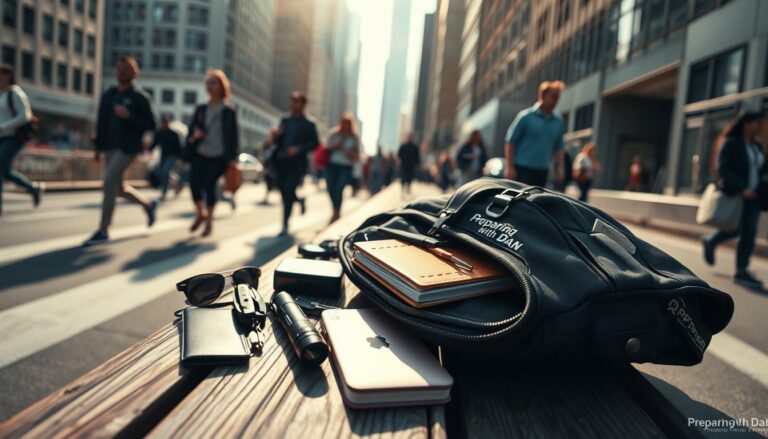
Urban everyday carry is not a tactical pocket dump. It is the answer to one question Ready.gov asks directly: could you shelter at work for 24 hours, or walk home, with what is on you right now? Its own work-kit list is short — food, water, medicines and comfortable walking shoes in a grab-and-go case. Everything in this guide is built outward from that, and the most important item is the shoes.
Most EDC content is about knives and flashlights. The real city emergency is more boring: the trains stop, the power is out, the phone is at 12%, and home is nine miles away. This guide is organised by the three layers that actually matter — on your body, in your bag, at your desk — and grounded in Ready.gov’s kit guidance (sources at the end). Our urban survival pillar covers the bigger picture.
Start from the scenario, not the gear
Ready.gov’s kit page says something most EDC lists skip: since you do not know where you will be when an emergency occurs, prepare supplies for home, work and cars. For work, its instruction is to be prepared to shelter for at least 24 hours, with food, water and other necessities like medicines, as well as comfortable walking shoes, stored in a “grab and go” case. That is the design brief. The two scenarios a city commuter should carry for are:
- Stuck: the building, the block or the transit system is closed for a day. You need to be comfortable, informed and medicated where you are.
- Walking home: miles on foot, possibly in the dark, possibly in the weather you left the house dressed against. You need feet, light, water and a route.
Anything that does not serve one of those two is optional. Most of the tactical catalogue does not.
Layer 1: on your body, every day
- Shoes you can walk five miles in, or a pair that can at the desk. This is Ready.gov’s item and it is the one that decides whether “walk home” is a plan or a fantasy. Heels, dress shoes and new boots fail this test.
- Phone plus a small power bank. The phone is the map, the flashlight, the alert receiver and the way to text (not call — texts get through congestion when calls do not). A dead phone loses all four; the power bank is the most valuable ten ounces on this page.
- A small flashlight or headlamp. Stairwells, subway tunnels and streets without power are dark in a way city dwellers rarely experience. A phone light drains the phone you need for everything else.
- Cash in small bills. Card readers and ATMs go down with the power; a bottle of water and a bus fare should not depend on the grid.
- Your medication for a day, and a card with your conditions, allergies, and the out-of-state contact’s number. If you are unconscious, this is how the rest of the plan finds you.
- A whistle on the keys. Three blasts. It is on every official kit list and weighs nothing.
- A multi-tool or small knife where the law allows it — check your city’s rules on blade length and locking mechanisms, and remember that most office buildings, courts and transit systems have their own bans. Our multi-tool review covers the models; the honest note is that in a city you will use the pliers and the screwdriver far more than the blade.
Layer 2: in the bag you carry anyway
The commuter bag can hold a get-home layer without becoming a survival pack:
- Half a litre of water and a way to carry more — a collapsible bottle. Water is heavy; the ability to refill is light.
- Two energy bars or the food you will actually eat, rotated monthly.
- A packable rain shell and a warm layer in the season that needs it. Walking home in January in an office shirt is where a nine-mile walk becomes a medical problem.
- N95 masks (two): dust from a collapse, smoke from a fire, or the ordinary contents of a subway tunnel. Cheap, flat, and on Ready.gov’s wildfire list for the same reason.
- A paper map of the city with your walking routes home marked — two of them, in different directions, because the bridge or the underpass you always use is exactly the thing that closes.
- A compact first aid pouch: blister care first (the walk), then bandages, gloves, painkillers.
- A bandana or shemagh: dust, sun, sweat, a sling, a signal.
What this layer deliberately leaves out: fire-starting kits, paracord bracelets, fishing lines, and anything designed for a forest. A city has shelter, lighting and water on every block; what it lacks in an emergency is working infrastructure and calm, and the bag should address those.
Layer 3: at the desk (Ready.gov’s 24-hour case)
This is the kit Ready.gov explicitly describes, and it lives in a drawer or a locker, not on your back:
- The walking shoes, if the ones you wear to work fail the five-mile test.
- Two litres of water and a day of food you would be glad to eat.
- A week of any prescription medication, and the spare glasses.
- A hand-crank radio — the building’s announcements stop when its power does, and the models we tested charge the phone too.
- A blanket or a compact sleeping bag if you might spend the night on a floor; a change of socks and underwear.
- A printed copy of the family plan: meeting points, the out-of-state contact, the school’s release policy. Our family emergency plan guide has the template.
The decision that matters more than the kit
The question on the day is not what to carry but whether to walk. Our guide on leaving the city fast covers the timing; the short version from Ready.gov’s evacuation guidance is to follow local officials’ instructions and to plan for the possibility that your evacuation route may be on foot. If officials say shelter in place, the desk kit is the plan. If they say leave, the shoes and the bag are. Deciding in advance which conditions mean which saves the hour of indecision that most people spend.
Legal note, without the lecture
Knife and self-defence laws differ by state, city and building, and a locking blade that is ordinary in one state is a misdemeanour in the next. Check before you carry, and default to tools whose only purpose is a tool. Our guide on self-defence without firearms covers the rest; nothing in an EDC kit substitutes for leaving early.
Rotate it twice a year
Water goes stale, bars expire, medication dates pass, the power bank self-discharges, and the walking shoes at the desk get borrowed for a lunchtime errand and never come back. Clocks change, kit changes — the same rule as the car kit. An EDC that was assembled once and never opened is a heavier bag, not a safer commute.
Official sources & further reading
The kit principles in this article come from official emergency-preparedness guidance. Consult it directly for the authoritative version:

Dan Lockland is a preparedness instructor and survival skills educator with over 15 years of hands-on experience. He shares practical, no-nonsense guidance on emergency preparedness, self-reliance, and sustainable living at PreparingWithDan.com.