
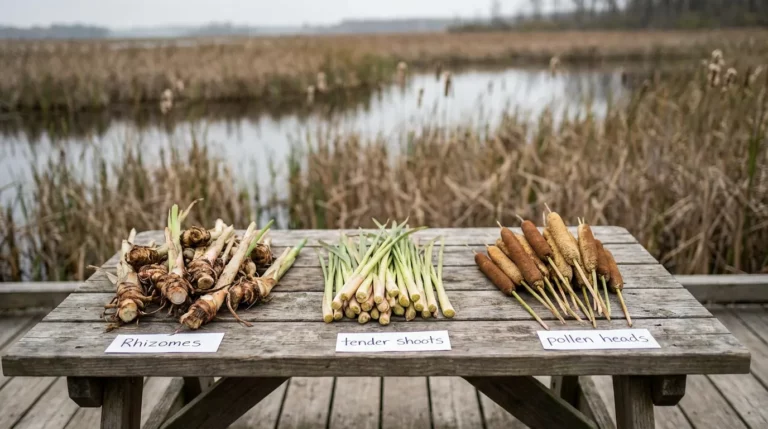
Cattails (Typha latifolia) are one of the most useful wild plants in North America for survival situations. Nearly every part of the plant is edible at some point in its growth cycle, and they grow abundantly near ponds, marshes, rivers, and ditches across the continent. If you learn to identify and harvest cattails, you gain access to a free, renewable food source that’s available in most environments from spring through winter.
The Edible Parts of a Cattail
Shoots and Stalks (Spring)
In early spring, young cattail shoots emerge from the root system and can be harvested when they’re 1-2 feet tall. Peel back the outer leaves to reveal the tender white inner core — often called “Cossack asparagus” because the taste and texture are similar to hearts of palm or mild cucumber. Eat them raw in salads or sautéed in oil. This is the easiest and most appetizing part of the plant for people new to foraging.
Pollen (Late Spring/Early Summer)
When the male flower spike (the upper portion of the brown “hotdog” shape) matures in late spring, it produces bright yellow pollen. To harvest, bend the spike into a bag and shake vigorously. The pollen is protein-rich (roughly 10-15% protein by weight) and can be mixed with regular flour at a 1:3 ratio for baking pancakes, bread, or muffins. It adds a slightly sweet, nutty flavor and a golden color. One productive patch can yield several cups of pollen in a single season.
Immature Flower Heads (Early Summer)
Before the familiar brown cattail head forms, the flower spike is green and dense. At this stage (usually early summer), you can harvest it, remove the outer husk, and boil or steam it for 10-15 minutes. The taste is often compared to corn on the cob — mild, starchy, and satisfying. Eat it the same way: off the cob with butter and salt if you have them.
Rhizomes/Roots (Fall through Early Spring)
The starchy rhizomes (underground root stems) are the most calorie-dense part of the cattail. Harvest them from fall through early spring when the plant’s energy is stored in the root system. Dig or pull the rhizomes from the mud, wash thoroughly, and peel off the outer skin. You can:
- Roast them like potatoes — the texture is similar, though more fibrous
- Boil and mash them as a starchy side
- Dry and grind them into flour — this was a primary starch source for many Native American tribes. Cattail root flour is gluten-free and calorie-dense, suitable for flatbreads, thickening stews, or mixing with other flours for baking
A single mature cattail rhizome network can yield several pounds of usable starch. In survival situations, this is the highest-value part of the plant.
Seed Fluff (Winter)
The brown cattail head that persists through winter contains thousands of tiny seeds embedded in fluffy down. While the seeds are technically edible (tiny, somewhat nutty), the real survival value of the fluff is as insulation material and fire tinder. It catches a spark easily and burns fast — carry dried cattail fluff in your fire kit as a reliable natural tinder. For insulation, it can be stuffed into clothing or a makeshift sleeping bag in emergency situations.
How to Identify Cattails Safely
Cattails are relatively easy to identify, but there’s one dangerous look-alike you need to know about: Iris (particularly wild iris/blue flag iris). Iris leaves are flat and fan-shaped like cattail leaves, and both grow in wet areas. The difference:
- Cattail leaves are round/D-shaped in cross-section and wrap around each other at the base. They feel slightly spongy.
- Iris leaves are flat in cross-section and spread in a fan pattern from the base. They smell different when crushed.
- Key test: If the leaves form a round stalk at the base, it’s cattail. If they fan out flat, leave it alone.
Wild iris is toxic and will cause severe gastrointestinal distress. Always confirm your identification before eating. When in doubt, look for the distinctive brown “hotdog” seed head — only cattails have this.
Harvesting and Preparation Tips
- Harvest from clean water sources. Cattails are bioaccumulators — they absorb pollutants from the water they grow in. Avoid harvesting near roads, industrial sites, agricultural runoff, or stagnant water with visible contamination.
- Wash everything thoroughly. Roots in particular come out of mud and need serious scrubbing.
- Cook roots before eating unless you’re eating the very tender spring shoots. Cooking breaks down the tough fibers and makes the starch more digestible.
- Dry extra pollen and flour. Cattail pollen and root flour store well in sealed containers for months, extending your food supply beyond the immediate harvest season.
Nutritional Value
Cattails provide meaningful nutrition for a foraged food. Per 100g of rhizome, you get approximately 266 calories, 64g carbohydrates, 5g protein, and 1g fat, plus potassium, phosphorus, and vitamin C. The pollen adds protein and micronutrients. As a survival food, cattails cover the critical starch and carbohydrate needs that are hardest to meet through foraging alone — most wild edibles are low-calorie leaves and berries. Cattails are the exception.
Bottom Line
Cattails are arguably the single most useful wild plant for survival food in North America. The shoots are edible raw, the flower heads taste like corn, the pollen makes excellent flour supplement, and the roots provide calorie-dense starch year-round. Learn to identify them confidently, harvest from clean water, and you’ve added a reliable food source to your survival skills. For more wild food options, see our urban foraging guide and our safe wild food foraging guide.

Dan Lockland is a preparedness instructor and survival skills educator with over 15 years of hands-on experience. He shares practical, no-nonsense guidance on emergency preparedness, self-reliance, and sustainable living at PreparingWithDan.com.