
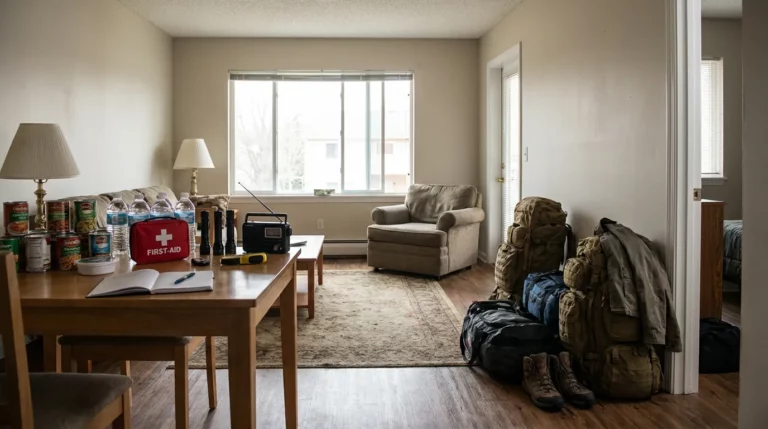
Stay home unless staying is the greater danger. Bugging in wins in most emergencies because your supplies, shelter and security are already there. Leave when the threat is the building itself – fire, flood, gas, structural damage – or when authorities order evacuation. Decide the trigger before the day arrives.
When a mandatory evacuation order hits or a wildfire jumps a ridge 10 miles from your home, you have minutes—not hours—to make the stay-or-go call. Most families wait until that moment to think it through. That is the worst possible time to make it. This guide gives you the decision framework before you need it, plus the concrete plans to execute both options for a family of four.
The Three-Question Decision Framework
Stop thinking about bugging in and bugging out as philosophies. They are situational tactics. The right choice depends on three questions you need to answer in the first minutes of any developing emergency:
- Is the threat moving toward you? A wildfire 30 miles away with shifting winds is moving. A pandemic lockdown is not. A chemical plant 2 miles upwind is immediate. A power outage is stationary. Moving threats demand evacuation. Stationary threats favor sheltering.
- Is your home defensible and sustainable? A well-stocked house on high ground with a generator is a fortress. A ground-floor apartment in a flood plain with three days of food is not. If staying means slowly running out of resources while the threat worsens, leaving is the correct call.
- Are the roads safer than your home right now? Highway evacuations during a Category 5 hurricane kill people. Driving through a wildfire corridor to beat a closing window also kills people. If the roads are more dangerous than your position, stay until they are not.
💡 Tip: Make the call early, not at the last minute
Every hour you wait to evacuate, road conditions worsen and options close. The sweet spot for bugging out is 12–24 hours before conditions deteriorate—before the official evacuation order, before the fuel stations run dry, before the highway turns into a parking lot. Early movers survive. Late movers improvise.
When Bugging In Is the Right Call
Sheltering in place is the correct default for the majority of emergencies most families will ever face. Extended power outages, winter storms, pandemics, localized civil unrest, and low-grade natural disasters all favor staying home if your home is prepared. You have your food, your water, your medical supplies, your tools, and your security. You know the terrain. The risks of the road are eliminated.
Best Scenarios for Bugging In
- Pandemic or quarantine: Staying home is the medically correct response. Sheltering exposes you to fewer infected contacts than evacuation.
- Extended power outage (grid down, no structural risk): Your supplies outlast the outage if you prepared correctly.
- Winter storm: Unless you are in a structural emergency, the roads are statistically more dangerous than home.
- Category 3 hurricane or below: If your home is structurally sound and not in a flood zone, a well-supplied house usually beats a shelter or hotel.
- Civil unrest not in your immediate area: Moving through unrest zones to evacuate increases your exposure. Staying low and secure is generally safer.
Your Bug-In Supply Position for a Family of 4
A prepared bug-in position means your home can sustain four people for at least two weeks with no resupply. This is the baseline, not the ceiling.
✅ 14-Day Bug-In Supply List for a Family of 4
- Water: 56 gallons minimum (1 gal/person/day × 4 × 14). WaterBrick 7-gallon containers (~$30 each) stack and store efficiently—8 containers covers it.
- Food: 14-day supply of non-perishables. Augason Farms 30-Day Emergency Food Bucket (~$130) handles one adult for a month—buy four for the family baseline.
- Cooking: Coleman Classic 2-burner propane stove (~$55) with 6+ propane canisters (~$7 each).
- Power: Goal Zero Yeti 500X (~$500) for device charging and essential power, plus a hand-crank Midland ER310 radio (~$50).
- Light: 3 LED lanterns + 4 packs of D batteries. GearLight LED Lantern (~$20 each).
- Sanitation: Luggable Loo toilet bucket (~$25) + 60 waste bags + hand sanitizer. Do not skip this—sanitation failures kill people in prolonged sheltering situations.
- First aid: Large first-aid kit (Adventure Medical Kits Trauma Kit ~$50) + 30-day medication supply for all household members.
- Security: Reinforce entry doors with door security bars (Master Lock door bar ~$30 each). Keep window and door access minimal during active unrest.
When Bugging Out Is the Right Call
There are emergencies where staying means dying. Wildfires, rising flood water in a flood zone, structural compromise from an earthquake, a chemical or nuclear release upwind of your position, or direct violent threat to your home—these are the situations where your supplies do not matter because you will not be alive to use them.
Best Scenarios for Bugging Out
- Wildfire within 20 miles with advancing fire line: Leave immediately. Do not wait for the evacuation order. The order means the window is closing, not opening.
- Flood zone with rising water: If your home is in a 100-year flood plain and water is rising, your possessions are already lost. Leave early with your essentials.
- Category 4 or 5 hurricane with mandatory evacuation: Your home is a liability. Go.
- Chemical plant incident or nuclear event upwind: Distance is the only effective protection. Every mile matters.
- Structural damage making the home unsafe: Compromised foundations, downed power lines through the structure, or gas leak risk mean you cannot shelter in place.
⚠️ Warning: The evacuation death trap
Research shows 60% of deaths in natural disasters occur during evacuations, mostly because people left too late and ended up trapped in traffic or driving through the hazard zone. The lesson is not “don’t evacuate”—it is “evacuate early.” If you wait for the official order to start packing, you are already behind the safe window.
The Bug Out Bag for a Family of 4
Each adult needs a separate bag. Children over 8 carry a light junior bag. Children under 8 share weight with parents. Every bag is a 72-hour kit minimum—enough to get you from home to your Tier 1 location and sustain you if that falls through.
Per-Person Bug Out Bag Contents
| Category | Item | Family of 4 Total | Est. Cost |
|---|---|---|---|
| Water | Sawyer Squeeze filter + 2L Platypus bladder | 4 filters + 4 bladders | ~$35/person |
| Food | Mountain House 3-Day Emergency Food Supply | 4 kits | ~$35/person |
| Shelter | SOL Emergency Bivvy (waterproof) + tarp | 4 bivvies + 1 tarp | ~$20/person |
| Fire | UCO Stormproof matches + BIC lighter | 2 kits per family | ~$10 total |
| Tools | Leatherman Wave+ multi-tool | 2 (one per adult) | ~$100/unit |
| Light | Petzl Tikkina headlamp + spare AAAs | 4 headlamps | ~$20/person |
| First aid | Adventure Medical Kit Ultralight | 2 kits | ~$25/kit |
| Documents | Waterproof envelope with copies of IDs, insurance, cash ($200 minimum) | 1 per adult | Varies |
| Communication | Midland ER310 hand-crank radio | 1 per family | ~$50 |
| Clothing | Change of clothes, rain poncho, emergency mylar blanket | 1 set per person | ~$25/person |
💡 Tip: Weight limits for bug-out bags
An adult bug-out bag should not exceed 25% of body weight. For a 160-lb adult, that is 40 lbs max—and that is for a fit person moving under stress. A bag you cannot carry for 5 miles is a bag you will abandon. Pack it, weigh it, then carry it around the block. Cut ruthlessly until it is manageable. Your kids’ bags should be under 10 lbs.
Your Three-Tier Bug Out Location Plan
Bugging out without a destination is not a plan—it is improvised wandering. A solid bug-out location plan has three tiers so you always have options if Tier 1 falls through.
| Tier | Distance | Examples | Key Requirement |
|---|---|---|---|
| Tier 1 | Under 20 miles (30-min drive) | Friend’s home, relative nearby, designated campground | Reachable on a quarter tank of gas. Pre-arranged, not assumed. |
| Tier 2 | 50–150 miles | Out-of-area relative, motel in a different county, rural campsite | Reachable on a full tank. Outside the disaster’s probable impact zone. |
| Tier 3 | 200+ miles | Family in another state, vacation property, secondary home | Long-term shelter option if the disaster is regional in scale. |
For each location: know two routes. Drive them both in advance. Note fuel stations, rest areas with accessible facilities, and choke points where traffic will stack. If a bridge closes or a highway floods, you need an alternate without having to think about it under pressure.
Scenario-by-Scenario Decision Table
| Scenario | Decision | Key Factor |
|---|---|---|
| Category 1–2 hurricane (not in flood zone) | Bug In | Structural home + supplies outlast storm |
| Category 4–5 hurricane or mandatory evacuation | Bug Out early | Leave 24+ hours before landfall, not at order |
| Wildfire within 20 miles with advancing line | Bug Out immediately | Do not wait for the order—the window closes fast |
| Extended power outage (home intact, not flood zone) | Bug In | Your supplies are already there |
| Flooding in a flood zone (rising water) | Bug Out before it rises | Water moves faster than you think |
| Pandemic / quarantine | Bug In | Home isolation reduces exposure and is legally correct |
| Civil unrest (not in your immediate block) | Bug In | Moving through unrest increases exposure |
| Direct violent threat to your home | Bug Out immediately | No possession is worth your life |
| Chemical or nuclear event upwind | Bug Out perpendicular to wind | Distance is the only protection—every mile counts |
| Earthquake (home structurally intact) | Bug In | Roads may be impassable; your supplies are accessible |
Practicing Your Plan Before You Need It
Only 25% of families with emergency plans have ever actually practiced them. Most have never timed how long it takes to load the car, grab the bags, and leave. Do it this weekend. You will find out how long it actually takes, which items are missing, and whether your kids know where to go if you are not home when the emergency hits.
A realistic evacuation drill for a family of 4 should cover:
- The trigger signal and who makes the call to bug out
- Who grabs which bags
- Who is responsible for kids, pets, and medications
- The rendezvous point if family members are separated when the call happens
- What happens if parent A cannot reach parent B within 30 minutes
✅ Action: Set a family rendezvous point today
Pick a specific address or landmark within walking distance of your home that every family member can find independently. Write it down. Put it in everyone’s phone. If an emergency hits while one parent is at work and the other is at school pickup, everyone knows where to converge. This is the single most important communication piece most families are missing.
Common Mistakes in Bug In / Bug Out Planning
1. No destination when bugging out. “We’ll head north and figure it out” is not a plan. Without a Tier 1 location confirmed in advance, you are competing for hotel rooms and shelter space with every other unprepared family in your area. Pre-arrange your locations now.
2. Waiting for the evacuation order to start loading. The order signals that conditions are dangerous enough for authorities to act. It does not signal that you have plenty of time. The families who survive wildfires intact are the ones who left when the forecast changed, not when the fire was visible.
3. A bug-out bag that weighs 60 pounds. If you cannot carry it for five miles at a walking pace, you will abandon it. Pack it, weigh it, walk around the block with it. Cut anything you have not touched in the last six months of training.
4. A single evacuation route. Roads close. Bridges flood. Accidents stop traffic for hours during mass evacuations. You need two mapped, driven, practiced routes that do not share the same chokepoints.
5. Assuming public shelters are a fallback. Red Cross shelters fill up within hours of a major evacuation. Many have capacity constraints, pet restrictions, and limited medical support. Your Tier 1 private location is almost always better than a crowded school gymnasium.
6. Bug-in supplies that only cover 72 hours. Most modern disasters—grid-down scenarios, hurricanes, ice storms—take 7–14 days to stabilize. If you only have three days of food and water, you will be in line at the relief station on day four competing with everyone else.
7. Not having a family communication plan for separation. If a parent is at work 20 miles away when the evacuation order drops, how does the family unite? What is the rendezvous point? Who calls whom? If you have not answered these questions in advance, you will answer them in a panic.
FAQ
How do I decide whether to bug out from a hurricane when officials say it might strengthen?
Use the track forecast, not the current category. If the storm is forecast to reach Category 3 or above, is within 24 hours of landfall, and your home is within the cone—leave now. Fuel stations run dry, interstates jam, and hotel rooms sell out fast. The cost of leaving early for a storm that weakens is one wasted night in a hotel. The cost of leaving late for a storm that strengthens is your family.
What is the minimum bug-out bag investment for a family of 4?
You can build four functional 72-hour bags for under $400 total by prioritizing essentials: Sawyer Squeeze filter (~$35 each), a Mountain House 3-day food kit (~$35 each), an emergency bivvy and poncho, a headlamp, and a waterproof document envelope with $200 cash and ID copies. The bag itself: a 40L hiking pack runs $40–80. Skip the “survival kit” bundles sold online—most are overpriced and underweight where it counts.
What if our bug-out location is also affected by the same disaster?
This is why you need three tiers. A Tier 1 location 15 miles away may be in the same hurricane cone as your home. Your Tier 2 at 100 miles is almost certainly outside it. For large-scale regional disasters (major earthquakes, pandemic), your Tier 3 location in another state may be the only safe option. Pre-identify all three before you need any of them.
How do we handle medications when bugging out?
All critical medications go in the bug-out bag, not in the medicine cabinet. Keep a 7-day supply in a labeled, waterproof container in each adult’s bag at all times—not something you grab when the alarm sounds, but something already there. For controlled substances, keep your prescription printout with the medication. At your bug-out destination, contact a local pharmacy within 24 hours if you need a refill.
Can we bug out on foot if we do not have a vehicle?
Yes, but it changes your planning significantly. On foot, your Tier 1 location needs to be within 10–15 miles. You need a lighter bag (under 20 lbs for sustained walking). Identify public transit, rideshare options, and neighbors who might offer a ride in advance. A folding cart or wagon for moving supplies short distances is worth keeping. Most importantly: if your situation may require foot evacuation, practice a 5-mile loaded walk once a year to know your realistic pace and limits.
The families who navigate major disasters intact are not the ones who picked the right philosophy. They are the ones who answered these questions in advance, built both plans, practiced them, and made the call early. The decision between bugging in and bugging out is not made during the disaster—it is made right now, before anything is happening, when you still have time to think clearly. Build both plans. Know your triggers. Leave early or shelter deep. Those are the two outcomes that work.
Official sources & further reading
The guidance in this article aligns with official emergency-preparedness resources. Consult them for the authoritative version:

Dan Lockland is a preparedness instructor and survival skills educator with over 15 years of hands-on experience. He shares practical, no-nonsense guidance on emergency preparedness, self-reliance, and sustainable living at PreparingWithDan.com.