
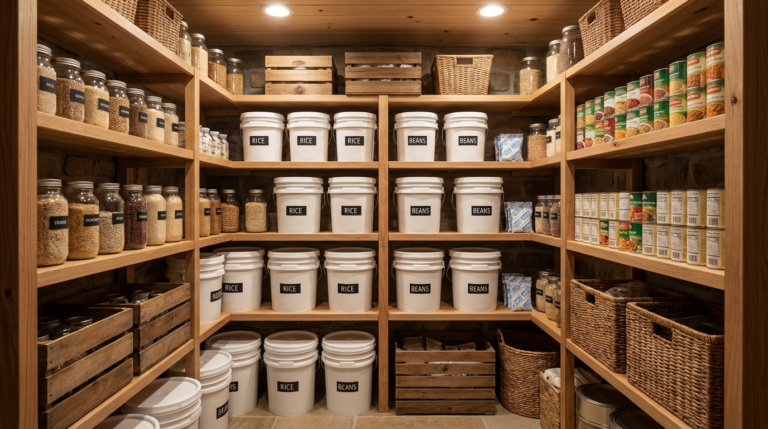
The most sustainable approach to food storage isn’t buying a year’s supply of freeze-dried meals in one order — it’s building a “deep pantry” through normal grocery shopping. You buy what you eat, you eat what you buy, and your pantry gradually deepens from 3 days to 2 weeks to 3 months without any special prep purchases. This guide covers that system — the tiered approach, the exact shopping list, and the organization method that makes it automatic.
Table of Contents
- The 3-Tier Pantry System
- The Core Prepper’s Pantry Shopping List
- Calorie Math: How Much Do You Actually Need?
- Organization and Rotation System
- How to Build Up Without a Large Upfront Cost
- Customizing for Dietary Restrictions
- Common Mistakes
- FAQ
The 3-Tier Pantry System
Most preppers think of food storage as a single thing: the emergency supply. A better model has three tiers, each serving a different time horizon:
| Tier | Duration | What it covers | Storage method | Rotation |
|---|---|---|---|---|
| Tier 1: Working pantry | 0–2 weeks | Normal daily cooking; short-term emergency | Kitchen pantry, regular shelving | Daily use |
| Tier 2: Deep pantry | 2 weeks – 3 months | Extended outage, job loss, supply disruption | Basement, extra shelving, cool closet | Monthly/quarterly use; FIFO rotation |
| Tier 3: Long-term reserve | 3 months – 1+ year | Extended crisis, serious supply chain failure | Sealed Mylar + buckets or freeze-dried | Annual or as-needed; 5–25 year shelf life |
Most families should build Tier 1 and Tier 2 before investing in Tier 3. Tier 2 (a 1–3 month deep pantry) costs $200–$600 and is built entirely from regular grocery shopping. Tier 3 (dedicated long-term storage) requires additional investment in bulk goods and storage equipment.
The deep pantry principle: Stock what you eat, eat what you stock. If you don’t eat freeze-dried beef stew normally, you won’t want to eat it in a crisis. The best prep food is the food you already cook.
The Core Prepper’s Pantry Shopping List
This list covers a 1-month supply for a family of 4. Items are selected for shelf life, calorie density, versatility, and real-world palatability.
Carbohydrates and grains (primary calorie source)
| Item | Quantity (1 month, 4 people) | Shelf life | Calories/lb |
|---|---|---|---|
| White rice | 25 lbs | 5+ years (pantry), 25 years (sealed) | ~1,550 |
| Dried pasta (various shapes) | 15 lbs | 2–3 years (pantry), 8+ years (sealed) | ~1,640 |
| Rolled oats | 10 lbs | 1–2 years (pantry), 20+ years (sealed) | ~1,720 |
| Crackers (Saltines, Triscuits) | 6 boxes | 6–9 months | ~1,900 |
| Flour (all-purpose) | 10 lbs | 1 year (pantry), 5+ years (sealed) | ~1,500 |
Protein sources
| Item | Quantity (1 month, 4 people) | Shelf life | Notes |
|---|---|---|---|
| Canned tuna (5 oz cans) | 24 cans | 3–5 years | ~25g protein per can |
| Canned salmon | 12 cans | 3–5 years | Higher omega-3; similar protein |
| Dried beans (pinto, black, kidney) | 15 lbs | 2–3 years (pantry), 25+ years (sealed) | Complete protein when paired with rice |
| Canned beans (15 oz) | 24 cans | 3–5 years | Ready to eat; no cooking required |
| Peanut butter (40 oz) | 3 jars | 1–2 years (opened), 2–3 years (sealed) | ~190 cal/serving; high fat/protein |
| Canned chicken | 12 cans | 3–5 years | Higher cost but convenient protein |
Fats and oils
| Item | Quantity | Shelf life | Notes |
|---|---|---|---|
| Coconut oil | 2 large jars (~54 oz) | 2–5 years | More stable than olive oil at room temp |
| Olive oil | 1–2 liters | 18–24 months | Store in dark location; light degrades quality |
| Vegetable/canola oil | 2 liters | 1–2 years | Cheapest option for high-volume cooking |
Flavor, nutrition, and morale items
| Item | Quantity | Notes |
|---|---|---|
| Salt | 5 lbs | Indefinite shelf life; key for preservation and flavor |
| Sugar | 5 lbs | Indefinite; baking, beverages, morale |
| Honey | 2 lbs | Indefinite; also has mild antimicrobial properties |
| Canned tomatoes (14 oz) | 24 cans | 3–5 years; transforms pasta, rice, and bean dishes |
| Canned soup / broth | 24 cans | 3–5 years; extends meals; comfort food |
| Instant coffee / tea | 1 month supply | Hot beverage is a significant morale factor |
| Dried herbs and spices | Assortment | 2–3 years; makes repetitive staples tolerable |
| Multivitamins | 120-count × 2 | 2+ years; fills nutritional gaps in a limited diet |
Calorie Math: How Much Do You Actually Need?
The most common pantry mistake is stocking containers without knowing if you have enough calories. The math:
- Adult (moderately active): 2,000–2,500 calories/day
- Child (6–12): 1,400–1,800 calories/day
- Family of 4 (2 adults + 2 children): ~7,000–8,500 calories/day
- 30-day supply for family of 4: ~210,000–255,000 calories
What your pantry actually holds:
| Item | Quantity | Calories |
|---|---|---|
| 25 lbs white rice | 25 lbs | ~38,750 |
| 15 lbs pasta | 15 lbs | ~24,600 |
| 10 lbs oats | 10 lbs | ~17,200 |
| 15 lbs dried beans | 15 lbs | ~24,000 |
| 3 jars peanut butter (40 oz each) | 7.5 lbs | ~19,950 |
| 24 cans tuna | 24 × 5oz | ~7,200 |
| Oils (2 liters combined) | ~68 oz | ~15,300 |
| 24 cans tomatoes + soups | various | ~6,000 |
| Total (approximate) | ~153,000 cal (≈ 18–22 days for family of 4) |
This confirms that the list above covers roughly 3 weeks, not 1 full month. To reach a genuine 30-day supply, increase rice to 30 lbs and beans to 20 lbs, or supplement with additional canned goods. Always calculate actual calories, not container counts.
Organization and Rotation System
The rotation system only works if it’s automatic — requiring no willpower or memory. The two-zone approach:
Zone 1 (Working pantry — kitchen): All items currently in active use. These get consumed in the normal course of cooking.
Zone 2 (Reserve pantry — basement, spare room, or dedicated shelving): The older stock from your deep pantry. Items move from Zone 2 to Zone 1 as they run low. New purchases always go to Zone 2.
Labeling system: Date every item when it enters Zone 2 with a permanent marker on the lid or can top. Date = purchase month/year. On your annual pantry audit (tie it to a date you won’t forget — daylight saving time, a birthday, New Year’s), check that everything in Zone 2 is within shelf life. Items 3–6 months from expiry move to Zone 1 immediately.
Shelf organization: Use a simple wire shelving unit ($30–$60 at Costco or Home Depot) in a cool, dark location. Keep heavier items (cans, jars) on lower shelves; lighter items (boxes, pouches) on upper shelves. Group by category: grains together, canned protein together, canned vegetables together. Vertical can dispensers ($15–$25 on Amazon) are excellent for Zone 1 rotation of canned goods.
How to Build Up Without a Large Upfront Cost
Three approaches that work for different budgets and timelines:
Method 1: Buy two, use one (slowest but free)
Every time you buy a grocery item, buy two and put one in your reserve. This builds your supply at zero additional net cost since you’ll use everything you buy. Takes 4–8 weeks to establish a 2-week supply. The “quick win” approach described at the top of this article.
Method 2: $25–$50/week dedicated addition
Set a fixed weekly budget for pantry building. $25/week over 20 weeks = $500 and a solid 3-month supply for most families. Focus each week on one category: Week 1 = grains, Week 2 = protein, Week 3 = canned vegetables, Week 4 = oils, etc.
Method 3: Quarterly bulk purchase (fastest)
A single Costco run every quarter can add 2–3 months of pantry depth. Focus on: 25 lb bag of rice ($18), 25 lb bag of pinto beans ($20), 10 lb container of oats ($10), case of canned tuna ($28), 3 large peanut butter jars ($16), case of canned tomatoes ($15). Total: ~$107 per quarter, or $428/year, builds a 6–12 month supply within 2–3 years of consistent purchases.
Customizing for Dietary Restrictions
| Restriction | Modifications needed | Key substitute items |
|---|---|---|
| Gluten-free | Replace pasta and flour with GF alternatives; verify canned goods | White rice (naturally GF), GF pasta, cornmeal, quinoa, rice flour |
| Vegetarian | Remove canned meat/fish; increase beans, lentils, nuts | Dried lentils, canned chickpeas, nut butters, textured vegetable protein |
| Vegan | Same as vegetarian; also check for dairy in crackers/snacks | Same as vegetarian; coconut milk (canned) for dairy substitute in cooking |
| Nut allergy | Remove peanut butter; substitute with seeds | Sunflower seed butter, tahini (sesame), canned fish for protein density |
| Diabetic | Reduce simple carbs; increase fiber and protein | Dried legumes (low GI), steel-cut oats, canned vegetables, sardines |
| Low sodium | Select “no salt added” canned goods; avoid processed crackers | No-salt-added canned tomatoes, dried beans (vs. canned) |
Common Mistakes When Building a Prepper’s Pantry
- Stocking food you don’t eat. A pantry full of unfamiliar or disliked foods won’t get rotated, will expire, and will be difficult to use under stress. Start with a list of 10–15 meals your family actually makes and stock the shelf-stable components of those meals. Emergency cooking should look like regular cooking, not survival rations.
- No calorie count. “We have a lot of canned goods” is not a prep plan. A family of 4 needs ~230,000 calories for 30 days. Count what you actually have in terms of calories, not container count. Many families who think they have 3 months of food actually have 3 weeks.
- Ignoring fats. Carbohydrates and protein get most prep attention, but fats are calorie-dense (3,500+ cal/lb for oils) and essential for satiety and brain function. A pantry without adequate fats leads to calorie deficit even when carbs and protein are covered. Stock 2–3 gallons of stable cooking oil minimum for a 30-day supply.
- No rotation, so food expires. The most expensive pantry mistake is discovering 50 cans of beans 3 years past their best-by date. Implement FIFO immediately: new purchases go behind old stock, consume from the front. If you don’t rotate, your pantry is just expensive waste waiting to happen.
- Forgetting manual can opener. A pantry full of canned goods with no manual can opener is unusable. Keep two manual can openers — one in the kitchen, one in the emergency kit. This is a $4–$8 item that fails more prep kits than any other single missing piece.
FAQ
How do I start a prepper’s pantry without a big upfront investment?
Buy two of every shelf-stable grocery item this week — one to use, one to store. Do this for 4–6 weeks and you’ll have a 2-week deep pantry with zero net additional spending. Then formalize it: set aside $25–$50/month specifically for pantry deepening, targeting one category per shopping trip. You’ll have a 3-month supply within a year.
How much food does a family of 4 need for 30 days?
Approximately 210,000–255,000 calories — about 7,000–8,500 calories per day for 2 adults and 2 children. In practical terms: 25–30 lbs rice, 15–20 lbs dried beans, 10 lbs oats, 15 lbs pasta, 3 large jars peanut butter, 24 cans tuna, 2 liters cooking oil, and a substantial stock of canned vegetables and soups. Total cost: $150–$200 at Costco or Walmart.
What’s the difference between a working pantry and a deep pantry?
Your working pantry is what you’re actively cooking from — typically 1–2 weeks of food in the kitchen. Your deep pantry is a reserve of the same items, stored separately, available when the working pantry runs low or in an emergency. The deep pantry is built by buying extra of regular grocery items and storing them in a cool, dark location. You eat from the working pantry and rotate from the deep pantry into it.
Should I buy freeze-dried food or regular pantry staples?
Build with pantry staples first — they cost 80–90% less per calorie than freeze-dried meals and use foods you’re already familiar with cooking. Once you have a solid 3-month supply of staples, freeze-dried meals add convenience, variety, and extended shelf life (25 years) for the longer-duration scenarios. The ratio most experienced preppers recommend: 70–80% staples, 20–30% freeze-dried.
How do I store canned goods and dry goods properly?
Canned goods: cool, dark location (under 70°F); off the floor on shelving; avoid damp areas. Inspect annually for dents, rust, and swelling. Dry goods (rice, beans, oats): in sealed food-grade containers or Mylar bags with oxygen absorbers; away from heat, moisture, and light. Don’t store near cleaning products or gasoline (dry goods absorb odors). A basement corner or interior closet is ideal for both.
Bottom Line
A prepper’s pantry is built one grocery trip at a time — not in one expensive bulk order. Start with the “buy two, use one” approach this week to build a 2-week supply from your normal shopping. Then add $25–$50/month to deepen to 3 months. A family of 4 can build a fully functional 90-day pantry for $300–$500 over 3–4 months without any dedicated prep mindset — just consistent, slightly deeper grocery shopping. For the long-term bulk storage methods that extend this system to 1+ years, see Mastering Long-Term Food Storage for Preppers. For cooking all of this during a blackout, see Cooking in a Blackout.
Last Updated: April 2026
