
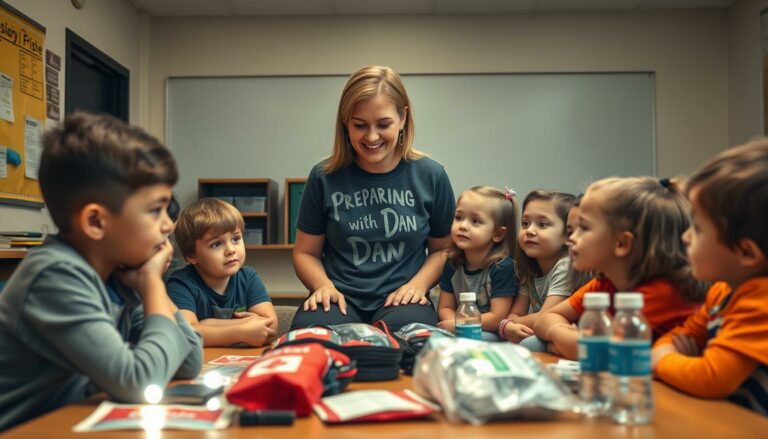
After a disaster, what a child needs from a parent is four things, in Ready Kids’ order: listen and answer questions with only as much information as they need; limit what they see on screens; make time to talk and play; and get back to a routine as fast as school and life allow. Most children’s reactions are short-term. Ready Kids names three things that make them last: being directly exposed (evacuated, injured, seeing injuries), losing someone, and the ongoing stress of temporary housing and a disrupted life.
Our guide on teaching kids emergency preparedness covers the conversation before anything happens. This one is the conversation after: the evening in the shelter, the week back in a half-repaired house, the month when the child still will not sleep alone. It follows the guidance of Ready Kids (FEMA), the American Red Cross and the National Child Traumatic Stress Network, and it is not a substitute for a paediatrician or a counsellor — the Red Cross gives the number for one at the end.
The first night: safe, together, briefly informed
The Red Cross puts the child’s experience simply: when disaster strikes, a child’s view of the world as a safe and predictable place is temporarily lost. How parents and other adults respond can help children recover more quickly and more completely. The first night, therefore, is not about explaining. It is about demonstrating that the adults are in charge and the child is safe:
- Say the true, simple thing. “There was a flood. We are safe. We are staying here tonight. Mom and Dad are handling it.” Then stop. Ready Kids’ rule: give just the amount of information you feel your child needs. A five-year-old does not need the forecast; a twelve-year-old may want it, and will ask.
- Keep the child physically close and keep the small rituals: the same bedtime phrase, the comfort object from the kit, the snack they always get. Our baby and toddler kit guide explains why the comfort object is in the kit; this is the night it earns its place.
- Do not narrate your own fear in front of them. You are allowed to be frightened — the Red Cross says everyone is entitled to their feelings, including the people others look to — but the child reads your face before your words. Fall apart with another adult, later.
Listen more than you explain
Ready Kids’ first instruction is encourage dialogue and answer questions: listen to your kids, ask them about their feelings and validate their concerns. In practice, children process a disaster in fragments, and the fragments come out sideways — a question about the dog, a drawing, a tantrum about a toy that was left behind. Each is the conversation. The useful responses are short and true: “Yes, the house got wet. No, you didn’t do anything wrong. Yes, we’ll get another one. I don’t know yet when we’ll go home — I’ll tell you as soon as I know.”
Two things to avoid: promising what you cannot control (“it will never happen again”), and correcting their feelings (“there’s nothing to be scared of” when there plainly was). Validate, then reassure about the present: that was scary, and right now we are safe.
Turn off the coverage
Ready Kids: intense media coverage of disasters can frighten young children and disturb teenagers as well. The Red Cross gives the same advice to adults — limit exposure to the sights and sounds of the disaster on TV, radio, social media and in the papers. A child who sees the same flooded street on a loop experiences it as still happening, or happening again. If a teenager is following the news, the instruction is to be available to talk and answer questions while they watch, not to ban it and leave them to their phone alone.
The routine is the treatment
Of the four Ready Kids points, this is the one parents underestimate because it sounds too ordinary. Help your children feel as if they still have a sense of structure, which can make them feel more relaxed. Meals at the same time, bedtime at the same time, homework if there is homework, chores if there are chores — even in a hotel room, even in a relative’s spare room. And when schools and childcare open again, help children return to normal activities like going to class, sports and play groups, even if the family is still living out of bags. School is where a child’s world is predictable; it should be the first thing restored, not the last.
Play, and other people
Ready Kids’ third point is make time for them and find support: talking, playing and doing family activities together tell a child they are safe more convincingly than any explanation. The second half of that sentence is for the parent: build support networks with friends, family and community organisations to help you cope, which can also help your children cope. A parent who is running on no sleep and no help cannot be the calm adult the child is reading. Accepting help is part of helping the child.
What is normal, and when to get help
The Red Cross lists the common reactions to a disaster for anyone, and children show them in child-sized ways: trouble sleeping, changes in appetite, clinginess or regression (a toilet-trained child having accidents), irritability and more arguments, difficulty concentrating at school, and for some children, physical complaints — headaches, stomach aches — with no medical cause. Most of these reactions are temporary and will go away over time.
Ready Kids identifies the three risk factors for reactions that do not fade on their own:
- Direct exposure — being evacuated, seeing others injured, or being injured.
- Loss or grief — the death or serious injury of family or friends.
- Ongoing stress from secondary effects — temporary housing, loss of friends and social networks, loss of belongings, a parent’s job.
If any of those apply, or if the reactions are still going strong after several weeks, or getting worse, the child’s paediatrician is the first call and the school counsellor the second. The National Child Traumatic Stress Network keeps disaster-specific resources for parents (linked below), and the Red Cross’s number is free and open at all hours: the Disaster Distress Helpline, 1-800-985-5990, call or text. It is for parents too.
The parent’s own recovery
The Red Cross’s advice for adults after a disaster reads like advice for looking after a child: eat, rest, take one step at a time, limit the news, accept your reactions. It is on the list because a child recovers at the speed of the calmest adult in the house. Our guide on coping strategies during crises covers the adult side; the practical point is that asking for help from the support network is not weakness in front of the child — it is the model of what to do when something is too big for one person.
Later: turn the fear into a plan
When the child is sleeping again and school is back, there is one more conversation, and it is the one that prevents the next disaster from feeling like this one: what would we do next time? Making the plan together — where the kit is, where we meet, whom we text — gives a child the thing the disaster took, a sense that the world is predictable and the adults have it handled. Our guide on child-friendly emergency drills covers how to do that as a game rather than a lecture.
Official sources & further reading
The guidance in this article comes from official sources. Consult them directly, and a paediatrician or counsellor for anything beyond ordinary reactions:

Dan Lockland is a preparedness instructor and survival skills educator with over 15 years of hands-on experience. He shares practical, no-nonsense guidance on emergency preparedness, self-reliance, and sustainable living at PreparingWithDan.com.