
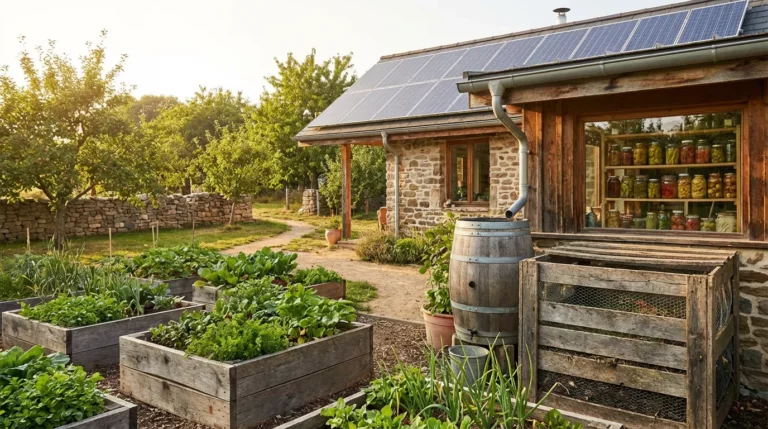
The overlap between good preparedness and good sustainability is larger than most people realize. Solar backup power reduces both your grid dependence and your carbon footprint. A rainwater collection system gives you a water supply independent of municipal infrastructure while conserving groundwater. A kitchen garden produces food while cutting transportation emissions. Composting reduces waste while generating soil fertility for that garden.
This isn’t a coincidence — both goals prioritize reduced dependence on fragile, centralized systems. This article covers the specific sustainable practices with the highest dual-return: genuine preparedness value plus genuine environmental benefit, without requiring expensive or complex installations.
Where Green Prepping and Practical Prepping Align
| Practice | Preparedness Value | Sustainability Value |
|---|---|---|
| Solar + battery backup | Power during grid outages | Reduced fossil fuel dependence |
| Rainwater collection | Water supply independent of municipal systems | Reduced stormwater runoff, conserved groundwater |
| Food production (garden) | Local food security, reduced supply chain exposure | Lower transportation emissions, pesticide reduction |
| Food preservation (canning, dehydrating) | Long-term food storage without refrigeration | Reduced food waste and packaging |
| Composting | Waste management without collection services | Diverts organic waste from landfill |
| Bicycle as transport | Mobility without fuel during supply disruptions | Zero emissions transportation |
| Reduced consumption / bulk buying | Lower resupply frequency, supply buffer | Reduced packaging waste and shipping impact |
A family of 4 that implements even half of the above has materially better resilience than a family that does none of it — and also a smaller environmental footprint. These aren’t competing goals. They’re the same goal expressed from different directions.
Solar Power and Energy Storage
A solar + battery backup system is the single highest-value green prep investment for most households. It provides power during grid outages (which are increasing in frequency due to extreme weather), reduces electricity bills, and eliminates or reduces fossil fuel dependence over the long term.
Entry-level option — portable solar generator: The Jackery Explorer 1000 Plus (~$800–$1,000) paired with 2 solar panels (~$300–$400) gives you roughly 1 kWh of storage and 400W of solar charging capacity. That’s enough to run a refrigerator for 6–8 hours, charge phones and laptops indefinitely in sunlight, and power LED lighting. Adequate for short outages and a realistic starting point for most households.
Whole-home option: A rooftop solar array with battery storage (Tesla Powerwall at ~$9,000–$12,000 installed, or similar products from Enphase or Generac) provides multi-day backup during grid outages and day-to-day electricity independence. Federal tax credits currently cover 30% of installation costs in the U.S. (through 2032 under the Inflation Reduction Act). A 10kWh battery system covers most households through a 1–2 day grid outage without reducing consumption.
Grid-tied vs. battery backup: Grid-tied solar without battery storage does not provide power during outages — the system shuts down as a safety measure when the grid goes down. If outage resilience is part of the goal, battery backup is required. Don’t assume solar panels alone provide emergency power.
Rainwater Collection
Rainwater harvesting serves two preparedness functions: supplemental water during normal conditions (reducing municipal water use and bills) and emergency water during supply disruptions. In most U.S. states, collecting rainwater from your roof is legal without permit; a few states have restrictions, so verify local regulations before installing.
Basic barrel system: A 50–55 gallon rain barrel connected to a downspout diverter costs $80–$150 and takes a few hours to install. A 1,000 sq ft roof section in a region with 30 inches of annual rainfall can theoretically collect 18,000+ gallons per year — though practical collection efficiency is lower. A barrel system is most useful for garden watering and non-potable uses (toilet flushing during water restrictions).
Larger cistern system: 500–2,500 gallon poly tanks ($300–$800) connected to full roof drainage provide meaningful storage for emergency scenarios. A family of 4 uses roughly 80–100 gallons of water per day for basic needs; 500 gallons represents 5 days of supply at reduced usage.
Potability: Roof-collected rainwater is not automatically safe to drink. It picks up bird droppings, debris, and atmospheric pollutants. For drinking use, filter through a gravity filter (Berkey or similar) and treat with chlorine or UV. For non-potable use (irrigation, toilet flushing, washing), no treatment is required.
Food Production and Preservation
Kitchen Garden Basics
A kitchen garden doesn’t need to replace your food supply to provide meaningful value. Even a 4×8 raised bed can produce 100+ pounds of vegetables per season — enough to meaningfully supplement fresh produce during extended supply disruptions, and enough to practice the skills needed for larger-scale production if circumstances change.
For a family starting from zero, prioritize high-yield, low-maintenance crops: bush beans, zucchini, tomatoes, kale, and lettuce. These produce more calories and volume per square foot than most alternatives and require minimal skill. A 4×8 bed costs about $50–$100 to build with untreated lumber, and soil amendment costs $40–$80 for the first year.
Perennial food plants (fruit trees, berry bushes, asparagus) have a 2–4 year establishment period but require minimal ongoing effort once established. An apple tree or two blueberry bushes planted this year produces for decades. This is one of the highest long-term return investments in food security for any homeowner with outdoor space.
Food Preservation Without Power
Canning, dehydrating, and fermenting extend fresh produce into shelf-stable food that doesn’t require refrigeration. These methods also serve as a waste-reduction strategy — overproduction from the garden goes into preservation rather than compost.
- Pressure canning: Required for low-acid foods (vegetables, meat, beans). An All American or Presto pressure canner (~$80–$300) processes quart jars that keep 1–3 years. A full day of canning from a productive garden can produce 20–30 quarts of shelf-stable food.
- Dehydrating: A food dehydrator (Excalibur 9-tray at ~$200, or basic 5-tray units at $40–$70) removes moisture, extending shelf life to 1+ years for most produce. Dried vegetables, fruit, and jerky require no refrigeration and take up significantly less space than fresh food.
- Lacto-fermentation: Salt + time converts vegetables into fermented foods (sauerkraut, kimchi, pickles) with no equipment beyond a jar. These keep months without refrigeration, improve gut health, and require zero energy to produce.
Composting and Waste Management
Standard trash collection stops or becomes unreliable during extended emergencies. Composting handles organic waste (which makes up 25–30% of typical household waste by weight) without requiring collection services. It also produces soil amendment that reduces or eliminates the need to buy commercial fertilizer for the garden.
Basic outdoor bin: A 3x3x3 ft compost bin from wire mesh or pallets accepts kitchen scraps and yard waste. Active management (turning every 1–2 weeks, balancing carbon/nitrogen) produces finished compost in 6–8 weeks. Passive piles take 6–12 months but require no effort.
Indoor worm bin (vermicomposting): For apartments or small spaces, a worm bin (available commercially for $30–$60, or DIY with two plastic storage bins) processes kitchen scraps into castings — the most nutrient-dense soil amendment available. A mature bin processes roughly 0.5–1 lb of food scraps per day per square foot of bin surface. Odorless when properly managed.
Greywater (wastewater from sinks, showers, laundry) can be redirected for irrigation in most U.S. jurisdictions with appropriate systems. This reduces both water bills and water demand during restrictions. Check local regulations; some states have specific greywater system standards.
Sustainable Transportation Options
A well-maintained bicycle is the most resilient personal transportation option available. It requires no fuel, minimal maintenance (a basic toolkit and occasional parts costing $20–$50/year), can carry significant loads with panniers or a cargo trailer, and operates on any road condition a car can use. For emergency scenarios where fuel is scarce or roads are congested, a bicycle often outperforms a car.
Every adult in a household should have a functional bicycle with the ability to maintain it (patch a tube, adjust brakes, fix a chain). Mountain bikes handle terrain diversity better than road bikes for emergency scenarios. A quality used commuter or hybrid bike runs $150–$400; new quality bikes start around $400.
Electric vehicles are genuinely green prep tools in the right context: if you have home solar charging, an EV can be recharged from your panels. But without home solar, an EV is only as clean as your grid and only as functional as the charging infrastructure — which is still vulnerable to outages. The grid independence advantage of EVs is only real if paired with home solar + battery storage.
Reducing Consumption as a Prep Strategy
Buying less, buying in bulk, and extending the life of what you own are simultaneously good sustainability practices and good prep practices. They reduce supply chain exposure (less frequent resupply needed), reduce packaging waste, and build the financial resilience to invest in more meaningful prep items.
Specifically: buying staple foods in bulk (25-lb bags of rice, beans, oats) dramatically reduces packaging per calorie and costs less per unit than small packaging. A family of 4 with 3 months of staple food stored has both a hedge against supply disruption and a lower per-meal packaging footprint than a household that shops weekly in single-serving packaging.
Common Mistakes
- Grid-tied solar without battery backup. Grid-tied solar panels shut down during power outages by design. If you invest in solar without battery storage and experience an outage, you’ll have panels on your roof and no power in your house. Battery backup is required for outage resilience.
- Treating green prep as purely philosophical. The value of these practices comes from implementation, not intention. A household that installs a rain barrel, builds a raised bed, and buys a portable solar generator has made concrete improvements. A household that reads about sustainable living without acting hasn’t improved its resilience at all.
- Starting with the most complex systems. Whole-home solar, large cisterns, and extensive permaculture gardens have real value — but they’re not the right starting point. Start with a portable solar generator, a single rain barrel, and a raised bed. Get the skills and habits first, then scale.
- Ignoring local regulations on rainwater and greywater. Most places allow rainwater collection; a few don’t or have restrictions. Similarly, greywater systems are regulated in most jurisdictions. Check before investing in systems that may require permits or specific installation standards.
- No food preservation skills. Stocking equipment (dehydrator, pressure canner) without practicing the skills is common. Pressure canning has specific safety requirements — botulism is a real risk with improper technique. Learn and practice the methods before depending on them.
FAQ
What’s the best single green prep investment for a limited budget?
A portable solar generator in the 500–1000 Wh range ($400–$800) paired with one or two folding solar panels ($100–$300). This covers the most critical power needs during outages (refrigerator, phone charging, lighting), reduces dependence on grid power for emergency situations, and can be charged from sunlight without any installation. It’s useful immediately, requires no permits, and works in any housing situation from apartment to house. The Jackery 500, EcoFlow River 2, and Anker SOLIX C300 are current competitive options at different price points.
Can I actually grow enough food to matter in an emergency?
Probably not replace your full diet, but yes — you can produce a meaningful supplement. A 100 sq ft garden (10×10 ft) in a good growing season can yield 100–150 lbs of vegetables. That’s not full caloric independence, but it’s meaningful fresh food during supply disruptions, free of cost after the initial investment, and a skill that scales. Full caloric self-sufficiency from gardening requires roughly 4,000–6,000 sq ft of productive growing space per person — achievable on a lot but not in most urban settings.
Is an electric vehicle a good prep investment?
Conditionally yes, with caveats. An EV + home solar + battery storage is a genuine resilient system: you can produce and store your own fuel indefinitely. An EV without home solar is dependent on charging infrastructure, which is vulnerable to the same grid outages that affect everything else. For pure emergency evacuation capacity, a fuel-efficient gas vehicle with a full tank and extra stored fuel is currently more resilient than an EV in most scenarios. EVs are improving on this dimension as V2H (vehicle-to-home) technology becomes more common.
How do I balance eco-friendly prepping with the reality that most emergency gear isn’t sustainable to produce?
Prioritize practices and skills over gear. The most sustainable prep is the one that reduces your dependence on purchasing anything during an emergency — water you harvested, food you grew, power you generated. For gear, buy quality items that last (a good water filter, a durable solar generator, canning equipment) rather than cheap items that fail and need replacement. Buying less, better, is both the sustainable choice and the prepared choice.
Bottom Line: Green prepping and effective preparedness point in the same direction: reduced dependence on centralized, fragile systems. Solar backup power, rainwater collection, home food production, composting, and bicycle transportation all serve both goals simultaneously. The practical starting points — a portable solar generator, a rain barrel, a raised bed — are accessible, affordable, and immediately useful. Start with one system, learn it well, and build from there. The overlap between sustainability and resilience is the entire point.

Dan Lockland is a preparedness instructor and survival skills educator with over 15 years of hands-on experience. He shares practical, no-nonsense guidance on emergency preparedness, self-reliance, and sustainable living at PreparingWithDan.com.