
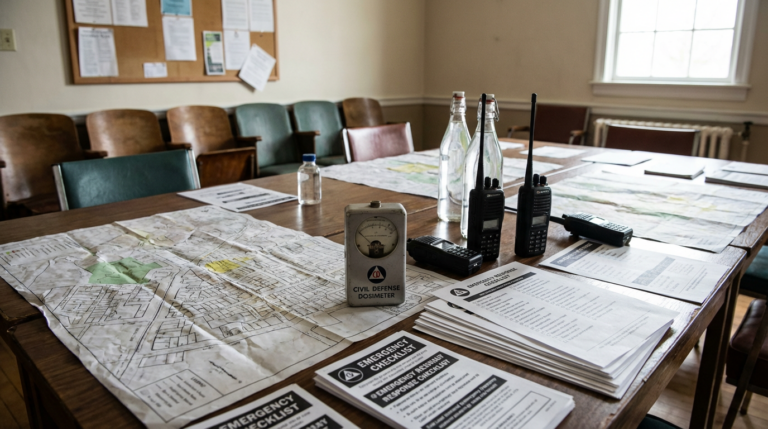
In a nuclear emergency, the decisions made in the first 15 minutes determine outcomes. Whether the event is a nuclear plant accident, a radiological dirty bomb in a nearby city, or — in the worst case — a nuclear detonation, the survival advantage goes to people who already know what to do and have the supplies to do it. A community nuclear response plan is not a government exercise in bureaucracy. For a prepper family, it is a practical agreement with your neighbors about what each household will do, who has what supplies, how you will communicate without cell service, and who knows about the people on your block who cannot take care of themselves.
This guide covers the practical side: the threat scenarios you are actually planning for, the first actions that matter most, the supplies needed, and how to build a neighborhood-level coordination network without waiting for local government to do it for you.
The Three Scenarios You Are Planning For
Nuclear emergency planning covers a spectrum of events with very different implications:
| Scenario | Likelihood | Primary Action | Duration of Shelter |
|---|---|---|---|
| Nuclear power plant accident | Low but real (Chernobyl, Fukushima precedent) | Shelter-in-place; KI tablets if within 50 miles | Hours to days, based on official guidance |
| Radiological dispersal device (dirty bomb) | Moderate (terrorism scenario; no major incident to date in US) | Immediate shelter-in-place; evacuate after plume passes | Hours; decontamination after leaving shelter |
| Nuclear detonation (improvised or weapon) | Very low; catastrophic if it occurs | Fallout shelter for 24–48 hours minimum | 2+ weeks depending on distance from ground zero |
| Nuclear facility industrial accident | Low | Similar to power plant accident | Hours to days |
Most planning energy should go toward the scenarios with actual historical precedent: nuclear plant accidents and radiological events. The nuclear detonation scenario is worth planning for because the actions overlap significantly with the others and the marginal cost of preparedness is low.
Your Family Plan: Build This First
Before any community coordination, your family needs its own nuclear response plan. The community plan layered on top of individual household plans is much stronger than a community plan that assumes households have nothing figured out independently.
The 15-Minute Action Checklist
If you hear about a nuclear emergency — whether via emergency alert, news, or seeing an unexpected flash:
- Get inside immediately. Any solid building is better than outdoors. A concrete or brick building is better than wood-frame. A basement is better than upper floors. Close all windows, doors, and fireplace dampers.
- Turn off HVAC systems. Air conditioners, furnaces, and ventilation fans all pull outside air in. Shut them off and cover vents if you have tape available.
- Tune in for official information. NOAA Weather Radio (battery powered), local AM radio, or the FEMA app. Follow instructions. If sheltering is ordered, stay put until specifically told to leave.
- Account for your family. If family members are elsewhere, they should also shelter where they are — do not drive through potentially contaminated air to reach each other. Make this decision in advance so everyone understands it.
- Take potassium iodide (KI) if applicable. Only if a nuclear power plant event is involved and authorities recommend it, or if detonation is suspected. KI protects only the thyroid gland from radioactive iodine. See the KI section below.
Supplies Every Household Needs for Nuclear Preparedness
- NOAA weather radio with battery backup ($30–$50): The most reliable emergency alert system in the US. Receives WEA alerts even when cell networks are down.
- Potassium iodide (KI) tablets: If you live within 50 miles of a nuclear power plant, KI is recommended. IOSAT 130mg tablets ($10–$15 for a family pack) or ThyroSafe. Store in your emergency kit. Check expiration every 5 years.
- Heavy-duty plastic sheeting and duct tape: For sealing a shelter room. A 10×10 room sealed with 4 mil plastic sheeting and tape significantly reduces radiation infiltration.
- 72-hour minimum food and water supply: Stored inside, sealed. You will not be going outside for resupply during a nuclear event.
- Geiger counter or radiation dosimeter: Not essential for most households but useful. The GQ GMC-300E ($80–$120) is a reliable entry-level option. Tells you when it is safe to go outside.
- N95 or P100 respirators: For decontamination phases — when you must go outside after a radiological event to decontaminate or evacuate. Stock 5–10 per person.
Potassium Iodide (KI): What It Does and Does Not Do
Potassium iodide is widely misunderstood. Clarifying what it actually does:
- What KI does: Saturates the thyroid gland with stable iodine, preventing it from absorbing radioactive iodine-131 released from a nuclear reactor accident or certain types of nuclear detonations.
- What KI does NOT do: Protect against gamma radiation, protect any organ other than the thyroid, or provide general radiation protection. It is a single-purpose tool.
- When to take it: Only when directed by authorities (nuclear plant accident or nuclear detonation), within 3–4 hours before or after radiation exposure. Taking it too early provides no protection at the actual exposure time.
- Dosing for a family of 4: Adults and children over 12: 130mg (one full tablet). Children 3–12 years: 65mg (half tablet). Infants under 1 month: 16mg (small fraction). Follow the dosing chart on the package.
- Who should be cautious: Anyone with thyroid conditions, iodine sensitivity, or certain skin conditions should consult a physician before stocking KI.
If you live within 50 miles of a nuclear power plant, KI should be in your emergency kit. FEMA distributes it free to residents within 10 miles of many plants; contact your local emergency management office.
Building the Neighborhood Network
A community nuclear response plan at the neighborhood level serves several practical functions: knowing who has what resources (Geiger counter, medical supplies, shelter space), identifying households that will need help (elderly neighbors, those with disabilities, families without transportation), and establishing communication protocols when cell networks fail.
Starting the Conversation
You do not need a formal organization or city approval to build a neighborhood network. Start with the people directly around you:
- Identify your 6–10 nearest neighbors
- Have an honest, non-alarmist conversation: I have been working on emergency preparedness and wanted to know if you had thought about what you would do in a major emergency — power outage, nuclear plant event, that kind of thing.
- Share what you have learned and ask what they have done
- Exchange phone numbers and a meeting location
- Identify any households with special needs
The goal of the first conversation is to identify who is already prepared, who has thought about it but has nothing in place, and who will need assistance in an emergency. This inventory informs your community plan.
Communication When Phones Fail
Cell networks fail during major emergencies — either from damage to infrastructure or from overload. Your neighborhood communication plan needs non-cellular options:
- Designated meeting point: A specific location (a neighbor’s front yard, a community center parking lot) where everyone in the network knows to go if communication fails. Have a primary and backup location.
- FRS/GMRS radios: Handheld walkie-talkies that work without cell infrastructure. A set of 4 Midland T77VP5 radios ($50–$80) enables neighborhood communication within 0.5–2 miles. Designate a shared channel (Channel 7, CTCSS code 10 as an example) so all neighbors are on the same frequency.
- Physical check-in schedule: If communications are down after a nuclear event, agree in advance that each household will check in at a neighbor’s door at a specific time each day during sheltering (e.g., once in the morning, once in the evening) to confirm everyone is okay.
- Signal system: A simple visual signal for “we are okay” vs. “we need help” — a specific item in the window (a flashlight pointed outward), a flag or colored cloth, or a chalk mark on the sidewalk. Simple, but it works when everything else does not.
Identifying Vulnerable Neighbors
Nuclear emergencies expose pre-existing vulnerabilities: people who cannot shelter in place effectively because of mobility limitations, people who depend on refrigerated medications, families without transportation for evacuation, people who will not receive emergency alerts because they do not have the right devices.
Build a simple list of neighbors in your network who need extra attention:
- Elderly residents living alone
- Neighbors with mobility limitations
- Families with infants or very young children
- Anyone dependent on electricity for medical equipment
- Non-English speakers who may not receive or understand alerts
Assign a specific person in the network to check on each vulnerable household within the first 15 minutes of a declared emergency. This is the most important coordination function the neighborhood network provides.
Shelter Assessment: Know Your Best Option Before You Need It
Not all buildings provide equal radiation protection. The protection factor (PF) indicates how much a structure reduces radiation dose compared to being outside. Higher is better:
| Location | Protection Factor | Notes |
|---|---|---|
| Open outside | 1 (baseline) | No protection |
| Wood-frame house (center room, 1st floor) | 2–10 | Minimal but meaningful; reduces dose 50–90% |
| Brick/concrete house (center room) | 5–20 | Substantially better; avoid windows |
| Office building (upper floors) | 2–10 | Mass of building above provides protection; avoid exterior rooms |
| Basement (wood-frame house) | 10–100 | Best option in most homes; underground preferred |
| Basement (concrete/brick building) | 100–1,000 | Excellent protection; most practical fallout shelter |
| Underground parking/subway | 50–200+ | Good if no outside air is entering |
Walk your neighborhood and identify the most protective building within 1 minute of each household. This is your community fallout shelter designation. If a nuclear event occurs, everyone in the network knows to go to that building (or their own basement) immediately.
Community Emergency Response Teams (CERT)
FEMA’s Community Emergency Response Team program provides free training to neighborhood volunteers in disaster response: first aid, search and rescue, fire suppression, and disaster psychology. A CERT-trained neighbor is the most valuable person in your network during any emergency, including nuclear events.
- Find your local CERT program: Ready.gov/cert or your county emergency management office
- Training duration: About 20–24 hours, typically spread over several weeks, free of charge
- What you get: Trained skills, a vest and basic equipment kit, and a connection to your local emergency management organization
- Target: Get at least 2–3 people in your neighborhood network CERT-trained
The Nuclear-Specific Neighborhood Plan: One-Page Summary
After your network is established, create a single-page nuclear response plan that every household receives. It should contain:
- Trigger: Any of the following activates the plan: WEA emergency alert about nuclear event; visible flash or mushroom cloud; NOAA announcement of nuclear plant emergency
- Immediate action: Shelter in place immediately in the most protected location in your building (basement preferred). Do not leave to pick up family members — they shelter where they are.
- Who checks on whom: Name, address, and contact for each assigned vulnerable household
- Communication: Primary channel for FRS radios; meeting location if radios fail; check-in schedule
- Shelter location: Address of the highest-protection building in the neighborhood
- KI guidance: If nuclear plant event: take KI when directed by authorities. Dosing by age on attached card.
- Wait for official all-clear: Do not exit shelter until NOAA or official sources declare it safe
Common Mistakes in Nuclear Community Planning
1. Assuming you should evacuate immediately
For radiological events and nuclear plant accidents, driving through contaminated air is significantly more dangerous than staying in a sealed building. The instinct to flee is strong but usually wrong. Shelter-in-place is the primary action for virtually every nuclear scenario except a direct nuclear detonation where your building is in the immediate blast zone. Plan for staying, not fleeing, as your default response.
2. Having KI but not knowing when to take it
KI is only effective if taken at the right time relative to radiation exposure, and only for thyroid protection against radioactive iodine. Taking it at the wrong time, for the wrong event type, or at the wrong dose creates a false sense of security. Make sure everyone in your household understands the specific conditions under which you would use it.
3. Relying entirely on cell phones for emergency alerts
Cell networks routinely fail or are overloaded during major emergencies. Wireless Emergency Alerts (WEA) are sent to cell phones but may not get through. A battery-powered NOAA weather radio is more reliable for receiving official guidance during infrastructure failures. This is the most important piece of communication equipment for emergency preparedness.
4. Not sealing your shelter room in advance
You will not have time to buy plastic sheeting and tape during a nuclear emergency. Store pre-cut plastic sheeting labeled for each room window and the doors of your designated shelter room. Tape your seams and practice once so you can do it quickly. The time to seal a room in an actual emergency is under 10 minutes with preparation, impossible without it.
5. Building a community plan without the individual family plans first
A neighborhood network where nobody has supplies, KI, or knows the individual shelter-in-place protocol is just a social group. The community plan enhances individual household preparedness — it does not replace it. Get your household sorted first, then add the community layer.
FAQ
How far from a nuclear power plant should I be worried about radiation exposure?
The NRC designates two planning zones around nuclear plants: the Plume Emergency Planning Zone (EPZ) within 10 miles, where evacuation or shelter-in-place may be ordered, and the Ingestion Planning Zone within 50 miles, where contamination of food and water is the primary concern. If you are within 10 miles of a plant, sheltering and KI are both relevant. Between 10–50 miles, KI may be recommended. Beyond 50 miles, food and water contamination monitoring is the main concern for most accident scenarios.
What do I do if a family member is outside when the alert comes?
They should shelter where they are — in the nearest solid building, immediately. You should shelter where you are. Do not drive toward each other. Driving through contaminated air increases exposure. After the shelter period ends (based on official guidance), you reunite. Plan this conversation with family members in advance so there is no ambiguity in the moment. Agree on a family rule: shelter where you are, wait for official guidance, then reunite.
How long do I need to shelter in place?
For a dirty bomb or localized radiological event: typically hours. For a nuclear plant accident: hours to days depending on wind direction and contamination spread; follow official guidance. For a nuclear detonation: the first 24–48 hours are most critical as fallout settles; significant radiation reduction occurs in the first 7 hours (decay by a factor of 10), and again at 49 hours. The FEMA guidance is to shelter for at least 24 hours following a detonation. Beyond that, follow official guidance. A Geiger counter that gives you real-time readings is the most useful tool for determining when it is safe to leave.
What should I do after leaving shelter?
Decontamination is the immediate priority: remove and bag your outer clothing (this removes approximately 80% of external contamination), shower thoroughly with soap and water (do not scrub — gentle washing to avoid skin abrasions that allow contamination in), blow your nose and wipe eyes, ears, and eyelids. Do not use hair conditioner (it binds radioactive particles to hair). Bag your clothing and leave it outside. Wash your hands before touching food or your face. Follow official guidance about what is safe to eat and drink in the local area.
Bottom Line
A nuclear response plan for your household and neighborhood is built on three things: knowing to shelter in place immediately, having the right supplies (NOAA radio, plastic sheeting, KI if near a plant), and having a pre-arranged network with your nearest neighbors so you know who needs help and how to communicate when everything else fails.
Start with your household. Get the NOAA radio and KI tablets this week. Then talk to your two nearest neighbors. The network grows from there.
